
Intel is setting expectations for its upcoming Arrow Lake-S desktop CPUs. Although the company is holding strong that the new generation will be competitive with the best processors when they release on October 24, the new range of CPUs won’t deliver much, if any, performance gains for gamers — and that’s coming from Intel itself.
To kick off the Arrow Lake generation, now called Intel Core Ultra 200S, Intel is releasing five processors. You can see the standard Core Ultra 9, 7, and 5 models in the table below, along with Core Ultra 7 and 5 models that cut the integrated graphics for a slightly lower price. All five of the processors are unlocked for overclocking with the new LGA 1851 socket. Unlike AMD’s new Zen 5 CPUs, Core Ultra 200S chips require a new motherboard as Intel retires its LGA 1700 socket.
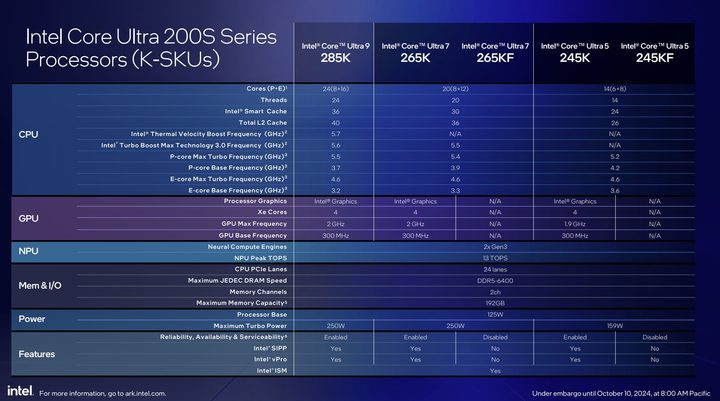
There isn’t much surprising when it comes to specs. Intel is pushing ahead with the same core counts and relatively high clock speeds, and it hasn’t changed the balance of performance and efficient cores compared to last-gen chips like the Core i9-14900K. If you have a keen eye, you’ll notice that these CPUs don’t come with Hyper-Threading. In fact, they use the same Skymont efficient core and Lion Cove performance core designs as Intel’s new Lunar Lake laptop CPUs, which also don’t have Hyper-Threading.
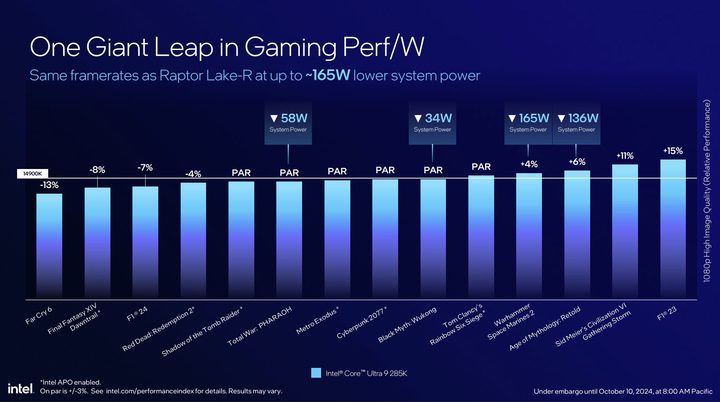
You don’t need a ton of threads for gaming, but even then, Intel says that its new Arrow Lake chips won’t deliver a large generational performance improvement, if any improvement at all. As you can see in the benchmarks above, the new Core Ultra 9 285K is on-par with last-gen’s Core i9-14900K in most games, and although it squeezes out a victory in titles like F1 2023, it loses to the last-gen chip in games like Far Cry 6 — and sometimes by a fairly wide margin.
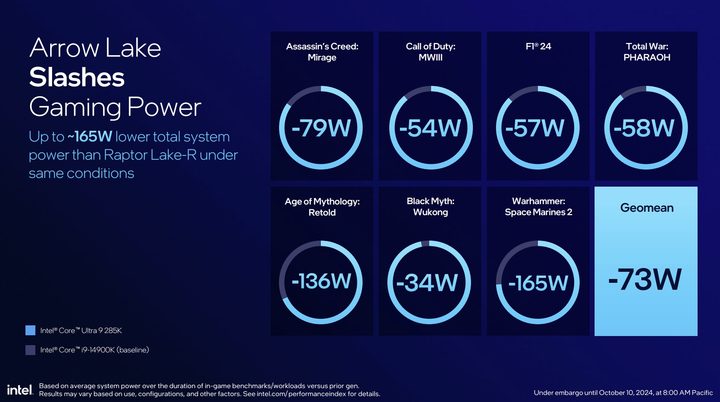
Intel says that the new chips are instead focused on efficiency. As you can see from Intel’s benchmarks above, the Core Ultra 9 285K delivers the same performance while cutting 73 watts on average. There are some games, such as Black Myth: Wukong, where the power savings are small. But in titles like Warhammer: Space Marines 2, Intel claims power savings up to 165W compared to the Core i9-14900K.
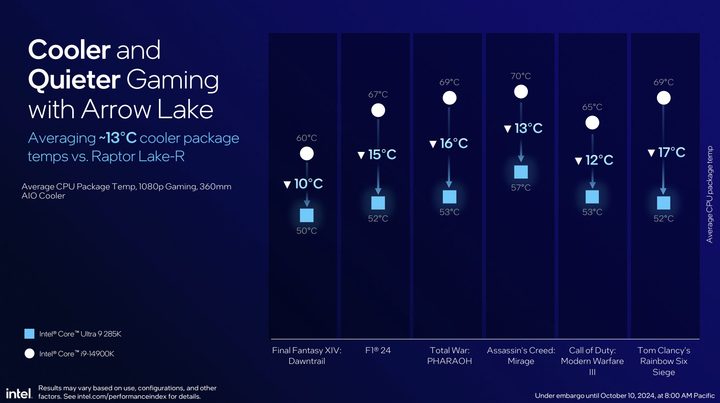
With less power, Intel is also claiming lower temperatures. Intel says the Core Ultra 9 285K runs 13 degrees Celsius cooler than the Core i9-14900K on average, with some games, such as Rainbow Six Siege, showing a 17-degree drop. That’s a pretty big decrease.
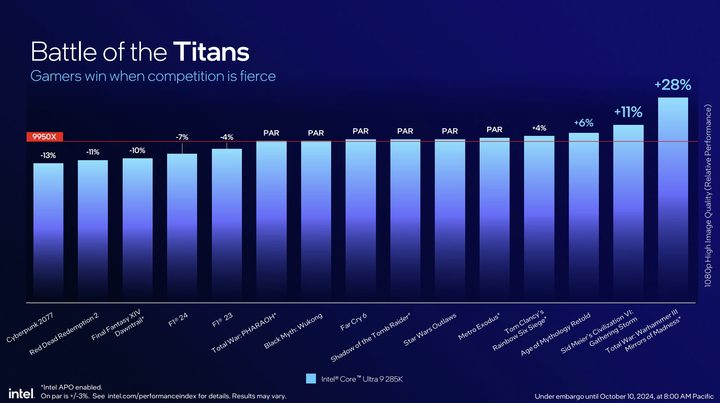
What about the competition? Intel says the Core Ultra 9 285K is, once again, on par with the Ryzen 9 9950X. As you can read in our Ryzen 9 9950X review, that part was fairly disappointing for gaming performance, and even then, the Core Ultra 9 285K loses to the new AMD chip in several games. Intel claims a couple of big leads in Total War: Warhammer III and Civilization VI, but the new Arrow Lake chip is either on-par or underperforming compared to the Ryzen 9 9950X everywhere else.
The more apt comparison for gamers is the Ryzen 7 7800X3D, which remains the fastest gaming CPU you can buy. We don’t have any benchmarks comparing the new Arrow Lake CPUs to the Ryzen 7 7800X3D yet, but Intel’s Robert Hallock says that the Core Ultra 9 285K will be about 5% behind the Ryzen 7 7800X3D in gaming performance on average.
As someone with a small form factor PC, I can appreciate Intel’s dedication to efficiency here, especially when a part like the Core Ultra 7 265K promises 188W less of power draw and a 15-degree temperature drop, all while only cutting gaming performance by 5% compared to the Core i9-14900K. However, these are Intel’s enthusiast-level desktop CPUs, and without any gaming performance gains, they might be a tough sell.
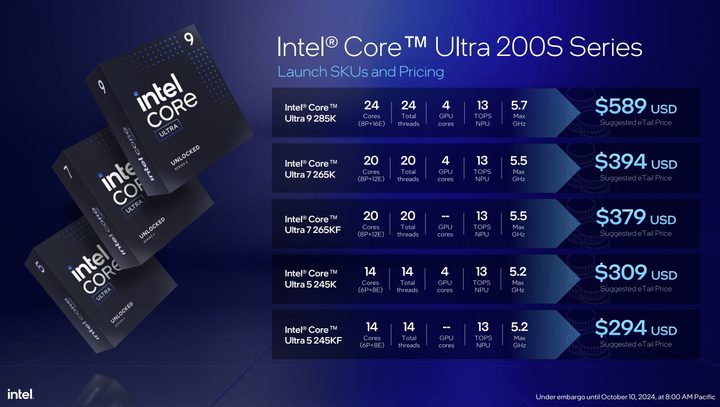
If nothing else, Intel has the prices right. You can see how the range shakes out above, with Intel undercutting AMD’s Zen 5 CPUs by quite a large margin across the stack. All five models will be available on October 24, according to Intel.


