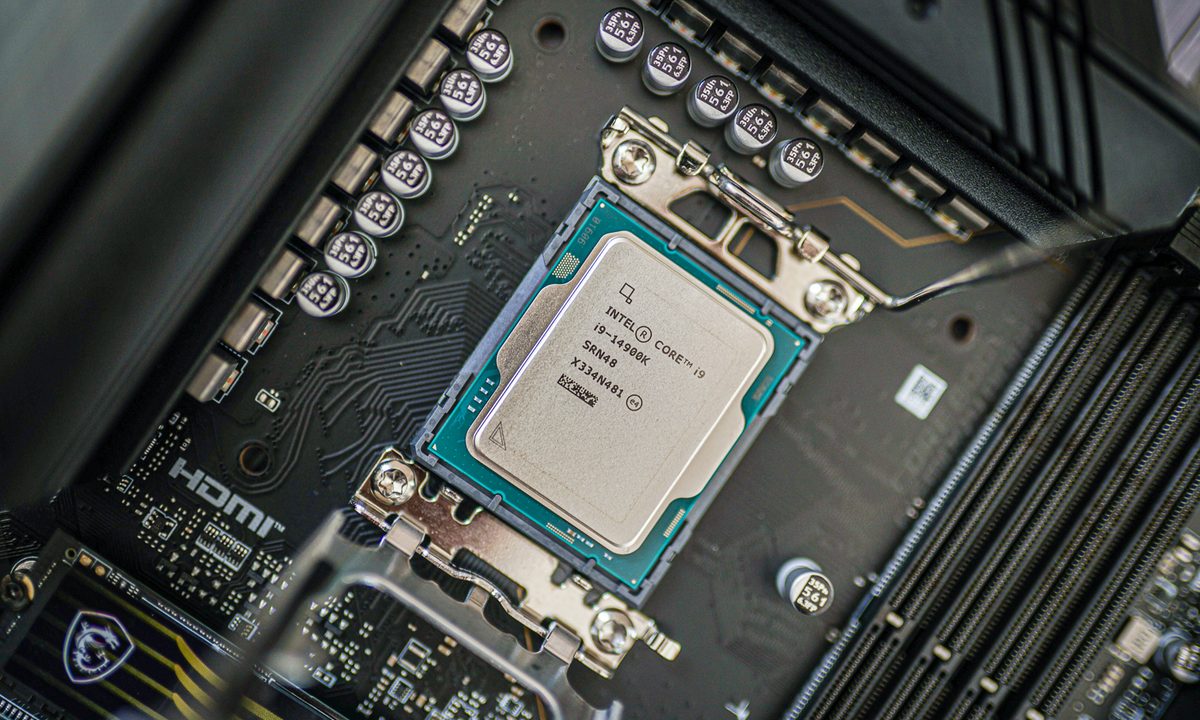
It seems that Intel’s next-gen CPUs might have a higher maximum temperature than some of the current top processors. According to a leak posted on X (formerly Twitter), Intel is said to be increasing the maximum thermal junction (TJ Max) temperature going forward.
The information comes from Jaykihn, a leaker who often shares information about Intel CPUs. Jaykihn claims that Intel is increasing the TJ Max in its upcoming CPUs, but only in the Arrow Lake and Panther Lake lineups, which are getting bumped up to 105 degrees Celsius. Lunar Lake CPUs are said to retain the 100 degrees Celsius maximum.
Panther Lake
PTL-U 4+0+4+4Xe 15W
PTL-H 4+8+4+12Xe 25W
PTL-H 4+8+4+4Xe 25WPTL-H 12Xe pictured.
Dies 4, 1, and 5 correspond to Compute, PCD, and Graphics (Xe3) respectively.
Other two dies are passive. pic.twitter.com/iiZh5fYDMG— Jaykihn (@jaykihn0) July 15, 2024
Although the increase might seem subtle, going up from 100 degrees Celsius to 105 degrees Celsius, it’s a pretty big deal — and the result could be a mixed bag.
What’s TJ Max? It’s the maximum temperature at which a processor can safely run before its built-in protection mechanisms begin to interfere. When that temperature threshold is reached, the CPU activates safety mechanisms that throttle performance and lower power consumption, improving tempseratures.
Overheating can lead to system instability, crashes, or frame rate drops, which is why this increase in TJ Max can be a good thing. With a higher TJMax, Intel makes a silent promise that its chips should remain stable even during heavy usage, since they’ll now be running at a higher temperature before needing to scale back.
On the other hand, you could see this as a loss instead of a gain — after all, these CPUs might now run hotter on average just because they can. That’s an even bigger deal for the mobile chips, which have device surface temperatures to worry about.
Then, there’s the question of cooling. Would having a higher TJ Max mean that you could opt for a less impressive cooling solution just because the CPU could handle it? In theory, yes, but no one wants their CPU to run at a constant 105 degrees Clesius unless they’re monitoring these temperatures quite carefully. It’s possible that this higher thermal headroom could backfire for some users.
If the higher maximum temperature applies both to Arrow Lake and to Panther Lake, we’ll see these changes hit the market this year and the next. Panther Lake is the follow-up to the mobile Core Ultra processors from the Lunar Lake range, and Arrow Lake are the desktop CPUs that Intel is said to be launching this year.
Jaykihn also shed some light on the possible specs of Panther Lake-H, Panther Lake-U, and Panther Lake-P processors. They shared an unofficial slide that shows off the architecture in Panther Lake. In addition, Jaykihn claimed that Panther Lake-U (the low-power range to be used in ultrathin laptops) will offer up to four P-cores and four low-power (LP) cores, as well as four Xe3 GPU cores.
The high-performance PTL-H is said to sport up to four P-cores, eight E-cores, four LP-cores, and four Xe3 GPU cores. Meanwhile, PTL-P will bump up the GPU cores to 12 Xe3 cores. The distinction between PLT-P and PTL-H was added by OneRaichu, another frequent leaker in the CPU space.
Intel has been having a pretty rough time with the ongoing Raptor Lake scandal, but the news today may end up being a good thing. We’ll need more information before we can say for sure — and that’s assuming this rumor ends up being true.