
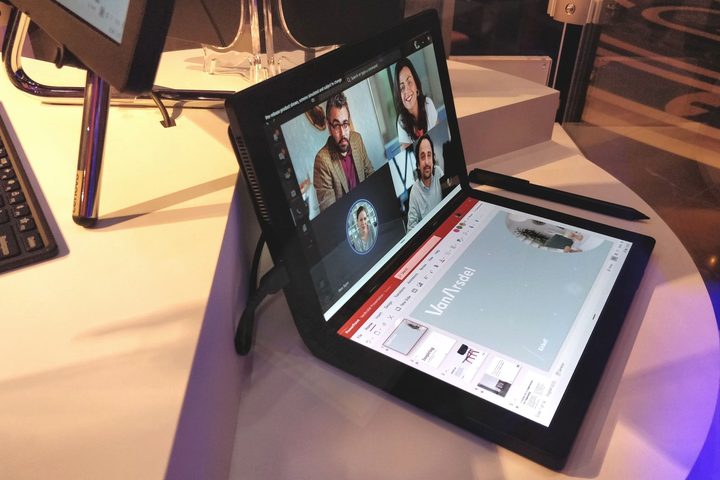
Intel unveiled its experimental new Lakefield processors last year, and now the company has announced plans to launch them in devices this year. The five-core Lakefield CPU will power traditional power-efficient laptops like Samsung’s Intel variant of the Galaxy Book S, which is launching this month, and exciting dual-screen form factors like Lenovo’s ThinkPad X1 Fold, slated to arrive later this year.
Lakefield will be available in Core i5-L16G7 and Core i3-L13G4 variants, each utilizing Intel’s Hybrid Technology. “Hybrid” means it uses both a 10nm Sunny Cove core for heavy workloads and four low-powered Tremont cores designed to extend battery life for less demanding tasks.
Intel will use a “hardware-guided” operating system scheduling approach to drive tasks to the appropriate core. According to Intel, this provides up to a 12% boost in single-threaded performance.
The Core i5 version comes with a base clock speed of 1.4GHz and can go as high as 3.0GHz, while the Core i3 starts at 0.8Ghz and goes up to 2.8GHz with maximum single-core turbo. The chips consume just 7W TDP.
Compared to the Y-series processors that preceded it, Lakefield’s use of Foveros 3D packaging allowed Intel to create a chip with a 56% smaller package area and up to 47% smaller board size. The more compact silicon and board footprint means that laptop manufacturers could now use the freed-up space to create slimmer designs, add larger batteries, introduce more features, or even debut dual-screen and foldable form factors.
Like other processors in Intel’s 10th-gen family, Lakefield will also come with Intel’s integrated Gen11 UHD graphics with A.I.-enhanced workloads, as well as support for Intel’s Wi-Fi 6 Gig+ connectivity. The Core i5 model comes with 64 graphics execution units, while the Core i3 has 48 EUs. These features should make Lakefield a solid platform for Intel’s Project Athena specifications. The power-efficient design draws as little as 2.5Mw of power in standby mode, which is a 91% reduction in power consumption compared to the Y-series Core m processors.
Lakefield has similarities to Intel’s older Core m chip, which helped power popular devices like MacBooks, and also kept them stay slim and enhanced battery life. Lakefield has a similar purpose — to help PC manufacturers bring exciting innovation to traditional single-screen and new dual-screen devices. Unlike the competing ARM-based Snapdragon 8cx from rival Qualcomm that powers Microsoft’s Always Connected PC platform, Lakefield’s design allows it to run x86 Windows programs without any performance bottlenecks due to app emulation. Intel’s processor will be able to handle both 32- and 64-bit applications, just like any of Intel’s other processors.
Lakefield’s announcement comes on the heels of rumors of Apple’s potential plans of switching from Intel to ARM processors for its Mac platform. It’s speculated that Apple could announce its plans later this month to developers at WWDC, which would result in the iPhone, iPad, MacBook, and Mac lines relying on Apple’s custom ARM-based A-series processors.


