

It’s not an exaggeration to call Lunar Lake radical. The upcoming chips don’t showcase the Intel we’ve seen so many times before — the one that pushes power, core counts, and clock speeds to their limit and wonders why it can’t manage a full day’s charge in a laptop. Lunar Lake is Intel admitting defeat, but not in a way that puts it down for the count. It’s clear that Lunar Lake, announced at Computex 2024, is a fresh start.
Intel has called it a “radical low-power architecture” previously, and that statement holds true. Everything in Lunar Lake is built around power efficiency. And with that new focus, Intel is shedding all of the tentpoles of its previous generations that don’t contribute — even down to needing to manufacture the chip in its own fabs.
A new focus
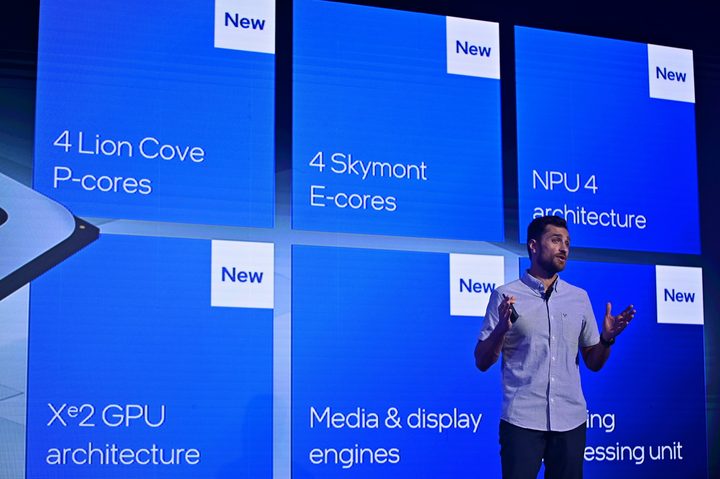
A big part of this new era for Intel comes down to the new core structure. Lunar Lake uses a hybrid architecture like previous Intel generations, but the focus is more on the Skymont efficient (E) cores, rather than the Lion Cove performance (P) cores. Skymont, according to Intel, is the main driver on Lunar Lake.
Instead of merely offloading some low-power tasks to the E-cores, as Intel has done in previous generation, the company says most tasks will run on the E-cores with Lunar Lake. The P-cores simply step in whenever they’re needed, allowing Lunar Lake to boost up when you need the extra performance.
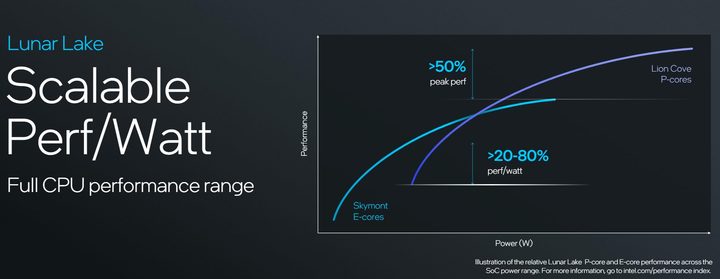
You can see how Intel overlaps the performance targets above. In previous generations, the E-cores could handle a single video stream or some other very lightweight task. But even slightly more hungry tasks, such as Microsoft Teams, would turn on the P-cores. That’s not the case with Lunar Lake.
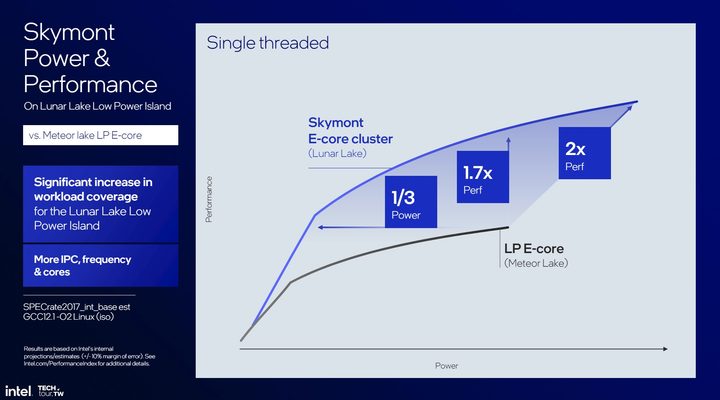
Naturally, Intel needs a more powerful E-core to make this happen, and it has some bold claims about what Skymont is capable of. The company says it can deliver the same performance as Meteor Lake’s E-core at a third of the power, and double the single-core performance at its peak power.
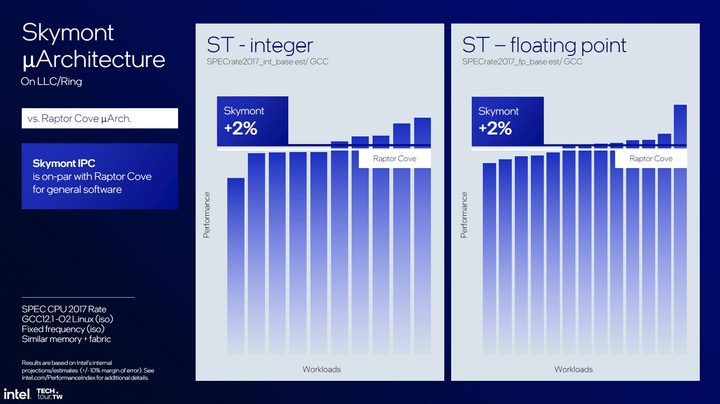
Perhaps more impressive, Intel claims that Skymont delivers an Instructions Per Clock (IPC) increase of 2% over average compared to Raptor Cove. That’s comparing Intel’s new E-core for laptops to Intel’s last-gen P-core for desktop. That’s a massive jump in performance.
This focus touches nearly every aspect of Lunar Lake. For instance, Intel is feeding different voltage rails to the P-cores and E-cores, allowing it to fully shut down the P-cores when they’re not needed. It made more minor changes, too — the E-cores have more cache now (4MB), as well as closer access to on-board memory.
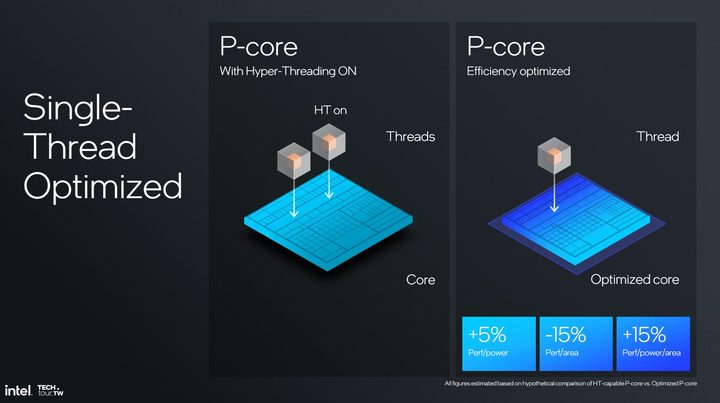
Although Skymont is the driver, the new Lion Cove cores still put a focus on efficiency. The biggest area that’s apparent — and one that’s sure to be controversial — is Hyper Threading. Lunar Lake doesn’t use Hyper Threading — not on the E-cores or P-cores. As Intel put it, “Hyper Threading doesn’t come for free.”
TSMC for the first time

There’s a shift in focus here, but some of Intel’s changes with Lunar Lake are more tangible. Intel has always made its own CPUs. It designs the chips, and it manufactures them. With Lunar Lake, Intel is outsourcing to chipmaker TSMC, which creates the chips for Apple, AMD, and Nvidia, among others.
The compute tile, which is the heart of Lunar Lake, uses TSMC’s N3B process, while the platform tile uses N6. N3B is a cutting-edge node that Intel currently doesn’t have an analogue for. It’s instead focusing its efforts on the smaller 18A node, which will roll out next year.
Although TSMC will make Lunar Lake, Intel says it doesn’t need to. The design, according to Intel, is IP and partitioning agnostic. Anyone can make it. It’s part of a larger strategy by Intel to keep manufacturing running around the world, not just in one region.
The specs

That’s a lot of high-level strategy, but let’s talk specs. The basis of Lunar Lake is an eight-core CPU, split between clusters of four E-cores and four P-cores. Intel says it can scale this design higher, but it will stay in clusters of four cores. Intel hasn’t shared any specific models yet, so we don’t know how that will look.
There are some big improvements elsewhere. In order to satisfy the requirements for Copilot+ PCs, Intel redesigned the neural processing unit (NPU) on Lunar Lake. It’s now capable of up to 48 Tera Operations Per Second (TOPS), which is more than four times as much as Meteor Lake and even a bit ahead of the Snapdragon X Elite.
That’s not the only AI engine, however. Intel says Lunar Lake has over 120 platform TOPS. You get 48 from the NPU, 5 from the CPU, and an astounding 67 from the GPU using Intel’s new Xe2 graphics architecture.
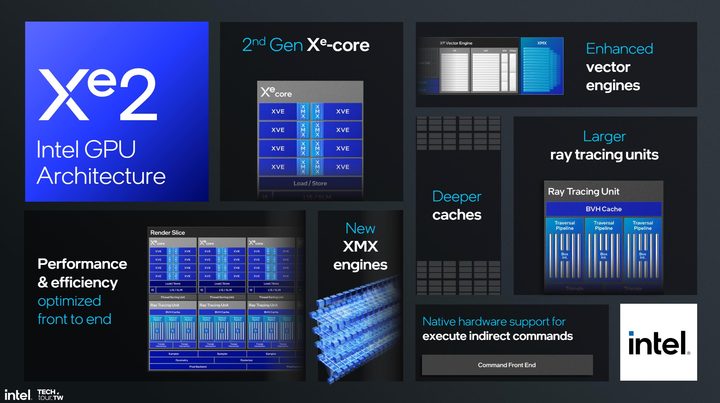
You probably know Xe2 better as Battlemage. This is the graphics architecture that Intel is not only using in Lunar Lake but also its next-gen desktop graphics cards. It sounds like a massive improvement, too. Intel is claiming up to 50% better performance than the previous generation. That alone is impressive, because Meteor Lake already included a huge leap ahead in GPU performance.
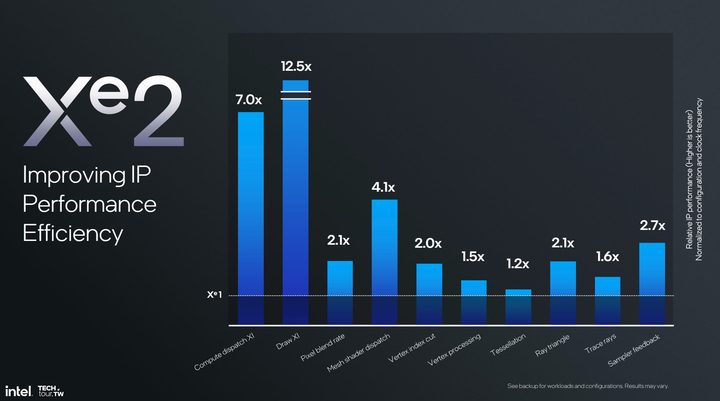
The explanation for the increase involves multiple changes in the architecture. It now natively supports the ExecuteIndirect command, for example, which is one of the most common commands in DirectX 12 games. This alone leads to an increase of more than 12x better performance in certain situations. Intel is also using a new compression technique, as well as faster clearing of cache to improve efficiency.
The CPU, GPU, and NPU create the core of Lunar Lake, but this is an entire system-on-a-chip (SoC). Intel has a display engine that supports DisplayPort 2.1 and HDMI 2.1, as well as a media engine that supports codecs like AV1 and the new VVC codec. There’s also memory — Intel says Lunar Lake can pack up to 32GB of LPDDR5X.
We still need to wait for Lunar Lake to show up in devices before drawing any conclusions, and a lot is unknown, including clock speeds and power targets. Although this is a radically different Intel than what we’ve seen, it’s important to read the room. Intel is talking architecture, while AMD and Qualcomm are talking about products. We need to see what Lunar Lake is actually capable of in a real device to see if Intel’s shift in focus holds any water.
But one thing is certain: Intel is entering a new era. Meteor Lake seemed like a stumble, but it makes much more sense in the context of Lunar Lake. With a lean core configuration, a focus on efficiency, and outsourcing to the best node Intel can get its hands on, it’s clear that Lunar Lake isn’t just a new generation. It’s a reinvention of the Intel we knew.


