

You and I might be hotly anticipating what Intel’s next-generation Arrow Lake processors will do later this year, but Intel’s mobile-first Lunar Lake may be the more exciting design. It’s certainly the one Intel seems more keen to talk about. It released a heap of new information on Lunar Lake, detailing what could be one of Intel’s most exciting product launches in years.
It’s bringing real efficiency back to its mobile product, and that could give AMD a lot to think about. Here’s everything we know about Lunar Lake so far, which are are gunning for a spot in the best laptops.
Lunar Lake specs
Intel revealed some details about Lunar Lake’s architecture and design in May 2024, stating that this mobile-first architectural design would be fast, but also incredibly efficient, beating the competition by up to 30% on power draw while offering competitive performance.
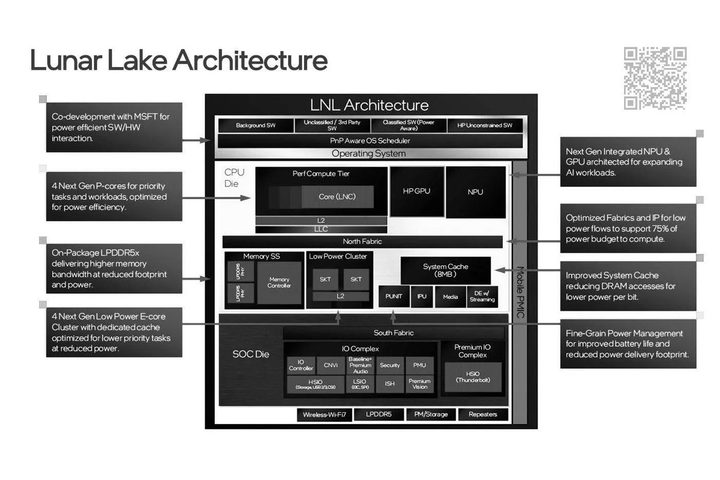
After getting more details about Lunar Lake at Computex in June, we now know that Intel is achieving its promises of greater performance and increased efficiency thanks to a larger focus on its efficiency (E) cores. Based on a newly designed Skymont architecture, these efficiency cores will shoulder much more of the load in Lunar Lake processors.
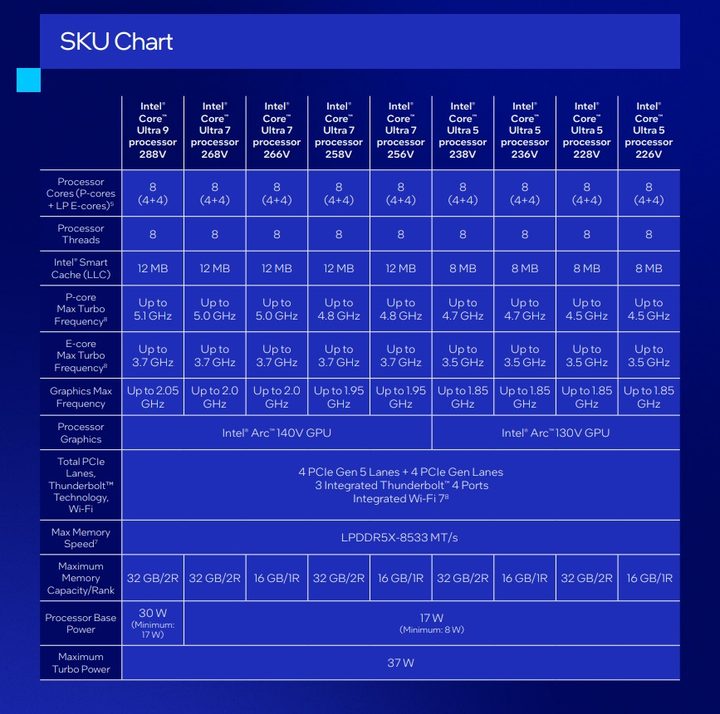
The main makeup of Lunar Lake will be four Lion Cove performance cores and four Skymont E cores. Intel detailed the full range of processors at IFA 2024, which you can see specs for below.
Lunar Lake will also come with Xe2 graphics onboard. That will be able to deliver up to 60 TOPS themselves, but are more designed with gaming in mind. These are the GPUs that will eventually make it into Intel’s Battlemage graphics cards, but for now should offer impressive performance for casual gaming that could make entry-level GPUs redundant. This performance leap reportedly comes from new native support for the ExecuteIndirect command, which is very often utilized in DX12 games. There’s also a new compression technique, and faster clearing of cache for better overall efficiency.

Lunar Lake does drop hyper-threading, as the rumors suggested, and it’s going to be built on a TSMC N3 processor for the compute tile and the N6 node for the platform tile. This is the first time in a while that Intel hasn’t made its own process node, but that’s because its own fabrication is skipping ahead to the 18A node.
As for features, Lunar Lake will support PCI-Express 5, Thunderbolt 4 and USB4, HDMI 2.1, DisplayPort 2.1, Wi-Fi 7, Bluetooth 5.4, and Gigabit Ethernet. The new chips will also support up to 32GB of LPDDR5X for faster memory performance.
Lunar Lake release date
Lunar Lake was officially launched on September 3, 2024, but as new CPU releases typically go, there weren’t any products available at that time. Intel says partners will release laptops on September 24, and it has designs available from Acer, Asus, Dell, HP, Lenovo, MSI, and Samsung. Undoubtedly, we’ll see more designs as time goes on. We’ve already seen a few new designs, such as the updated Dell XPS 13.
Lunar Lake performance
Despite its target of lower-power laptops, Intel’s Lunar Lake is allegedly a seriously powerful design. The first ground-up architectural overhaul in a few generations, Lunar Lake will continue to leverage Intel’s Foveros technology for bigger performance and smaller efficiency cores. Dropping hyper-threading reportedly won’t slow it down, though, as early reports suggested that Lunar Lake could offer performance close to 1.5 times that of Meteor Lake processors at a very comparable power draw.
Intel backed up these claims, promising a more than 50% performance-per-watt improvement in the Lion Cove P cores, and between 20% and 80% generational improvement from the Skymont E cores. Compared with Meteor Lake E cores, the new Skymont design can reportedly deliver up to twice the performance, or work at as little as a third of the power draw while delivering Meteor Lake-like performance, for much greater efficiency and improved battery life.
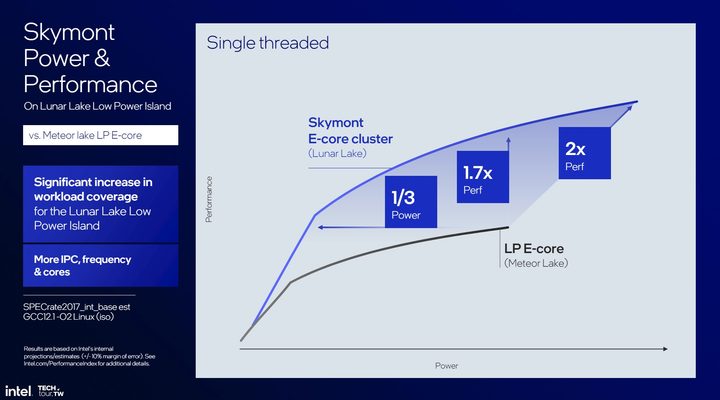
This reportedly shakes out to around a 2% instructions-per-clock improvement over Intel’s Raptor Cove P core design, meaning the new Skymont E core architecture is faster per clock than a much-bigger P core. That’s a lot of added performance. That comes from added cache, a new process node, and big efficiency improvements in the architectural design, as well as support for more, faster memory.
Intel will be able to utilize a new process node to eke out some extra performance or efficiency, depending on what it’s targeting. It won’t use its internal process nodes, though, and will instead be based on TSMCs 3nm 3NB process.
AI performance will also be a major factor in Lunar Lake’s release, with Intel stating that Lunar Lake’s redesigned neural processor will handle up to 45 TOPS. That’s competitive with the neural processing unit (NPU) in the Snapdragon X Elite, but Intel’s not stopping there. Lunar Lake’s Xe 2 GPU will be able to handle up to 60 trillion calculations per second, too, giving the total chip over 100 TOPS.

Gaming performance will be much improved, too. Frame rates and efficiency will be far higher with Lunar Lake, making it great for casual gaming laptops.
This is all based on Intel releases, and some slightly ague charts and graphics, so keep your skeptic’s hat on for now until we get our hands on these chips ourselves. But the performance promises are tantalizing indeed and raise some real questions about how well AMD’s Ryzen AI 300 processors will be able to hold up — read our Zenbook S 16 review to see those chips in action.
It’s still all to play for
For a CPU design that Intel claims will launch before the end of 2024, we still don’t have much beyond promises. They’re strong promises, but promises nonetheless. Thankfully, it shouldn’t be long before we have Lunar Lake CPUs in hand, allowing us to see if Intel’s promises hold any weight.
Regardless, Lunar Lake is a radical departure for Intel. It’s an example of the company abandoning its core design tenets in order to make something that’s truly competitive. Hopefully that pays off.


