  1. Home
  2. Computing
  3. News

Intel denies claims that 10nm on desktop is dead

Add as a preferred source on Google

Intel’s struggles with 10nm have been well-documented over the years, and recent reports have been adding fuel to the fire. German site Hardwareluxx reports that Intel may skip using its 10nm process node for desktop-bound CPUs and shoot for 7nm chips instead, targeting a 2022 release.

The tip stems from supposed trustworthy insiders claiming Intel can’t meet the mass market’s demand for 10nm desktop processors.

Recommended Videos

Since the publishing of this story, Intel has provided Digital Trends with the following statement to comment on the matter: “We continue to make great progress on 10nm, and our current roadmap of 10nm products includes desktop.”

The statement contradicts the supposed leaked roadmap, which showed that the 9th-gen Coffee Lake-S Refresh window ends during the third quarter of Intel’s corporate year for 2020. Intel’s 10th-gen Comet Lake-S then stretched from the second quarter of 2020 to the second quarter of 2021 (corporate year), while Rocket Lake-S began in the second quarter of 2021. Both Comet Lake-S and Rocket Lake-S are said to be based on Intel’s 14nm process.
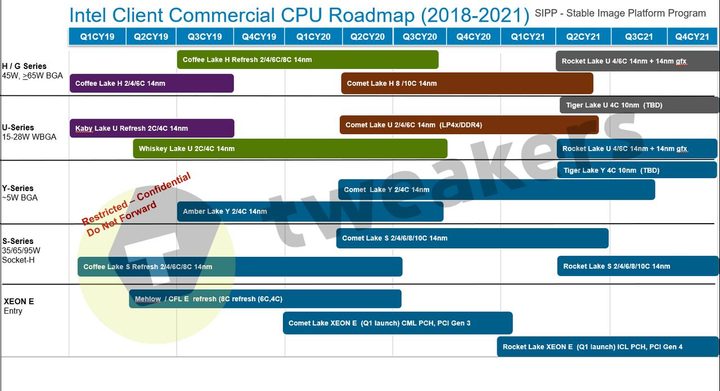
Image used with permission by copyright holder

Comet Lake-S could have up to 10 cores and 20 threads requiring a TDP of 35 to 125 watts. It will support DDR4 memory, Thunderbolt 3, USB 3.1 Gen 2 (10Gbps), 4K content and HDR, PCIe 3.0, Intel Optane, and more.

Little is known about the Rocket Lake-S family, though it would supposedly offer up to 10 cores as well. Speculation hints to Intel porting newer core technology to the Rocket Lake platform for increased performance.

Finally, the roadmap shows that the 7nm Meteor Lake-S would then follow after Rocket Lake-S. This would be the first desktop chip to use a new process node since Intel launched its Broadwell platform in 2015. This platform is said to be powered by Intel’s Ocean Cove core design currently in development, but it reportedly wouldn’t be available until 2022. This would have given Intel considerably more time to refine the process, but left AMD with a large lead in the high-end desktop space in the meantime.

Leaked roadmaps have been wrong in the past, and Intel’s official statement was pretty direct. We don’t know the details of Intel’s actual roadmap, but it seems as if 10nm desktop chips are still in the works.

It should be noted that Intel’s Ice Lake family for laptops already offers 10nm chips. These 10th-gen chips are shipping on devices available now, such as the Dell XPS 13 2-in-1 and Razer Blade Stealth. These new chips benefited from the inclusion of the new Iris Plus integrated graphics, which doubled the graphics performance over previous generations.

Updated on October 14 to include Intel’s official statement.

Kevin Parrish
Kevin started taking PCs apart in the 90s when Quake was on the way and his PC lacked the required components. Since then…
Google’s new desktop mode makes one thing clear: Samsung DeX was onto something
Android 16 finally brings a real desktop mode to Pixel phones, but Google’s long-awaited move mostly proves Samsung spent years getting the hard parts right
File, Webpage, Person

I’ve been waiting for Android to take desktop mode seriously for years. Back in 2019, I bought a OnePlus 7 Pro and wasted an embarrassing amount of time trying to brute-force its half-baked desktop mode into something useful.

The idea made perfect sense to me even then. Phones were already absurdly powerful, and the thought of carrying one real computer in my pocket felt less like science fiction and more like delayed common sense.

Read more
Anthropic launches Claude design to simplify visual creation with AI
Finally, AI that designs your slides so you don’t have to
Claude

Anthropic has introduced a new AI-powered design tool called Claude Design, aimed at helping users create visual content such as prototypes, presentations, and marketing assets through simple conversational inputs. The product, developed under Anthropic Labs, is currently available in research preview for paid Claude subscribers and is being rolled out gradually.

Claude Design is powered by the company’s latest vision model, Claude Opus 4.7, and is positioned as a tool that bridges the gap between technical design expertise and everyday creative needs.

Read more
AI triggered a RAMmageddon so bad that Apple looks like the sensible choice
Laptop prices got so stupid in 2026, that Apple turned into the value king.
Student using MacBook Neo in classroom.

I really didn't want to believe it, but here we are. Apple is now looking like the sensible laptop brand. Not the cool underdog. Not the affordable alternative. Apple, in 2026. The reason is not that the company suddenly became generous, but rather the rest of the competition has suddenly become so deranged that a MacBook lineup starting at $599 feels weirdly grounded.

Apple's MacBook Neo starts at $599, while Microsoft's own 13-inch Surface Laptop now starts at $1,199 after this month's price hikes. This isn't a small gap that you can ignore. Meanwhile, Apple's MacBook Air with M5 starts at $1,099 with 16GB of memory and 512GB of storage, which looks like one of the few premium laptops still priced by human beings.

Read more