
For the last several years, every new generation from Intel has felt like a make-or-break moment. Now, with Arrow Lake CPUs, the stakes are even higher. Intel is facing unprecedented financial troubles, and although it still makes some of the best processors, the silicon giant that used to loom over the PC industry isn’t as strong as it once was.
Arrow Lake is yet another major shift. The CPUs kill Intel’s long-standing Hyper-Threading feature. They introduce two new core architectures. And they debut the Core Ultra branding on desktop, along with the new LGA 1851 socket. I’m worried that Intel’s strategy won’t work with Arrow Lake, though.
The company has shown that its new architecture is very efficient through Lunar Lake laptops like the Zenbook S 14, and Intel wants to carry that efficiency over to desktops. It’s a completely different market, however. Arrow Lake CPUs look impressive in some respects, but for the desktop market they’re catered toward, I’m starting to worry that it’s going to fall flat on its face.
Gaming leads
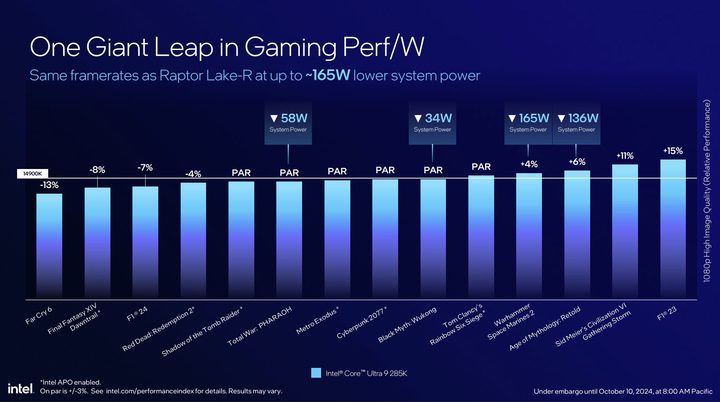
Here’s the problem with Arrow Lake — Intel really isn’t interested in delivering an improvement in gaming performance. There are some games where it’s competitive, other games where Arrow Lake chips hold a lead, and even more where Intel flat-out loses. But the company made it clear that its goal was to merely maintain gaming performance with Arrow Lake. Not necessarily improve it.
The trade-off for extra gaming performance, of course, is that Intel says you will enjoy less power draw and lower temperatures. That might not sound too enticing for gamers, but as someone rocking a mini-ITX PC packing an RTX 4090, I can appreciate lower temperatures and power draw. It’s no secret that undervolting has become popular among desktop CPUs over the last few years, as gamers discovered they could get basically identical gaming performance at much lower power draw.
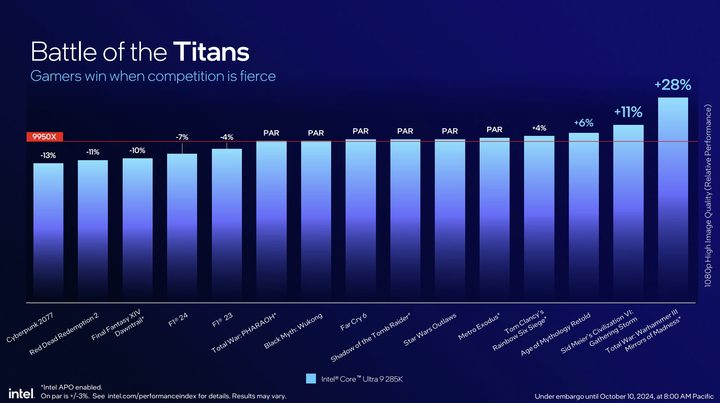
Intel is building that into the architecture, but there’s a problem. This is an entirely new generation of CPUs. As it stands, Intel is on par with Ryzen 9000 CPUs, which themselves aren’t great performers in games, and clearly behind chips like the Ryzen 7 7800X3D.
There’s a practical market for lower power and temperature, but gaming still represents an important use case for enthusiast-class desktop CPUs. There’s a reason the Ryzen 7 7800X3D was the best-selling processor on Amazon for months before it went out of stock. Even if Intel is able to maintain gaming performance at lower temperature and power, that doesn’t exactly encourage running out to spend $400 to $600 on a new CPU, plus the cost of a new motherboard.
Gaming performance still leads most CPU reviews, too. I’ll look at power, thermals, productivity performance, clock speed, and just about every other aspect of Core Ultra 200S chips when I have them in-hand. But gaming will still be at the center of the review, and I suspect that’ll be the case for most other reviewers, too.
The 3D V-Cache problem

Intel hasn’t had an answer for AMD’s 3D V-Cache. The company says it just packs more cache on the CPU itself, but the numbers don’t lie — the Ryzen 7 7800X3D, in particular, is the fastest gaming CPU you can buy. This chip poses a pretty big problem for the Core Ultra 200S range, too.
First, performance. On average, Intel says it expects the flagship Core Ultra 9 285K — a $590 CPU, mind you — will underperform the Ryzen 7 7800X3D by about 5%. That’s not the end of the world, especially if Intel’s CPU is able to do so at lower power and while generating less heat. But based on Intel’s numbers, I’m not confident that’ll be the case.
The Ryzen 7 7800X3D is extremely efficient on its own. The CPU is rated to draw up to 120 watts, but it almost never does. Instead, it hovers around 70 to 80 watts of power draw. The Core Ultra 9 and 7 from Intel’s new range both have a default power of 250 watts. Intel says performance stays consistent down to 125 watts, but will it stay consistent down to 70 watts? I doubt it.
Efficiency is important, but it’s not more important than performance. The Ryzen 7 7800X3D wasn’t a success because it was efficient. It was successful because it was stupid fast. The efficiency was just the cherry on top.
Intel is entering this new world when the Ryzen 7 9800X3D looms on the horizon, too. That CPU isn’t here yet, and we don’t know how it’ll perform. But if it’s anything like the Ryzen 7 7800X3D, Intel has an uphill battle with Arrow Lake to win back gamers.
Worried, not certain
You may read this article as me rooting for Intel to fail, but that’s not the case. I’m worried Arrow Lake CPUs won’t hit in the way Intel wants them to but let me clear: I’d love to be wrong. If I can recommend a highly efficient, performant Intel Core Ultra 200S chip for less money than the Ryzen 9000 competition, I’d do it all day long.
There’s some world where that’s possible. Something I didn’t touch on here, for example, is overclocking — the first batch of Arrow Lake chips are unlocked for overclocking. Maybe there’s a lot of overclocking headroom given how efficient the chips are. Maybe that makes all the difference for performance, given that you’re an enthusiast with enough cooling power to keep the CPU cool. That would certainly change the outlook. Maybe.
All I can go on right now is what Intel has shared, however, and it doesn’t look good. It’s great that Intel wants to make more-efficient CPUs, especially given how insane power demands have gotten for Intel’s flagship chips over the past few years. I just wished Intel could deliver an efficient part while still lifting up gaming performance. That shouldn’t be out of the question.


