An upcoming Intel Raptor Lake processor has just been spotted in a very early benchmark. It was then compared to its predecessor, Intel Alder Lake, as well as AMD’s current-gen Zen 3 chips.
Although the review can’t be considered fully accurate, the little we do know so far bodes well for Raptor Lake — the CPU was up to 50% faster than Alder Lake in some of the benchmarks.

Today’s scores come straight from the source — SiSoftware. Using its own Sandra benchmarking tool, the company tested an early engineering sample of the Intel Core i9-13900 and then compared the results to those of the current-gen equivalent CPUs. This resulted in something close to a review of the CPU, although of course, it’s much too early to make any real judgment calls as to its performance.
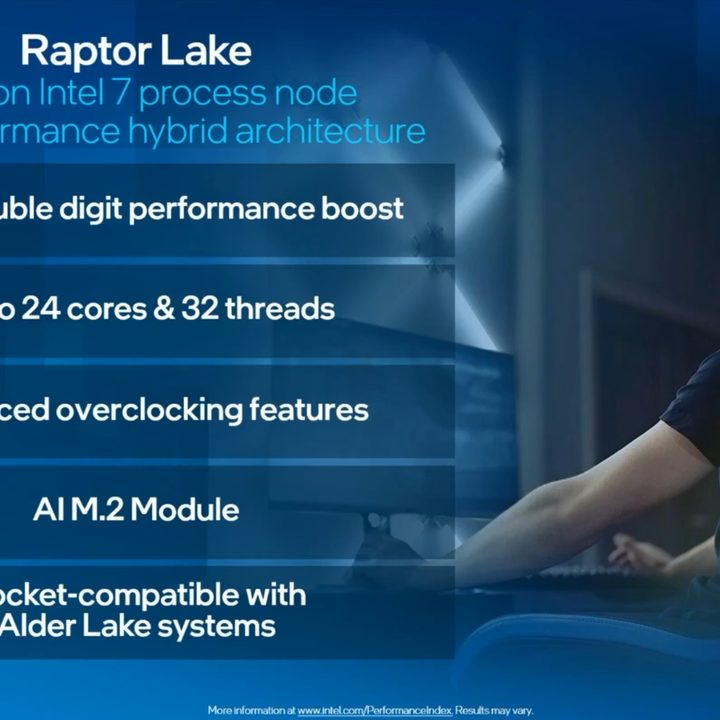
The engineering sample obtained by SiSoftware was not quite as powerful as the real thing is going to be upon release. It came with the full expected core count of eight performance (P) cores and 16 efficient (E) cores, adding up to a total of 24 cores and 32 threads. However, the clock speeds maxed out at 3.7GHz on the P-cores and just 2.76GHz on the E-cores. The rumored clock speed that should become available upon the release of the chip should hit as high as 5.5GHz for the flagship Core i9-13900, so we’re still a long way from getting anything close to the real numbers.
Intel Raptor Lake features a largely upgraded cache, and this can clearly be seen on the tested chip. The lineup as a whole is said to feature an up to 20% larger L3 cache (up to 36MB unified) and a twice as big L2 cache (up to 32MB). Those are also the numbers provided by the Core i9-13900, so we’re seeing a total of 68MB of cache, marking a huge increase over Intel Alder Lake.
SiSoftware didn’t go into detail as to what kind of a system was used in these tests. We know that Raptor Lake will support up to DDR5-5600 memory, but we don’t know whether that was the kind of RAM used during the benchmarks. Similarly, we don’t know what kind of systems the other CPUs were running. What we do know is that the Intel Core i9-13900 is being compared to the Intel Core i9-12900 with 16 cores and 24 threads, the Core i9-11900K with eight cores and 16 threads, and lastly, the AMD Ryzen 9 5900X with 12 cores and 24 threads.
As for the benchmark results, it’s hard to deny that they’re pretty juicy. In Whetstone FP32 tests, the Core i9-13900 managed to beat its predecessor by up to 50%. It also proved itself able to deliver a 2x gain in the FP64 test. In the end, it defeated both the Core i9-12900 and the AMD Ryzen 9 5900X. These results take a huge hit in other tests, though, where Raptor Lake wins by 4-6% instead. This is because, just like Intel Alder Lake-S, the new generation of CPUs doesn’t support AVX-512, which is a set of CPU instructions that are not supported by Intel’s E-cores in their current state. AMD’s Zen 4 processors will have AVX-512 capabilities, which could potentially put Team Red in the lead in such tests.
Although the results are a bit all over the board, they should certainly drive the hype for Intel Raptor Lake, set to release in the fall. The CPU outperformed its successor at much lower clock speeds. It does fall short in heavy vectorized/SIMD (single instruction, multiple data) tests, but still wins by around 5-8%. Keep in mind that in terms of benchmarks, this is as early as it gets, so everything might still change by the time the real product makes it to market.