

Intel’s rollout of its 11th-gen Tiger Lake line has been painfully slow. But finally, after being announced originally at CES in January, Intel is now finally providing the final specifications for its upcoming mobile processors — and it feels like a triumphant comeback for Intel.
They’re set to launch in laptops this fall, with more than 150 designs in the works from just about every laptop manufacturer you can imagine. There’s even a completely redesigned set of branding and logos to match.
But that’s not all. The company is also launching a new certification platform surrounding its Iris Xe graphics, known as Intel Evo. Let’s start, though, with what we’ve been waiting for: The juicy, juicy specs.
Specs
The 11th-gen Tiger Lake is Intel’s second attempt at its troubled 10nm node. It was delayed many times over, and when it finally arrived, its release was limited. They were only used in laptops with low TDPs, and clock speeds were surprisingly low. Even Intel has admitted that getting good results out of 10nm would be a struggle.
Tiger Lake doesn’t expand the reach of 10nm. These are still exclusively for thin and light laptops, leaving out products such as desktop or gaming laptops. It does, however, improve performance in a big way.
| Cores/Threads | Graphics (execution units) | Cache | Base clock | Boost clock (all-core) | Graphics boost clock | TDP | |
| Intel Core i7-1185G7 | 4/8 | Iris Xe (96) | 12MB | 3.0GHz | 4.8GHz (4.3GHz) | 1.35GHz | 12-28w |
| Intel Core i7-1165G7 | 4/8 | Iris Xe (96) | 12MB | 2.8GHz | 4.7GHz (4.1GHz) | 1.30GHz | 12-28w |
| Intel Core i7-1135G7 | 4/8 | Iris Xe (80) | 8MB | 2.4GHz | 4.2GHz (3.8GHz) | 1.30GHz | 12-28w |
| Intel Core i5-1125G4 | 4/8 | Intel UHD (48) | 8MB | 2.0GHz | 3.7GHz (3.3GHz) | 1.25GHz | 12-28w |
| Intel Core i3-1115G4 | 2/4 | Intel UHD (48) | 6MB | 3.0GHz | 3.6GHz (3.3GHz) | 1.25GHz | 12-28w |
The main thing to notice is frequency. Across the lineup, both base clocks and boosts clocks have been significantly improved. The top-of-the-stack option, the Core i7-1185G7, has a base clock of 3.0GHz, a 23% increase over the Core i7-1086G7. It’s an even bigger leap on the bottom end, where the Core i3-1115G4’s frequency is 60% higher than its 10th-gen predecessor. That’s a far larger generational leap than what we’re used to seeing from Intel.
More important, the base frequencies also represent a meaningful jump beyond what AMD’s Ryzen 4000 processors offer.
The secret sauce behind these high frequencies is its redesigned transistors, which Intel calls “10nm SuperFin.” By introducing efficiencies throughout the stack, these 11th-gen processors have more voltage to spend on clock speed.
Cache size has also grown throughout the lineup, now offering up to 12MB on the Core i7-1185G7.
Performance

Unfortunately, there haven’t been any improvements to the number of cores and threads. This is an area AMD has taken a huge lead in, offering 15- and 25-watt processors with up to eight cores and 16 threads. But these latest 11th-gen chips are still stuck at just four cores. Sadly, the Core i3 still has just two cores and four threads.
In its press release, though, Intel claims Tiger Lake processors offer “up to 2.7× faster real-world photo editing and up to 2× faster real-world video editing versus competitive products.”
Rather than relying on more cores and threads, which is AMD’s approach, Intel uses its DL (deep learning) Boost to offer smarter performance enhancements, tuned to the needs of specific applications and workflows. Intel framed it as moving beyond measuring performance by benchmarks, which it tends to fall behind AMD on.
“Not all cores are created equal,” as an Intel representative stated in its briefing.
Intel didn’t shy away from making direct comparisons. Intel didn’t specify which processor it was comparing, but the company says one of its 11th-gen processors is nearly 100% faster at video encoding in Adobe Premiere than the AMD Ryzen 7 4800U.
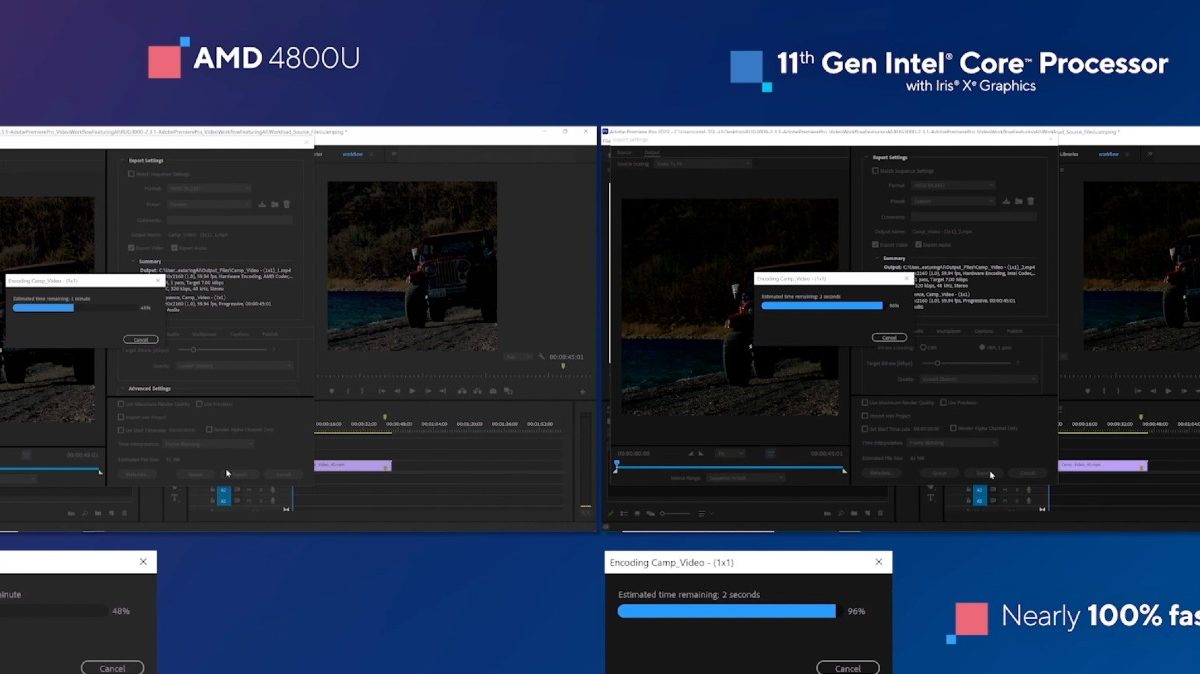
Intel also demoed how it uses AI to do things like remove background noise in video calls.
We’ll have to wait to test Intel’s 11th-gen-powered laptops to see how they compare to the competition.
Intel Iris Xe graphics
The biggest upgrade, though, is in integrated graphics. Tiger Lake marks the debut of the Intel Iris Xe, the company’s new graphics platform. In the chips labeled “G7,” they get either 80 or 96 EUs (execution units). The Iris Plus graphics in Ice Lake maxed out at 64 EUs, which shows just how much faster Intel Xe will be.
As always, there are two oddities in Intel’s naming convention. First, there are two chips labeled “G7” that have a different amount of EUs, which is confusing and potentially misleading. The whole point of the “G7” label was to convey the graphics potential from a glance right in the processor name. Now, further elaboration is needed. Based on this chart, the “G1” level of graphics have been removed altogether.
But performance is what matters ultimately. Intel says games like Borderlands 3, Far Cry New Dawn, and Hitman 2 will now be playable at 1080p at twice the frame rates of last year’s graphics.
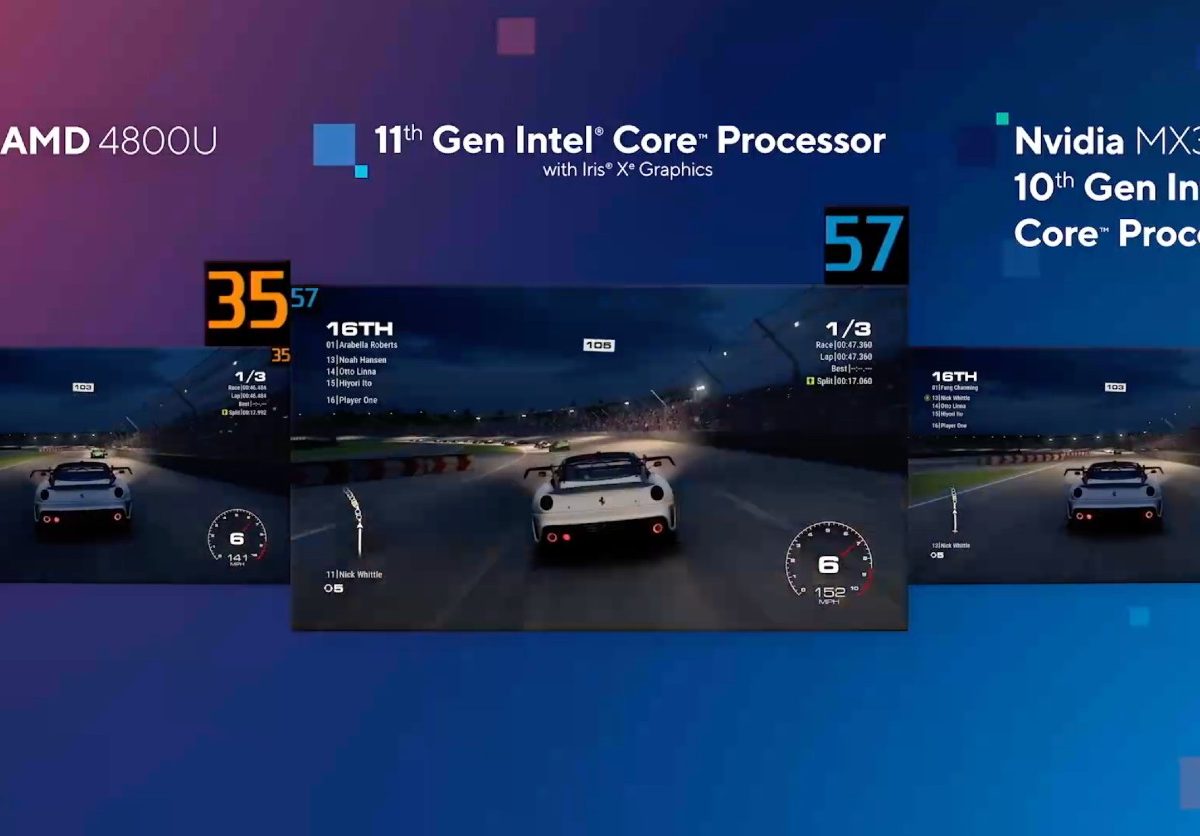
Intel even compared how its Iris Xe graphics compared to both AMD’s Radeon integrated graphics and entry-level discrete graphics like the Nvidia MX350. In the racing game Grid, Intel showed that the Iris Xe graphics has a commanding lead on both of its competitors.
This leap ahead in integrated graphics is a big deal. Not only does this better match what AMD has with its Radeon graphics, it also means PC gaming is finally becoming more accessible. Intel Xe might not magically turn thin and light laptops into gaming machines, but it at least makes some light gaming possible on these laptops.
Intel Evo

Timed with the launch of Iris Xe, the company has a new platform to brand these new laptops. “Intel Evo” is a brand that will begin to appear on laptop marketing, a certification that calls special attention to graphics performance.
There’s more to the label than just graphics, though. Intel Evo has a list of requirements that a laptop must meet in order to be awarded with the special badge. They include features such as consistent responsiveness on battery, system wake from sleep in less than one second, nine or more hours of real-world battery life, and fast charging.
It’s an expansion of Project Athena, and it again requires Intel to test the systems in its own labs. The company has struggled to effectively brand Project Athena, at one point calling it “Engineered For Mobile Performance.” Intel Evo rolls off the tongue a bit better.
The entire launch was also noticeable for what was missing: any mention of the IFA technology show, currently taking place in Europe. IFA is Europe’s largest technology show — one of the biggest in the world in fact — and Intel has used it in the past as a launch point for new chips, platforms, and products from partners. In 2019, Intel launched the 10th-generation Ice Lake CPUs and related graphics tech from Berlin.


