Intel surprised everyone last year by hiring Raja Koduri, a senior vice president and chief architect of Radeon at AMD. The hire suggested Intel was ready to get serious about graphics hardware. Now we’re seeing the first fruits of that labor, as well as a few more details about ‘Xe,’ the company’s upcoming discrete graphics solution.
Intel Gen11 is a boost coming soon
While Intel’s push for a discrete graphics solution has hogged the hype, the company provided far greater detail about an update to its integrated graphics that will be arriving in 2019. Simply called “Gen11,” it targets a modest boost in performance for Intel processors shipping with integrated graphics.
The key specification is one teraflop, the performance target Intel says Gen11 will meet or exceed. That’s not going to blow your socks off if you’re a PC enthusiast, as the fastest discrete video cards can exceed 10 teraflops, but it’s a significant step forward for Intel’s integrated graphics processors, or IGP. It also puts Gen11 much closer to modern home game consoles.
Intel says the Gen11 design will have 64 execution units, up from 24 in previous incarnations. Note, though, that the company wouldn’t commit to whether all Gen11 designs will have this many units, or only certain models. Intel’s IGP currently comes in several flavors. We’d be surprised if only one version of Gen11 shipped.

The performance gain is flanked with new features. The most notable is VESA Adaptive Sync. Here’s the important part: Adaptive Sync is basically FreeSync. VESA didn’t implement the stand from scratch, but instead adopted AMD’s open solution. That means most existing desktop monitors with FreeSync or Adaptive Sync compatibility will also support the feature when connected to a laptop powered by Intel’s Gen11 IGP.
It’s a big deal. Adaptive Sync matches frame rendering and the display refresh rate to eliminate the stuttering and screen-tearing that can result from a mismatched framerate. The result is a smoother, more enjoyable, more responsive game.
HDR is also supported, and it too is a big step forward. Only a few HDR monitors are currently sold, but adoption is no doubt held back because HDR is only supported by expensive discrete video cards. Gen11 will make HDR support far more common, which in turn should make HDR monitors more common.
We saw Gen11 in action at Intel’s ‘Architecture Day,’ where the company showed a side-by-side comparison of Tekken 7 played on Gen11 and a current-generation Intel UHD solution. The difference was night and day. Still, gamers should keep expectations in check. Intel hopes to simply make it possible for players on Intel graphics to play most modern games – not play them at the best detail settings.
‘Arctic Sound’ is now Intel Xe, but we don’t know much more
Early announcements about Intel’s discrete graphics solution referred to it only by its code name, Arctic Sound. Now we have a real name to call it by – Intel Xe.
That, unfortunately, is almost all the new information we have. Intel did present a few slides on the product. Raja Koduri, speaking at the architecture event, said it “scales from teraflops to petaflops.” In other words, the same architecture will be used in everything from Intel integrated graphics to enthusiast video cards and data center GPU compute products. Intel once again confirmed that it will offer a discrete graphics solution for enthusiasts, and 2020 is still the target for its introduction.
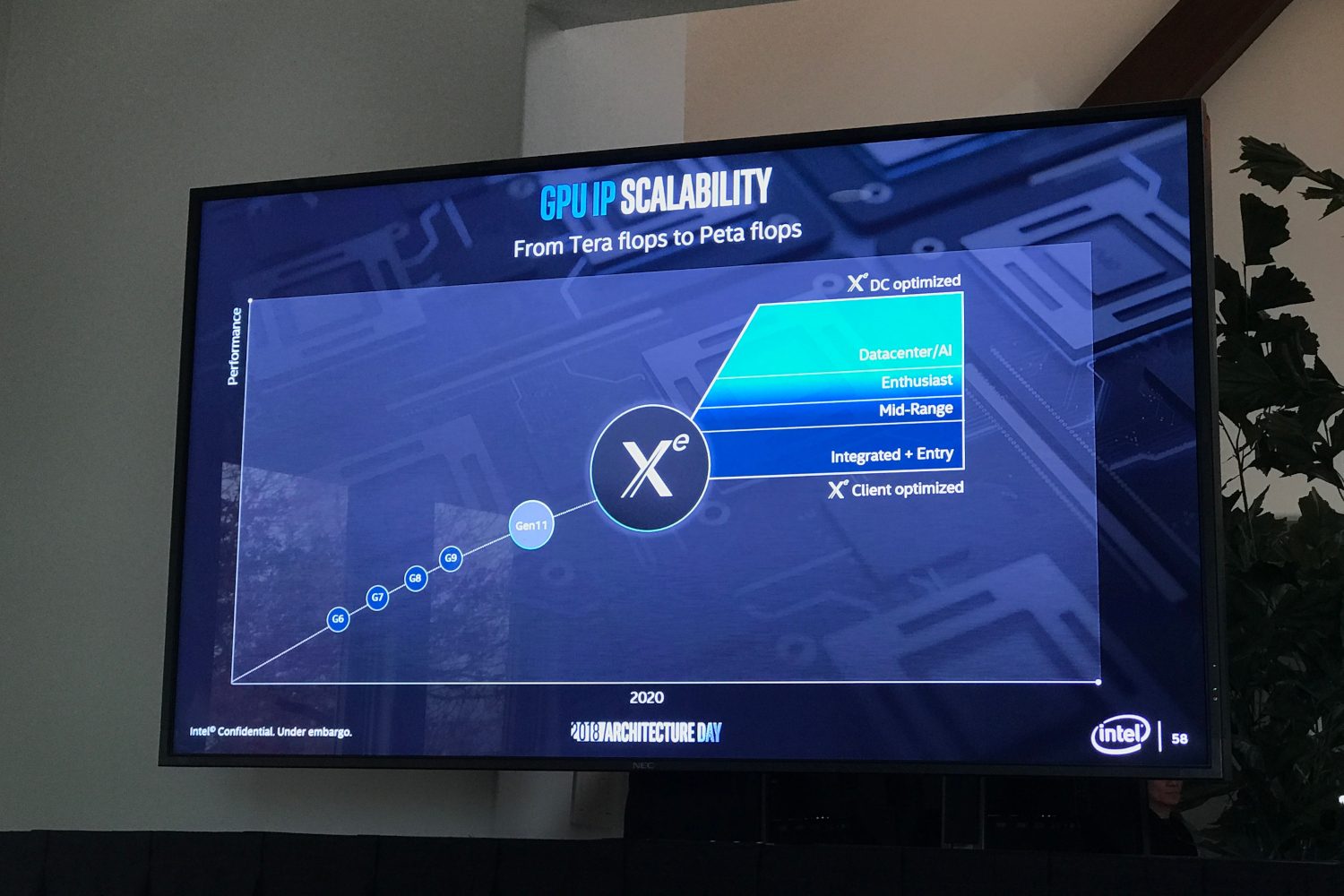
Koduri also said Intel will be ramping up its software support to meet the new demand. “We want to make more games playable,” he said, “and a key part of that is the whole software stack.” He highlighted how Intel started to release some day-one driver updates for popular game releases and sees that happening more often going forward. Koduri is also confident that, once Intel’s hardware offers the performance, game developers will be eager to support it. “Game developers like it, because it’s 200 million users a year.” That’s in reference to the very large install base Intel can reach, as most laptops and desktops are sold with an Intel processor.
Now, we wait
Intel’s announcement of a discrete graphics solution has been met with almost as much disbelief as excitement. It’s a gap that the company has left unaddressed for years, and some past initiatives failed to see widespread adoption.
Yet the company didn’t blink at its ‘Architecture Day’ event. It reaffirmed it’s working on discrete graphics, that it plans to address every market, and that it’s targeting 2020 for launch. That’s not so long from now, and should make for some exciting announcements as more details arrive throughout 2019. We’re also eager to see how this will complement Foveros, a new packaging technology designed to place multiple Intel architectures on one package.