
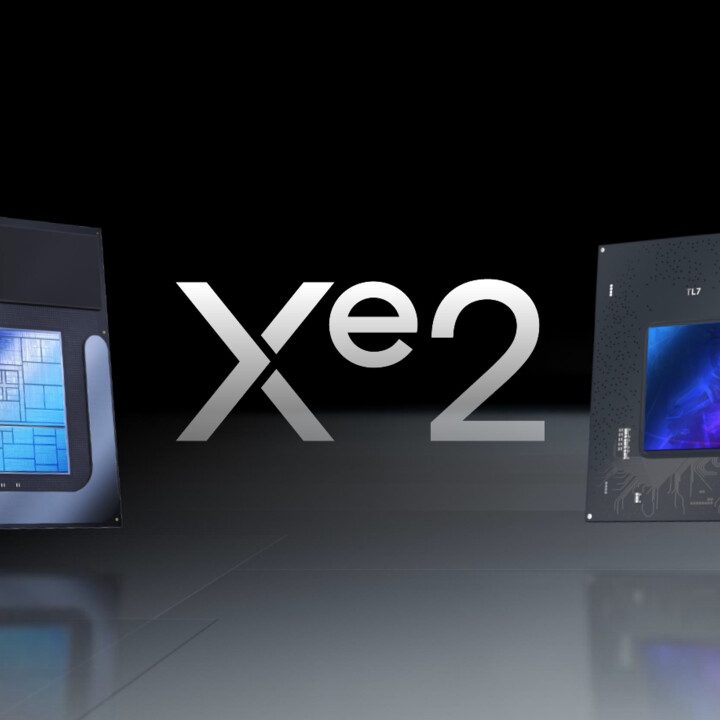
Despite all the talk around the efficiency and AI performance of Intel’s new Core Ultra Series 2 processors, code-named Lunar Lake, the real star of the show just might just be its integrated GPU.
I got all the details at a special event in Berlin just ahead of IFA 2024, and walked away very excited for what the new Xe2 graphics architecture could offer, as it could position Intel as the leader in graphics solutions for low-powered, ultrathin laptops.
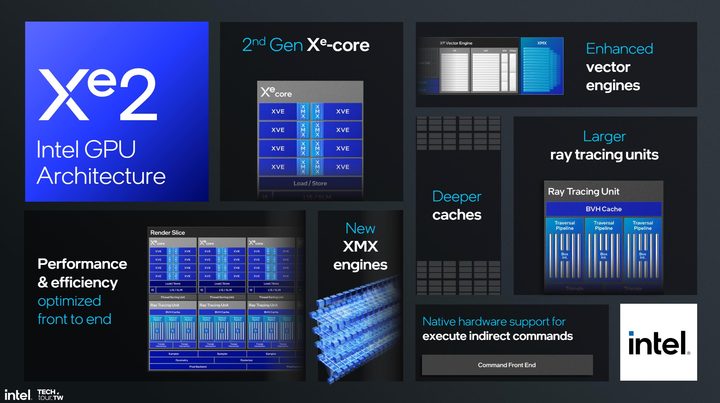
The integrated GPU features up to eight cores, 64 vector engines, 8MB of cache, and support for DirectX 12 Ultimate, all while utilizing LPDDR memory on package. It also includes improved XeSS (Xe Super Sampling) performance and XMX (Xe Matrix Extensions) AI engines, which enhance upscaling and ray tracing capabilities. There are two variants available: the 8-core Intel Arc 140V and the 7-core Intel Arc 130V, with clock speeds varying by SKU.
Intel demonstrated the GPU’s power by testing a range of games at 1080p with medium graphics settings on the Core Ultra 9 288V (140V GPU). The results showed a 31% performance improvement over the previous-generation Core Ultra 7 155H, 68% faster speeds compared to Qualcomm’s Snapdragon X Elite X1E-84-100, and a 16% lead over AMD’s Ryzen AI 9 HX 370.
While AMD’s Strix Point holds its own in titles like Cyberpunk 2077 and Hogwarts Legacy, Intel’s integrated GPU outperforms competitors in the majority of benchmarks, particularly against Qualcomm, whose Snapdragon X Elite struggled to run over half of the tested games.
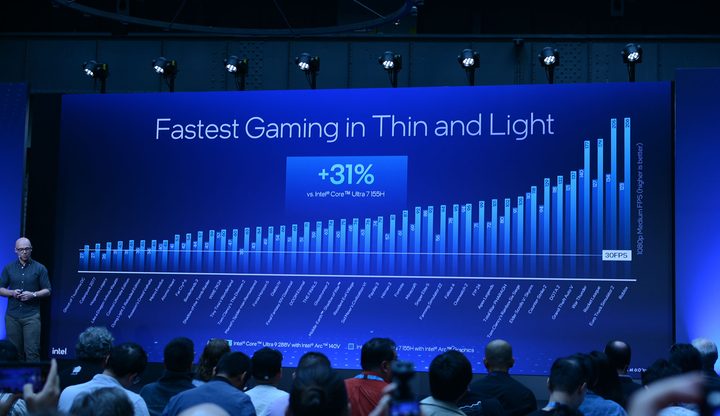
What’s particularly noteworthy is that these benchmarks were achieved without any super sampling enabled, and Intel’s new integrated GPU is capable of running ray-traced games at acceptable frame rates. Considering these processors are aimed at thin and light notebooks rather than dedicated gaming rigs, the performance is especially impressive.
However, Intel’s Xe2 GPU is expected to feature in at least one gaming device, the upcoming MSI Claw 8 AI+ gaming handheld, which will be powered by the Core Ultra 200V. Robert Hallock, vice president and general manager for Intel’s Client AI and Technical Marketing, confirmed the same, although he didn’t confirm the SKU.
I got a chance to see the device in action for a short amount of time, but sadly, I wasn’t allowed to check the specifications, power consumption or frame rates.
At the launch event, Intel also showcased the performance and efficiency of the new Core Ultra Series 2 chips through a series of demos. One notable demo compared two Lunar Lake-powered laptops, one with a Core Ultra 9 288V and the other with a Core Ultra 7 258V, against notebooks running Qualcomm’s Snapdragon X Elite and AMD’s Ryzen AI 9 HX 370.

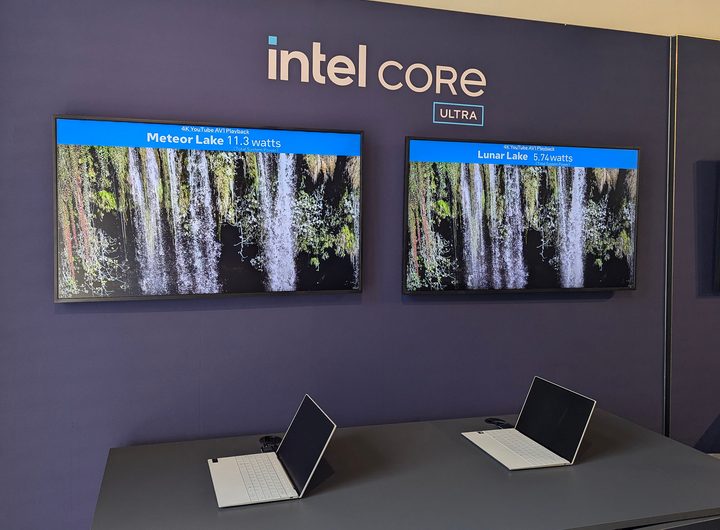
Both Intel-powered machines delivered 5% to 10% higher average frame rates while drawing similar or lower power compared to their Qualcomm and AMD counterparts. Another demo highlighted the significant gen-to-gen power efficiency improvement when running a 4K YouTube video using the AV1 codec, with the Lunar Lake laptop consuming half the power of the previous-gen Meteor Lake model.
Overall, early impressions of Intel’s Xe2-powered GPU and the new Core Ultra Series 2 processors are highly positive. Intel finally has an answer for consumers looking for a thin and light notebook that can offer long battery life and at the same time have enough grunt to run games at a stable 60 frames per second (fps).
The Lunar Lake-powered notebooks are expected to hit the market soon, and we’ll be able to verify these performance claims in due course. Until then, stay tuned for further updates as these new devices become available.


