
  1. Home
  2. Computing
  3. News

Digital Trends may earn a commission when you buy through links on our site. Why trust us?

Intel’s new Arc Pro B70 and B65 GPUs are built for AI work

Intel's new Arc Pro cards are here to run AI workloads on your workstation.

Add as a preferred source on Google
Intel Arc pro graphics
Intel

Intel has launched two new graphics cards aimed at professionals: the Arc Pro B70 and Arc Pro B65. These are not gaming cards. They are built for local AI inferencing, software development, and running multiple GPUs together in rack-scale AI setups.

Is the Arc Pro B70 the card AI fans have been waiting for?

For anyone who has been following Intel’s GPU journey, the Arc Pro B70 is a big deal. The Arc Pro B70 is the answer to anyone asking Intel to create an ultra-powerful GPU to power their workstation. 

It comes with 32 Xe cores, a 256-bit memory interface, 32 GB of GDDR6 memory with 608 GB/s of bandwidth, and 32 ray tracing units. For AI work, it delivers up to 367 TOPS, which is a solid number for local AI inferencing tasks. 

The card connects via PCI Express 5.0 x16 and supports all the major compute APIs, including Intel’s own oneAPI, OpenCL 3.0, and OpenVINO. Power draw sits between 160 W and 290 W, depending on the partner card, with the Intel reference model rated at 230 W.

What about the Arc Pro B65?

The Arc Pro B65 is the more affordable card, but it still brings good performance. It packs 24 Xe cores, 32 GB of GDDR6 RAM with the same 608 GB/s memory bandwidth, and 20 ray tracing units. It uses the full PCIe 5.0 x16 interface and is rated for a typical board power of 200 W.
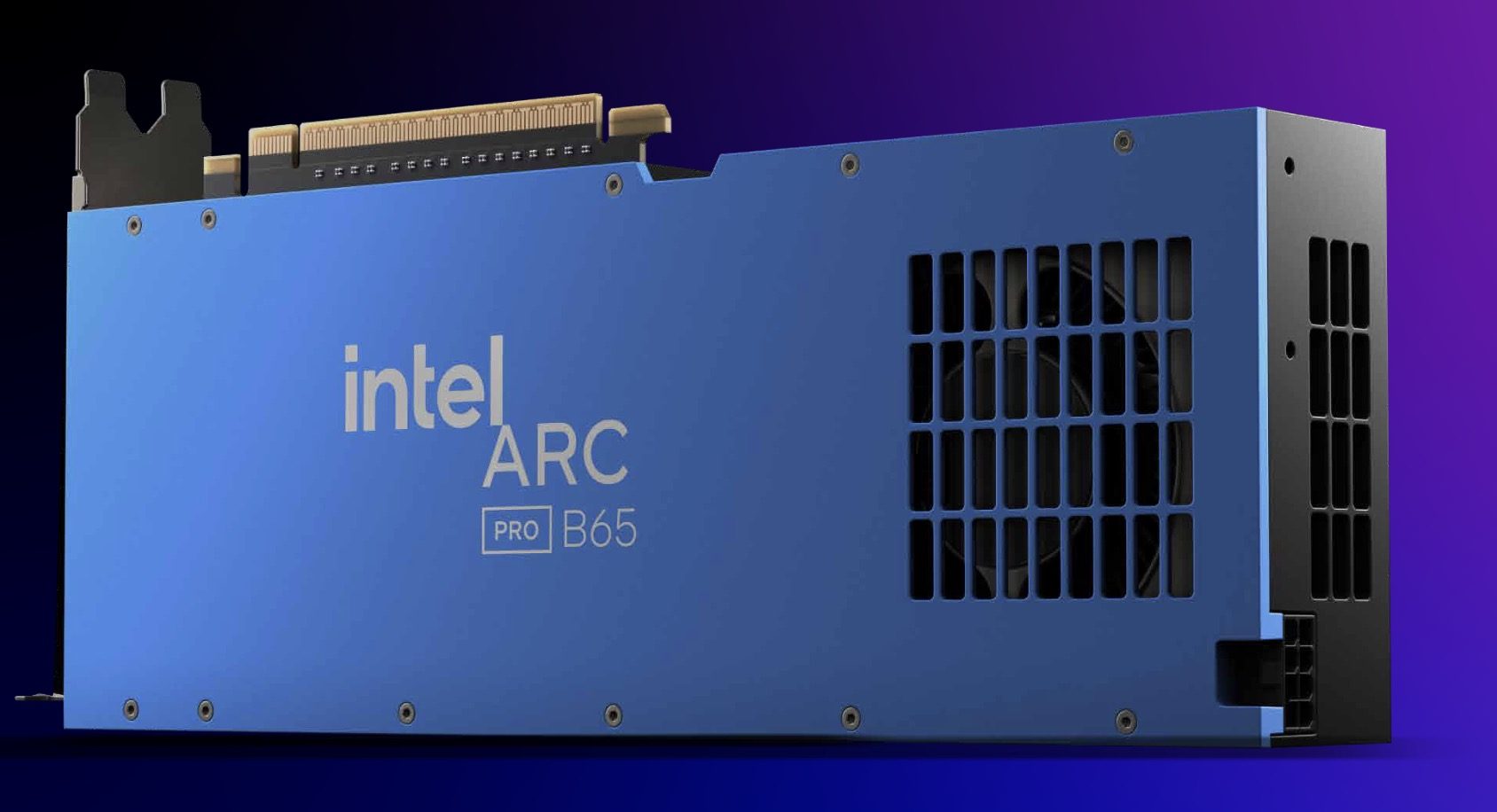
Both the Arc Pro B65 and B70 cards support Windows 10, Windows 11, and Linux with certified drivers, and share the same display outputs: four HDMI 2.1 ports. They both support up to 8K display output at 120Hz. 

Recommended Videos

If your work involves running AI models locally or professional visualization, Intel’s new Arc Pro lineup is worth a serious look.

Rachit Agarwal
Rachit is a seasoned tech journalist with over seven years of experience covering the consumer technology landscape.
Next-gen AI breakthrough promises chatbots that can read the room better
Researchers are teaching AI chatbots to read between the lines
Generative AI

Have you ever asked a chatbot something and felt like it completely missed your point? You say something with a bit of nuance, and the AI misses the subtlety entirely. That is exactly the problem researchers are trying to solve.

Even though the emotional connection with AI can feel deeper than human conversation for many users, most AI systems today still treat a sentence as a single block of sentiment. If you mix praise and criticism, the nuance often gets lost.

Read more
ChatGPT is not getting an erotic mode, after all
OpenAI pulls back as “adult mode” runs into bigger concerns
ChatGPT-to-rollback-to-friendly-and-adulttt

If you were expecting ChatGPT to get an “erotic mode,” that idea is officially off the table. According to Financial Times, OpenAI’s spicy mode is on hold “indefinitely.”

Inside OpenAI's struggle to bring the adult mode to life

Read more
Turns out, if you ask an AI to play an expert, it gets less reliable
Asking AI to pretend it's an expert can backfire, but researchers may have found a fix.
AI

you’ve probably seen the tip floating around: tell AI to act like an expert in a field, and you’ll get better answers. It’s popular advice, and it does work, sometimes. However, a new study suggests that using AI personas may not be as effective as we thought it would be.

Researchers from the University of California tested 12 different personas across six language models. The personas ranged from math and coding experts to creative writers and safety monitors. The goal was to find out how well AI performs when it is instructed to act as an expert.

Read more