

While 2023 was a relatively quiet year for laptops, 2024 is going to be a shake-up. With everything from AI chips to an embrace of ARM, we’re about to see some things come to fruition that have been bubbling in the background for years. Even PC sales are expected to receive a bump as a result of it.
The end result will be laptops that might look familiar on the outside — but will represent a major shift in how they are made and used, and even how they function.
Efficiency looks to make a leap
Apple’s MacBooks are the longest-lasting laptops you can buy today. Whether you’re talking-and-a-half or more of real work. There isn’t a Windows laptop made yet that can achieve the same while providing even passable performance.
Apple Silicon uses ARM technology that’s intimately optimized via macOS to provide incredible efficiency and fast speeds. Until now, Intel has relied on older technology and brute force to improve performance generation over generation, but efficiency has continued to suffer. It’s rare that we review an Intel-based laptop that offers even a meaningful fraction of Apple’s longevity.
That should change dramatically with Intel’s Meteor Lake, the company’s 14th-gen CPUs, which were just unveiled this week. Meteor Lake represents the most significant change to Intel’s architecture in years, incorporating the first 7nm process and a four-tile architecture that integrates a Compute Tile with E-cores and P-cores that are faster and more efficient, an SOC Tile that introduces a Neural Processing Unit (NPU) for power-efficient AI, a GPU Tile with faster Intel Iris Xe LPG graphics, and an IO Tile that fuses Thunderbolt 4 and PCIe Gen 5.0 on the chip.
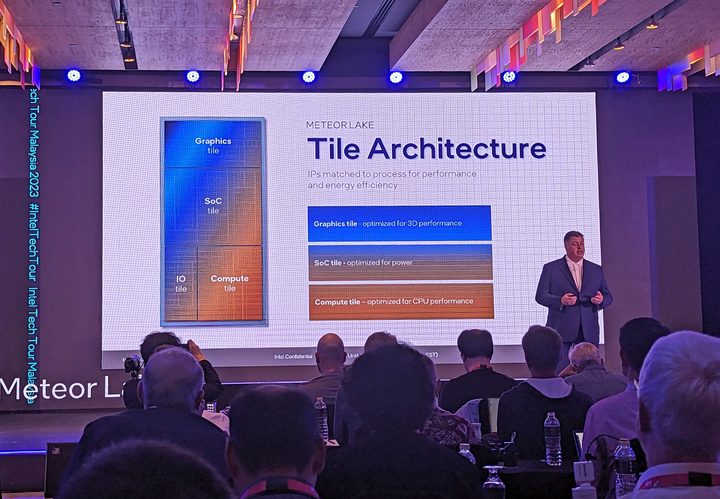
There are numerous technical details involved with Meteor Lake that go beyond the scope of this story. But suffice it to say that if Intel’s promises hold true, Windows laptops will be faster and more efficient than ever. Whether they’ll compete with Apple’s latest remains to be seen, but at the very least, the gap should get a lot smaller.
But Intel’s not alone in pursuing faster speeds to go with improved battery life. Qualcomm has announced the Snapdragon X Elite that uses the company’s Oryon CPU and Adreno GPU along with a dedicated NPU. The chip has 12 high-performance cores running at up to 4.25GHz, two cores at a time, with a base speed of 3.8GHz. Qualcomm claims that its 4nm process results in CPU performance that doubles up the Intel Core i7-1260P while consuming 68% less juice. Perhaps more impressive, the Snapdragon X Elite could be 60% faster than the Core i7-13800H while using 65% less power.

If these claims hold true, that would make the Elite X 50% faster in multicore tasks than the Apple M2. That’s not so impressive considering that Apple just released the faster M3, but even so, the Snapdragon X Elite promises to dramatically improve Windows on ARM performance while maintaining the platform’s excellent efficiency.
AI everywhere, literally
I wrote in 2017 that AI was an important technology. My assertion seems quaint today when generative AI has become a dominant news story, if not a dominant technology in practice. But setting aside all the hype, AI promises to make its way into mobile computing in a big way in 2024.
We saw above that Intel and AMD are building NPUs into their chipsets to better support a variety of AI implementations. AMD already did something similar with its Ryzen 7040 Series chips using the company’s XDNA technology.
The big question is, what will these AI technologies accomplish? Intel already talks about AI improving battery life by changing how CPUs transition power states and better matching those transitions to users. Other than some graphics applications, though, AI currently has limited usefulness. That should change, though, once AI hardware exists on laptops.
The industry as a whole has a lot to prove in terms of the usefulness of the NPU, especially considering how powerful GPUs are at AI workloads and how much of AI is processed in the cloud. Still, if Intel, AMD, and Qualcomm can leverage relationships with developers to actually use the NPU to speed up a variety of tasks on a PC, that might be the most convincing and seamless use of AI we’ve seen yet.
When will Windows 12 arrive?
It’s only speculation at this point, but the reports have begun to indicate that Windows 12 will arrive sometime in 2024. Rumors abound about what the new operating system might look like, and some of them are particularly intriguing.
First is that Windows 12 might be modular, with editions tailored for specific laptop form factors and specifications. An example would be a version code-named “Next Valley” that would have specific support for Intel’s Meteor Lake CPUs.
Another capability that Windows 12 might include is enhanced AI. It’s uncertain exactly what kind of AI will emerge, but possibilities include image recognition, AI-enhanced copy and paste, prompted projects, and more. Perhaps Intel will introduce some of its own anticipated AI-assisted battery life improvements in Windows 12. We’ve already seen what Microsoft is willing to do with Copilot, as it integrated AI directly into the operating system, but it’s not hard to imagine the company taking things even further.
Continued form factor evolution

While 2023 was a relatively boring year for laptops, it did introduce some important trends.
Foldable and dual-screen laptops like the HP Spectre Foldable PC and Lenovo Yoga Book 9i should become more prevalent next year, hopefully at more affordable prices. Many users demand flexibility, and while the typical convertible 2-in-1 and tablet with detachable keyboard are a start, nothing provides the same kind of flexibility as laptops with multiple displays. More than that, they’re just fun new explorations of a form factor that goes beyond a conventional clamshell.
Displays should continue to improve in 2024, with OLED, QLED, and mini-LED showing up on more laptops and improving performance. Refresh rates will continue to rise, with 120Hz becoming as common as 60Hz. Even IPS displays will get better, and laptops with subpar panels will become fewer and farther between.
The most practical trend we saw in 2023, however, was an increase in the number of excellent ,yet highly affordable laptops. The Asus Zenbook 14 OLED offered solid performance and a spectacular display for just $700, and it’s one of a number of outstanding laptops for less than $1,000. Expect to see more of the same in 2024 as Windows laptop makers try their hardest to differentiate their products from Apple’s MacBook lineup and offer compelling reasons to buy a new PC.


