
Intel’s new 14th-gen Meteor Lake CPUs are finally here. The company officially announced its latest generation client system on a chip (SoC) lineup, which is claimed to deliver “game-changing performance” and power efficiency for the PC industry. Intel says it’s the “largest client SoC architectural shift in 40 years,” and it seems specifically targeted at Apple’s wildly popular M-series processors.
The new Meteor Lake series introduces a major architectural shift as it is the first to be built on Intel 4 process technology. It makes use of the 7nm process and is designed using extreme ultraviolet (EUV) lithography to improve yield and area scaling to increase power efficiency.
Talking about Meteor Lake’s scalable SoC architecture, Mikal Hunsaker, senior principal engineer at Intel, said: “Our 12th-generation Intel Core processors, code-named Alder Lake, introduced Intel’s hybrid computing architecture, which increased core efficiency and delivered intelligent workload optimization by integrating two core microarchitectures into a single die.”
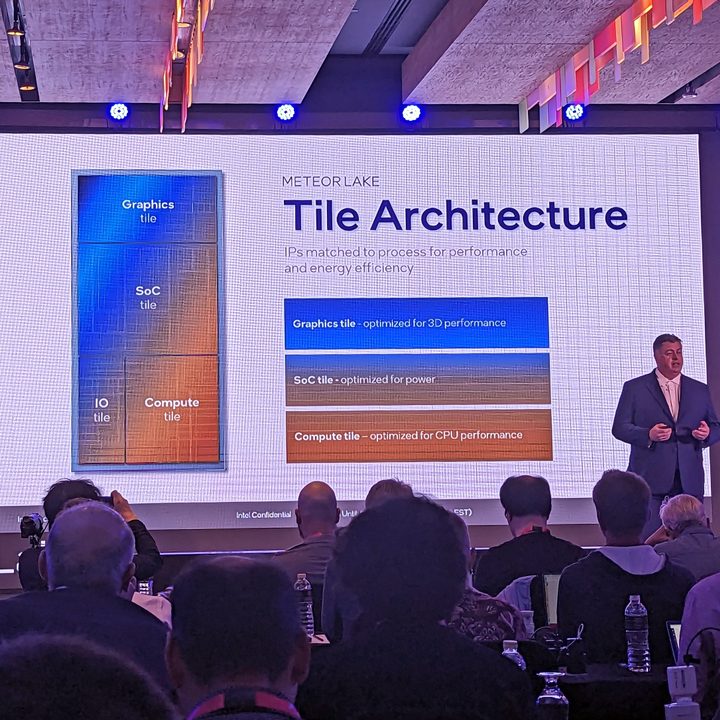
Utilizing Intel’s Foveros 3D packaging technology, Meteor Lake features a four-tile architecture design:
- Compute Tile: This tile houses the latest-generation E-cores and P-cores, both of which introduce microarchitecture improvements. It is constructed using the Intel 4 process node, which is claimed to bring advancements in power-efficient performance.
- SOC Tile: This tile integrates a Neural Processing Unit (NPU), introducing power-efficient AI capabilities to the PC that are compatible with standardized program interfaces like OpenVino, among others. Intel has also introduced new low-power island E-cores that are directly attached to the SoC fabric on this tile and designed for a range of low-power workloads, further optimizing power-efficient performance. The SoC also integrates Wi-Fi and Bluetooth, including Wi-Fi 6E, as well as media capabilities, supporting 8K HDR and AV1 codecs, and adhering to HDMI 2.1 and Display Port 2.1 standards.
- GPU Tile: This tile incorporates the Intel Arc Graphics architecture into the client SoC, providing discrete-level performance within an integrated form factor. The improvements in graphics capabilities, paired with enhanced power efficiency, will allow Meteor Lake to achieve up to 2x performance compared to the previous generation.
- IO Tile: This tile encompasses connectivity features including integrated Thunderbolt 4 and PCIe Gen 5.0 support.

Intel is also introducing an NPU into client silicon for the first time with Meteor Lake. It has been designed to facilitate low-power, high-quality AI experiences and is well-suited for workloads transitioning from the CPU that require improved quality or efficiency. It is also said to be suitable for workloads that would traditionally rely on cloud computing due to the absence of efficient client-side compute resources.

Meteor Lake will also integrate a new Intel Arc GPU in Meteor Lake. Intel has combined the contemporary feature set of the Xe-HPG microarchitecture with the power-efficient design of the Xe-LP microarchitecture to create the Xe-LPG microarchitecture utilized in the Meteor Lake GPU. The new GPU is claimed to offer up to twice the graphics performance and performance per watt when compared to the previous generation of mobile processors, and it includes features such as DX12 Ultimate with hardware-accelerated ray tracing, variable rate shading, and sampler feedback.
It is expected that the first wave of products powered by Meteor Lake processors will start shipping on December 14. Intel is yet to announce its full lineup, including various SKUs, so keep a lookout for its next big announcement in the coming weeks.


