  1. Home
  2. Computing
  3. News

Digital Trends may earn a commission when you buy through links on our site. Why trust us?

LG finally did it: a 27-inch OLED gaming monitor with a 240Hz refresh rate

Add as a preferred source on Google

PC gamers rejoice: LG has announced a 27-inch OLED monitor with G-Sync support, 240Hz refresh rate, and blink-and-you’ll-miss-it 0.03ms response time.

We’ve seen plenty of OLED gaming monitors over the years, but none in a screen size that most PC gamers actually want. But this is finally it: a 27-inch OLED monitor, and it’s already one of the most anticipated new monitors for next year
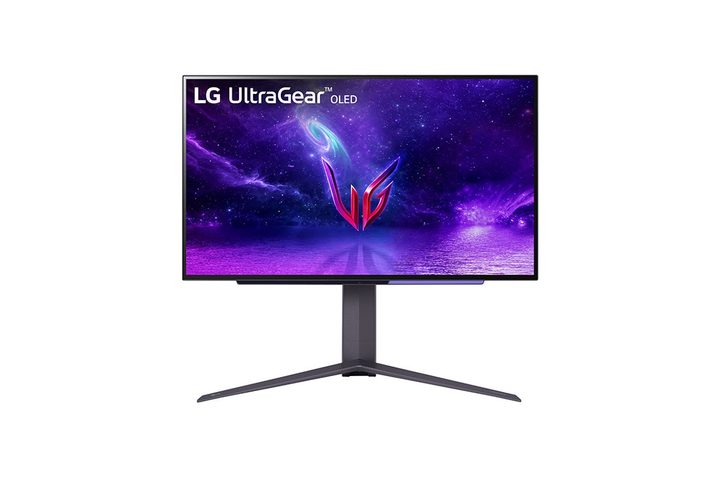
LG 27GR95QE front view over white background.
Image used with permission by copyright holder

The official name is the LG UltraGear 27GR95QE, which expands on LG’s current line of OLED-based gaming monitors and televisions.

Recommended Videos

The 27GR95QE will be rocking a resolution of 2560 x 1400 (QHD) at 16:9, running a max response rate of 240Hz, and 0.03ms response time. It will also have no problem flexing its OLED muscle with 1.07 billion color depth, support for 98.5% DCI-P3, and a contrast ratio of 1,500,000:1, among other features.

The product page doesn’t provide a brightness figure for the panel, oddly. Instead, there’s a “to be determined” placeholder. We’ll be particularly interested to see how bright this thing gets for the purpose of testing HDR performance.

LG 27GR95QE rear view over cyan background.
Image used with permission by copyright holder

A must for a gaming monitor, of course, is some kind of RGB ambient lighting. The LG has a double-chevron arrangement of lights around the back panel. We’re also happy to see 10-bit HDR support, plus compatibility with AMD FreeSync Premium and Nvidia G-Sync. You can tilt the display from -5 to 15 degrees, and swivel from -10 to 10 degrees.

As for ports, the unit sports one DisplayPort 1.4, two HDMI, one USB 3.0 up stream, two USB 3.0 down stream, a TOSLINK, and one TRRS jack.

LG has not said when the 27GR95QE will go on sale, but we can only hope that it makes it just in time for the holidays. With a suggested retail price of $1,000, this monitor has the potential to pair well with your RTX 4090-powered machine.

Hopefully we’ll get to hear more about this monitor soon, as details are fairly sparse at the moment.

Aaron Leong
Former Computing Writer
Aaron enjoys all manner of tech - from mobile (phones/smartwear), audio (headphones/earbuds), computing (gaming/Chromebooks)…
Gemini in Chrome can now see exactly what you’re looking at on screen
Google's new "Select from screen" tool makes it easier to ask Gemini questions about text and images in a browser tab.
Google Chrome Gemini Featured

Google is making Gemini a lot more aware of what's happening inside Chrome. The company has started rolling out a new "Select from screen" feature that lets users highlight specific text or images from a webpage and send them directly to Gemini, making conversations with the AI assistant far more contextual.

Gemini can now focus on exactly what users want to ask about

Read more
Microsoft’s new Surface PCs are cheaper — but there’s a catch
Cardboard, Box, Carton

The tech industry’s favorite balancing act is getting harder by the month. Component prices are rising, memory costs refuse to settle down, and laptop makers are scrambling to keep sticker shock under control. Microsoft’s latest Surface refresh feels like a direct response to that problem.

The company has introduced new entry-level versions of its 12-inch Surface Pro and 13-inch Surface laptop, offering lower starting prices without changing the processor or storage. On the surface, that sounds like good news for budget-conscious buyers. Dig a little deeper, however, and you’ll find a compromise hiding in plain sight.

Read more
A new supercomputer has dethroned the U.S — here’s why it matters
Crowd, Person, Architecture

The race to build the world’s fastest supercomputer has been dominated by the United States. Now, China has stormed back into the lead. A newly ranked system called LineShine has claimed the No. 1 position on the latest Top500 list, a closely watched ranking of the planet’s most powerful supercomputers. The machine, located in Shenzhen, pushed past the U.S. government’s El Capitan system and became the first Chinese computer to top the list since 2017. That’s notable on its own. But what makes LineShine particularly interesting is how it got there.

The tortoise just outran the rocket

Read more