
“Why you can trust Digital Trends – We have a 20-year history of testing, reviewing, and rating products, services and apps to help you make a sound buying decision. Find out more about how we test and score products.“
Logitech is making a name for itself in the PC gaming market. We’ve seen high quality products pass through our hands over the last few years, and as of late, the company’s Logitech G brand has become somewhat of a staple in esports, which demands nothing but the best for high-performance, high-precision gaming.
Yet the Logitech G brand aims to be innovative, too. Lurking in the background over the past three years was a secret product designed to push the envelope even further. The team set out to eliminate the cord tethering mice to PCs, and has done just that.
The result? Logitech’s $100 PowerPlay Wireless Charging System. It includes the PowerPlay base, a PowerCore module, the hard mouse mat, the cloth mouse mat, and a 6-foot braided USB cord. The mice tested in this review are sold separately.
We had a chance to test Logitech’s PowerPlay system prior to its launch. The provided press-only kit included not only the kit, but also two of Logitech’s compatible PC gaming mice.
So, does it work?
This is no simple mouse mat
The first component, the PowerPlay Charging Base, is quite large, measuring 13.54 inches wide and 12.60 inches deep. The base is only 2mm thick, and you can clearly see the flat, wireless charging antennas embedded within when viewing at just the right angle. In the top-left corner you’ll find the small, attached control module, which is responsible for providing wireless connectivity, and sending power to the antennas.


These embedded antennas are what create a vertical energy field based on electromagnetic resonance. The field doesn’t reside over the entire surface of the charging base, but instead occupies the middle three-quarters. This field has a height of up to 4mm from the surface of the base, so the mat must remain within a specific thickness, or else the mouse won’t charge. So, not all mouse mats will work with the PowerPlay system.
PowerPlay charges the mouse battery while providing wireless connectivity.
The pre-production package sent to us included two mouse mats. One had a cloth surface measuring 2mm thick, and the other had a hard (but bendable) surface measuring 3mm thick. The included mats were specifically designed for the charging base, but any mouse mat can be used on the PowerPlay system. However, Logitech says that unapproved mats can degrade the power field.
As for the control module, it connects to a PC through a six-foot-long, removable USB cable. Like many Logitech G products, this cable has a three-prong connector. One attaches to the control module’s USB port, and two serve as anchors for stability. The module includes an illuminated Logitech G logo that can be customized through the company’s desktop software. There’s also an LED that stays fully lit during the charging process, and half-lit when the pad is connected to the module but on standby (not charging).
The second component of the PowerPlay system is the kit’s included PowerCore module. It’s about as large as a silver dollar, and fits into the PowerCore port on the bottom of a compatible mouse by “snapping” into place via magnets. The module includes embedded antennas that pick up the energy generated from the charging pad, and converts that energy into a voltage that’s used to recharge the peripheral’s internal battery. The included magnets not only serve as an anchor for the module, but also serves as contacts for passing the electrical current from the module to the rechargeable battery.
A slow, steady charge
The PowerCore module takes 12 to 14 hours to fully charge a dead battery if the mouse isn’t in full use. If you’re using the mouse, then the recharge rate is five times that amount. If the mouse battery is completely dead, then it can’t be used for up to five minutes as the pad sends a charge to the module to revive the battery.

The best solution, it seems, is to fully charge the mouse battery using a USB cable, and then rely on the charging pad to keep the battery sustained at a high level. Thus, when you’re sleeping at night, the charging pad can max out the battery capacity.
The Logitech G team set out to eliminate the cord for good, and has done just that.
According to Logitech, the PowerPlay module charges the mouse battery up to 95 percent, and then restarts when the battery reaches 80 percent capacity. The only way to determine the charging process state is via the LED on the charging base’s control module, which dims when on standby, and brightens when charging. The LED only lights up when the PowerCore module contacts the charging pad’s electromagnetic field.
Whether the system’s charging speed matters will depend on how you use the mouse. It’s not ideal if you move one mouse for use off the PowerPlay base, and then return. Stick to the base, though, and you’ll never run out of juice. That’s a boon for gamers, who are always worried about how long a mouse will last.
However, keep in mind that the PowerPlay system can only charge one mouse at a time. It also cannot be used on a surface that conducts energy, like a metal table. The base itself is hard to keep clean too, as the rubbery surface tightly clings to dust and other funk that falls away from humans. The included cloth mat can be just as bad.
What about the compatible mice?
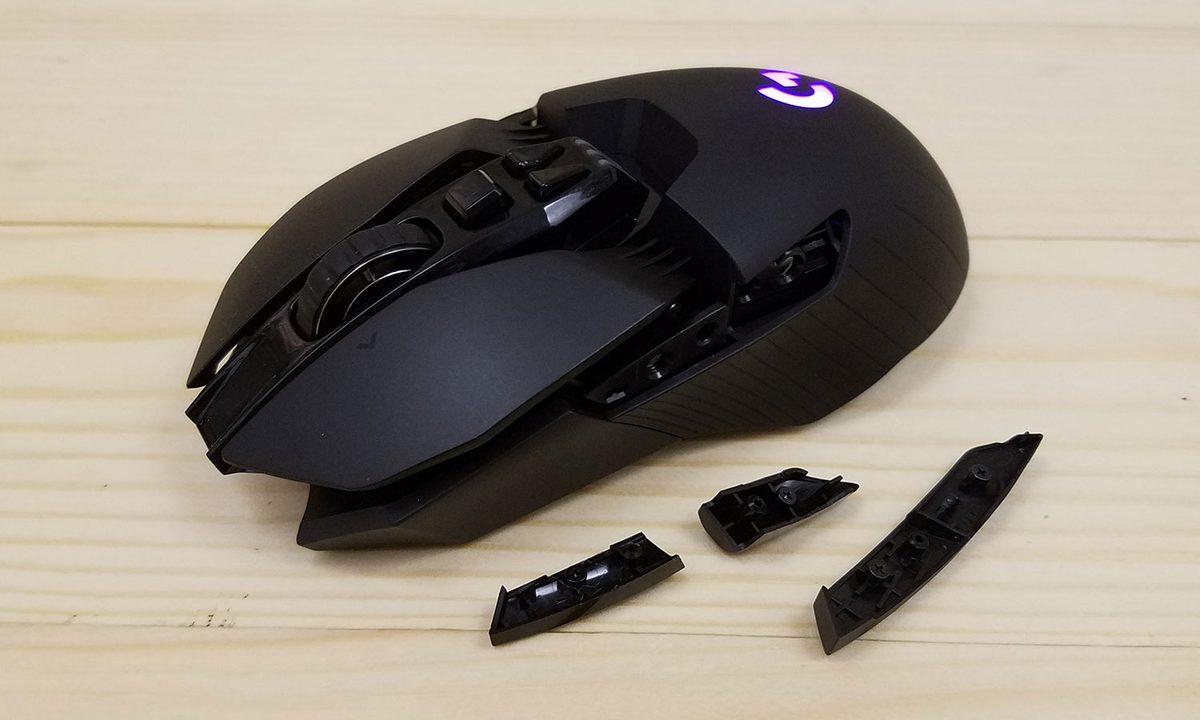
Right now, there are only two compatible units: the G903 ($150) and the G703 ($100). The G903 is the more “elite” version of the two, sporting nine programmable buttons. The G903 is ambidextrous in nature, as it comes with a second pair of removable side buttons to accommodate left-handed gamers. These two buttons are held in magnetically, and stored in a padded case with a hard shell.
This case also comes equipped with a USB dongle if you’re not using the charging pad. There’s an included weight that can be slipped into the PowerCore port’s cap if the module isn’t installed. This weight is the size of a silver dollar, and helps anchor the mouse during movement for PC gamers who like “heavy” peripherals.

The G903 also has an illuminated Logitech G logo supporting 16.8 million colors, which can be customized through Logitech’s desktop software. There are three set LED strips, too, that display the current DPI setting. This may be somewhat confusing at first, because the mouse provides five customizable settings ranging from 200 to 12,000 DPI.
Opting for the more affordable G703 requires sacrifice. It only includes five programmable buttons (outside the DPI cycling buttons), and is built only for right-handed gamers. However, there are two customizable lighting zones – the Logitech G logo, and a thin strip circling the mouse wheel’s perimeter. Its sensitivity ranges from 200 to 12,000 DPI as well, and a single DPI cycling button supports four customizable levels.
PowerPlay is expensive, but it works
Logitech is pushing innovation forward with the launch of its PowerPlay platform. It charges the mouse battery while providing wireless connectivity in the process, so the only tether is the one between the PC and Logitech’s charging pad.
Unsurprisingly, it does have a few rough edges. Logitech’s PowerPlay is essentially new territory for desktop-based wireless charging. We hope the second version will have faster recharge times, and a larger charging field.
Yet, even with the potential for improvement, PowerPlay seems worthwhile. It’s a wonderful novelty. You don’t need this – but it’s incredibly convenient and, finally, makes it possible to play PC games wirelessly without worrying about the battery’s charge.


