
Meta has announced the latest iteration of its open-source AI model family Llama 4, which the brand has developed while competition in the generative AI industry continues to intensify.
The new AI family includes four models, and Meta detailed Llama 4 Scout, Llama 4 Maverick, and Llama 4 Behemoth. Meta detailed on its AI website that the models were trained on “large amounts of unlabeled text, image, and video data.” This indicates that the models will have varied multimodal capabilities.
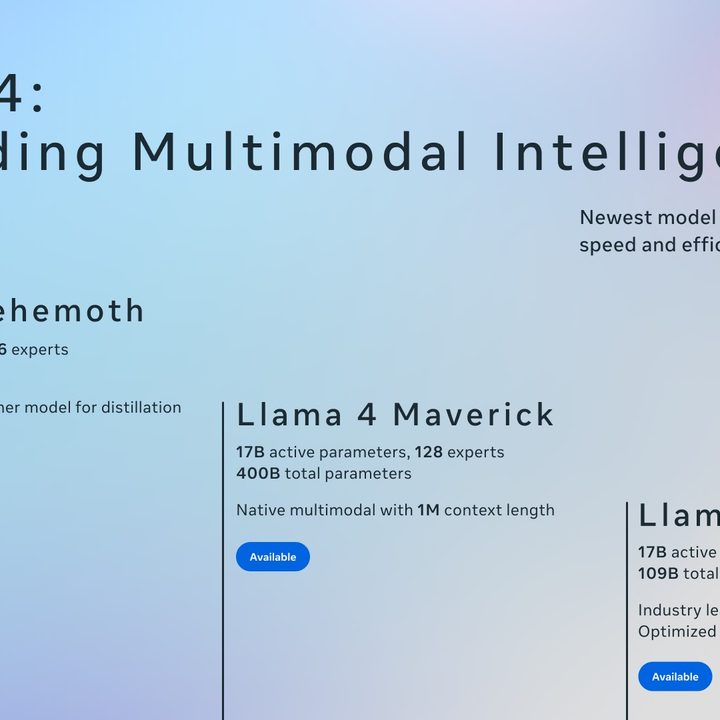
Currently, two of the models– Llama 4 Scout and Llama 4 Maverick- are available for users to access across Meta’s platforms, including WhatsApp, Messenger, and Instagram Direct, in addition to Meta’s AI website, Llama.com, as of Saturday. The developers can also access AI models at open-source repositories such as Hugging Face. The Llama 4 Behemoth model is not yet released and is still in training. The company has indicated that the industry should expect the Behemoth model to outperform comparable models, and that it will serve as a teacher for the other models in the Llama 4 family.
Amid its internal testing, Meta compared the Llama 4 models to competitor AI technologies to determine their capacity and best use cases. The company indicated that Llama 4 Maverick would work best for creative writing. Additionally, it outperformed the OpenAI GPT-4o and Google Gemini 2.0 models in functions such as coding, reasoning, multilingual, long-context, and image generation. Meanwhile, Maverick struggled to keep up with the capabilities of AI models, including Gemini 2.5 Pro, GPT-4.5, and Anthropic Claude 3.7 Sonnet.
While Meta claims that Behemoth can outperform most of these models, except for Gemini 2.5 Pro, the company hasn’t been able to reduce the hardware costs of training its most powerful model.
TechCrunch noted that the attention the Chinese AI company DeepSeek has gained from its competitive yet inexpensive models put Meta on notice. The company has reportedly been intensely studying how the rival company developed its notable models, including R1 and V3, at lower operating costs than prior Llama models.
The company detailed that the Llama 4 Scout model can run on one Nvidia H100 GPU. The Llama 4 Maverick model can run on one Nvidia H100 DGX graphics system.
Meta is set to host its first LlamaCon AI conference on April 29. The company also has a standalone Meta AI chatbot that is set to launch in the second quarter of the year, according to CNBC.
Meta isn’t the only company being ginger with the timeline of its major AI models. OpenAI recently adjusted the launch of its GPT-5 model, with the company’s CEO, Sam Altman, announcing on social media that fans should expect new o3 and o4-mini reasoning models in the coming weeks as an alternative to GPT-5. The executive detailed that GPT-5 will now launch in the coming months, which will give OpenAI additional time to get the model up to standard.