In Marvel’s Iron Man 2, the protagonist, Tony Stark, creates a new element to power the arc reactor in his chest and the mech suit he wears in superhero mode. It remains one of the coolest cinematic scenes for sci-fi fans. Microsoft has managed to achieve something of the same caliber in 2025 by creating a new state of matter.
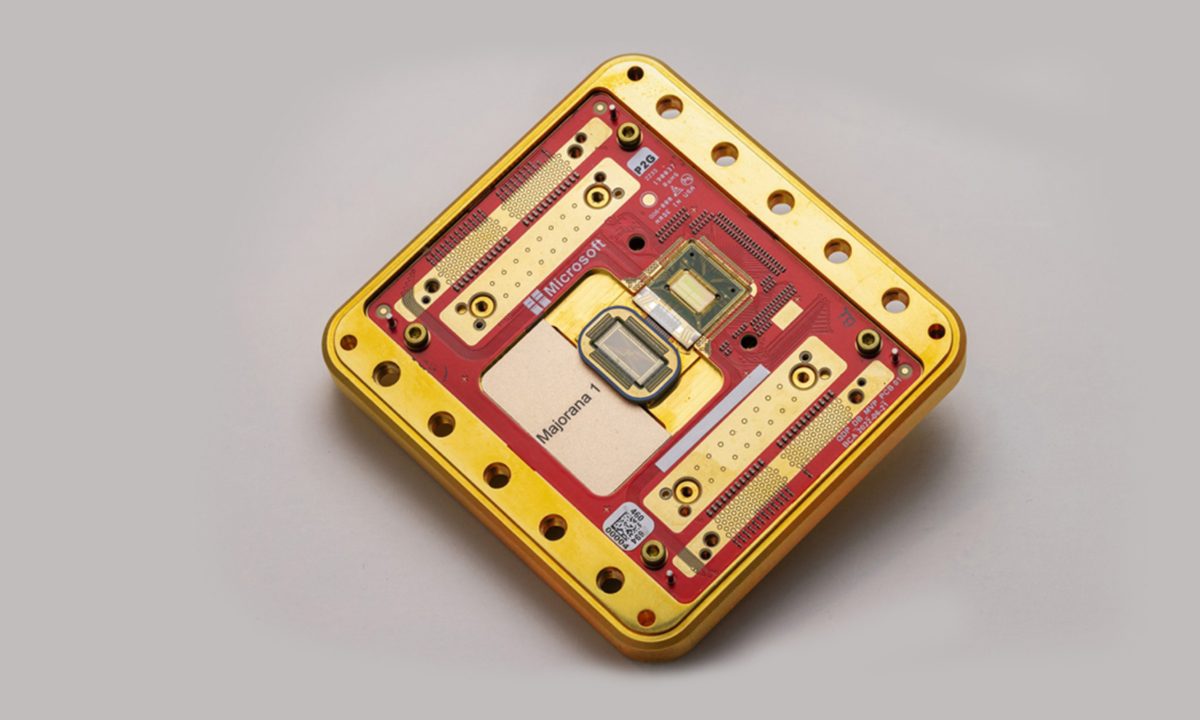
Earlier today, the tech giant introduced Majorana 1, the world’s first quantum computing chip, a breakthrough that has set the whole tech world abuzz. The company spent years building the chip, which entailed numerous breakthroughs.
But none sound as impressive as developing a new state of matter. There are three fundamental states of matter — solid, liquid, and gas — and two exotic forms that we know as plasma and the Bose-Einstein Condensates (BECs). Microsoft has created what it calls the topological state of matter.
“This breakthrough required developing an entirely new materials stack made of indium arsenide and aluminum, much of which Microsoft designed and fabricated atom by atom,” says the company.
A couple reflections on the quantum computing breakthrough we just announced…
Most of us grew up learning there are three main types of matter that matter: solid, liquid, and gas. Today, that changed.
After a nearly 20 year pursuit, we’ve created an entirely new state of… pic.twitter.com/Vp4sxMHNjc
— Satya Nadella (@satyanadella) February 19, 2025
The company technically created a new variety of particles called Majoranas, which lends its name to the quantum chip it powers. So far, this state of matter has only existed in theory, claims Microsoft.
It is a hybrid derivative of two main components: an aluminum strip acting as the superconducting unit, while the semiconducting unit is made out of a chemical called Indium Arsenide (InAs).
“When cooled to near absolute zero and tuned with magnetic fields, these devices form topological superconducting nanowires with Majorana Zero Modes (MZMs) at the wires’ ends,” adds the company.
Why quantum computing is the future?
The fundamental block of quantum computing is a qubit, which is analogous to the bits that are at the heart of classical computers. For the Majorana-powered quantum computers, the MZMs serve as foundation material for the qubits.
Now, qubits can be created in various ways. Microsoft’s iteration relies on what the company refers to as topological qubits. At the heart of Majorana 1 is a topological core that can be scaled to a million qubits on a single chip.
Thanks to the innovation, Microsoft says it is en route to developing the world’s first fault-tolerant prototype (FTP) of a stable quantum computer in years, and not decades.
Notably, the company is undertaking the mission as part of the government’s Underexplored Systems for Utility-Scale Quantum Computing (US2QC) program run by the Defense Advanced Research Projects Agency (DARPA).
“The foundational technology is proven, and we believe our architecture is scalable,” notes the company. Microsoft says the advancement of quantum computing will dramatically speed up scientific processes, such as discovery of new drugs, creation of self-healing materials, agricultural advancements, and more.
For example, Microsoft’s work on quantum computing alongside experts at Case Western Reserve University has already helped with developing cancer scans at a much faster pace, and improving the precision of identifying disease signs.
These developments offer the potential to revolutionize medical diagnostics and treatment by enabling earlier detection of diseases like cancer and more importantly, the synthesis of new medicines.
Google is not too far behind with quantum computing endeavors of its own. The head of its quantum division, Hartmut Neven, recently claimed that real-world applications of quantum computing will be here within the next five years.