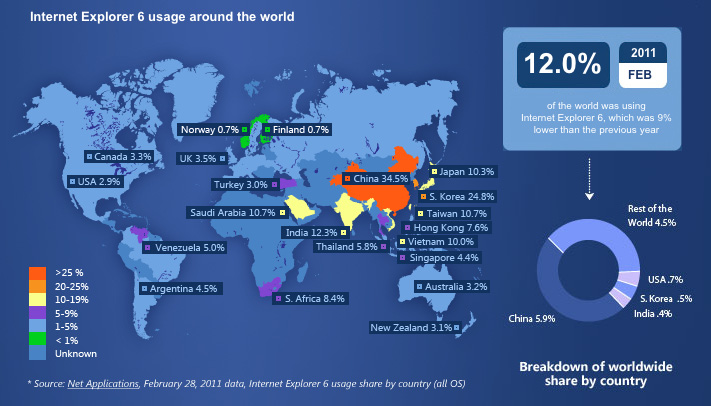
It’s been more than 10 years since Microsoft launched Internet Explorer 6, and arguably it’s been one of the most successful Web browsers on the planet. Too successful perhaps, since a decade later it still accounts for about 12 percent of all Web traffic on the planet, according to Net Applications. Since IE6 represents decade-old technology—riddled with security issues, performance problems, and a raft of incompatibilities that have made it the bane of Web designers everywhere—Microsoft has a clear message for users: it’s time to move on. To that end, Microsoft has launched a new site that hopes to monitor the number of Internet users on IE6…and get that number below one percent.
Internet Explorer 6 continues to have adherents in many corporate, educational, and government institutions, sometimes because budgets don’t enable hardware to be upgraded to systems that can support current browsers, and sometimes because critical software has not been updated to support more-modern browsers. Nonetheless, Microsoft is recommending everyone from consumers to corporate users upgrade to a more-modern browser, in part because the Web has come a long way in the last decade—many major sites and services have outright stopped support IE6—but also for privacy, security, and reliability improvements. Microsoft is encouraging third party sites to display countdown banners to educate users about upgrading from IE6, and for individual users to use social media lie Facebook and Twitter to tell people to get off IE6.
Microsoft’s program to reduce Internet Explorer usage is relatively unprecedented in the technology industry—it’s rare for a company to launch a marketing campaign around the idea that users should stop using one of their products. Of course, Microsoft is very keen that users upgrade to Internet Explorer 8 (or Internet Explorer 9, due soon), and doesn’t mention browser competitors like Firefox, Chrome, Safari, or Opera.
However, it’s not clear how effective Microsoft’s campaign might be, particularly since it seems to be English-only at the moment. China is the world’s largest market of Internet users, and according to Net Applications figures touted by Microsoft, over a third of those users are running IE6—in all, China accounts for nearly half of all IE6 users in the world. Other countries with substantial IE6 user bases include South Korea, India—and, yes, the United States.