
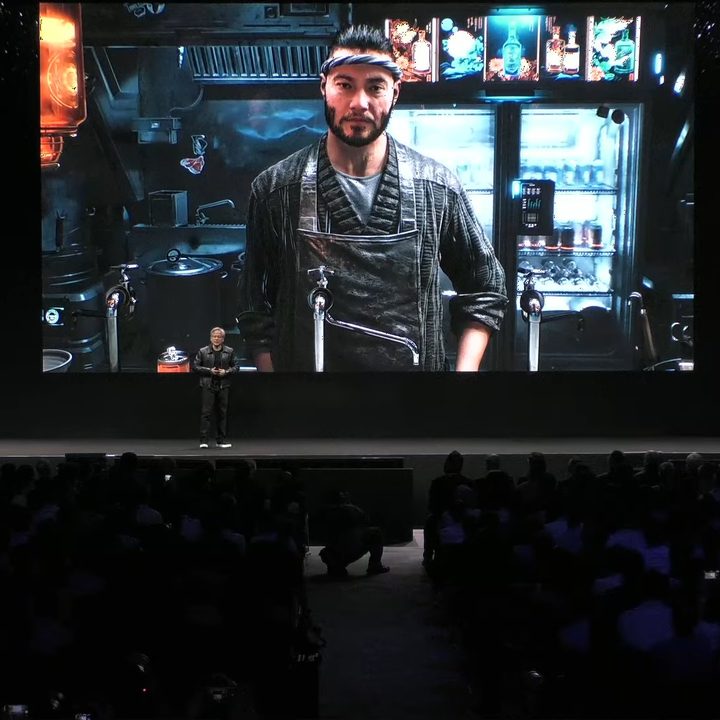
Nvidia ACE, the tool that’s meant to transform games with generative AI, is evolving, and Nvidia has just revealed an interesting update to it. It turns out that developers won’t just be able to utilize ACE to create fully-interactive characters, complete with dialogue and facial expressions, but they’ll also be able to use Nvidia’s new NeMo SteerLM technology to adapt these characters’ personalities.
Nvidia initially announced its ACE tool earlier this year, keeping the details pretty scarce. ACE is something like ChatGPT for games, meant to make it easier for game developers to create characters with fully-developed backstories, adding more depth to the way they interact with players.
Using this tech, players can use voice inputs to interact with in-game non-player characters (NPCs). Riva speech-to-text then translates their voice into a text input and feeds it to the AI. It’s fed into a large language model (LLM), which generates a response, and Nvidia uses a few more AI tools to convert the response back to speech and animate the character.
Between player interaction and NPC response, there’s a pretty elaborate path, and Nvidia has just added an extra layer of complexity by including the new NeMo SteerLM.
Nvidia presents NeMo SteerLM as a few toggles that should make it simpler for a character’s behavior to be adjusted. The three options we’ve seen so far are “Creativity,” “Humor,” and “Toxicity.” While most gamers — or at least those who play online — are used to toxic behaviors by now, it’s interesting to see it as an option for what is essentially an AI chatbot with extra steps.

Before the addition of NeMo SteerLM, the AI would prepare a custom response to answer the player’s query. It would then go back through Riva for text-to-speech, and lastly, Nvidia Omniverse for facial expressions to match the speech. Now, however, before the AI generates a response, NeMo SteerLM will intervene with some attributes to determine how helpful, funny, or quirky the NPC is going to be in its interactions.
Amping up these three traits could bring hilarious results, but equally, it’s easy to imagine the AI going completely off the rails, much like that time when Bing Chat told us that it wanted to be human.
To combat possible AI insanity, Nvidia has launched the NeMo Guardrails tool for developers to be able to block such crazy behaviors as well as prevent players from trying to achieve unwanted outcomes. Now, the path between the player and the AI has expanded to include yet another tool. I’m looking forward to seeing this feature implemented in games. Something tells me that despite every best effort on Nvidia’s part, the early days of ACE in games will not be as harmonious as one might hope.


