
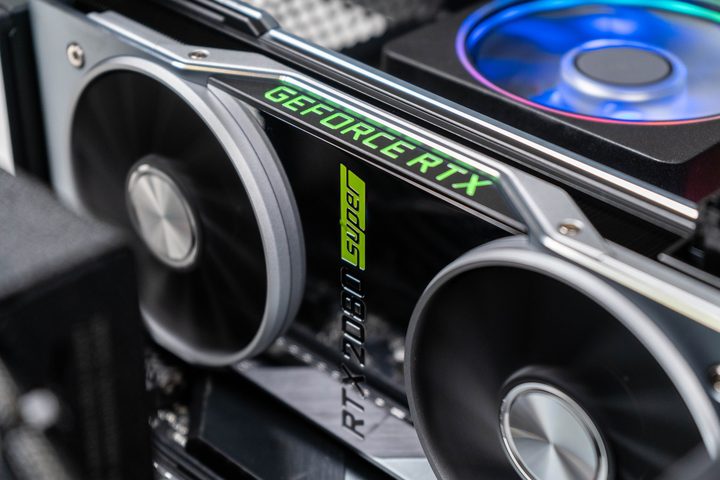
Nvidia has been showing off some new technological innovations at this year’s Gamescom show, most of which require one of its RTX graphics cards to experience at their full potential. One that doesn’t is the new, ultra-low latency option that’s now included with its latest Game Ready Driver (436.02), which debuted during the show. It, like AMD’s anti-lag, helps reduce latency between user inputs and their action in games. According to Nvidia’s own benchmarks, its solution is better.
After two graphics card generations from both Nvidia and AMD that haven’t pushed the performance envelope significantly, features are a greater selling point than they’ve been in the past. For Nvidia, the two biggest benefits of its RTX generation have been RT and Tensor core-powered ray tracing and deep learning super sampling. For AMD, it’s been image sharpening and input lag reduction. While Nvidia previously claimed it had its own anti-lag system for years, it’s now released a new, improved version that’s more in line with what AMD offers. Only better, according to its own benchmarks.
Although the time saved is in terms of milliseconds, high-speed gamers should notice a slight improvement from when no anti-lag features enabled. Nvidia claims, via TechRadar, that it can reduce input lag in Apex Legends from 30ms down to just 19ms. The Division 2’s input lag could be reduced from 49ms down to just 22ms with ultra-low-latency enabled.
AMD has made similarly impressive claims about its anti-lag feature’s capabilities, suggesting that input lag could be cut in half. While that would likely compete favorably with Nvidia’s low-latency, according to Nvidia’s testing and results, Nvidia is the clear winner. First-party benchmarks need to always be taken with a healthy dose of skepticism, but this is still good news for consumers. AMD’s anti-lag feature was enough of a concern for Nvidia that it aped it and created a feature for Nvidia gamers that is as good, if not better in some cases, which just means more gamers end up with lower input lag in their games. That’s a good thing.
AMD introduced image sharpening in a recent release and now Nvidia has done so as well. Also introduced with the new driver release, is its new Freestyle Sharpening feature that will purportedly work better than its previous “detail” filter, providing better-quality images while not exacting as much of a performance hit.
Elsewhere in this driver release, Nvidia also introduced a more expansive list of G-Sync-compatible monitors and beta support for its GPU integer scaling, which should make older games and those with a pixel art style look far better on higher-resolution monitors where they can otherwise look a little blurry.
You can download Nvidia’s latest drivers from the official website.
Interested in reducing your input lag even further? A high refresh rate monitor can help.


