
Nvidia Deep Learning Super Sampling (DLSS) has been the upscaling tech for over two years, but a new challenger is approaching. Ghostwire Tokyo showcases a relatively new technique in Unreal Engine 5 called Temporal Super Resolution (TSR) that looks and performs nearly as well as DLSS does, and it has a big advantage: It works with any graphics card.
DLSS has enjoyed the limelight as a proprietary supersampling technique that delivers much better image quality than competitors like AMD FidelityFX Super Resolution (FSR). Companies like AMD haven’t been idle, though, and general-purpose upscaling solutions like FSR 2.0 and TSR will make DLSS obsolete.
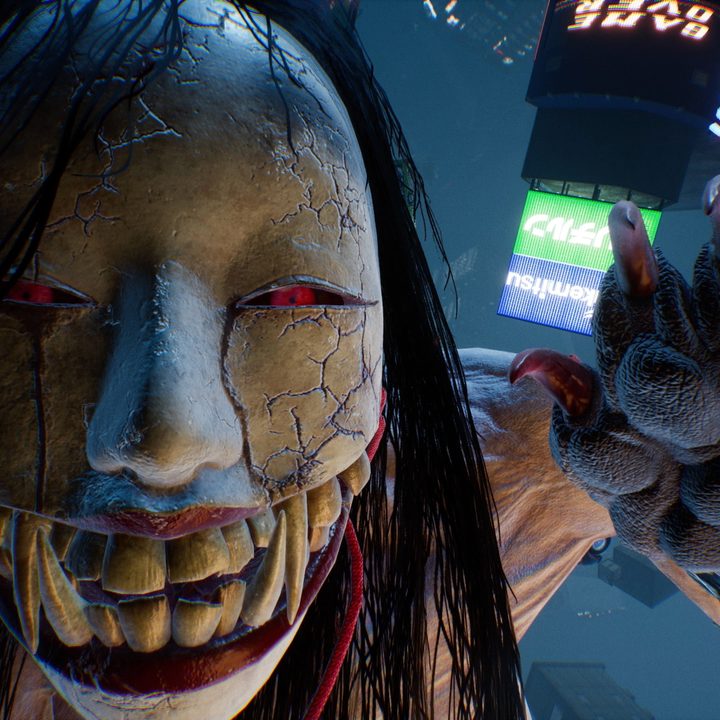
TSR is a feature of Unreal Engine 5, but developer Tango Gameworks was able to get it working in the UE4-based Ghostwire Tokyo. Unlike DLSS, it doesn’t require dedicated A.I. accelerators to work. Instead, it feeds temporal (timed-based) data into a supersampling algorithm to upscale the image.
Although TSR is an emerging feature, it’s already being put to use in other places. AMD’s upcoming FSR 2.0 overhaul is a prime example, utilizing temporal inputs that feed a supersampling algorithm. Ghostwire Tokyo provides a glimpse at the future of PC graphics: One where every game has high-quality upscaling that works across GPUs.
The image below shows TSR, FSR 1.0, and DLSS next to each other, in that order. DLSS and TSR look identical. Even massively zoomed in, I can’t find any significant differences. Compare that to FSR 1.0, which has black spots in the blue Tottoko Cine sign, as well as a dirty edge around the green sign below it.

In a scene with sharp detail, the same holds true. TSR and DLSS look the same, and FSR 1.0 has problems. Notice the TV hanging up on the left, which is much blurrier with FSR 1.0, as well as the dimmer lights going down the hallway. With FSR 1.0, these lights flickered as the upscaling algorithm struggled to keep up. With TSR and DLSS, they were stable.

The main draw of DLSS has been its excellent image quality, which Nvidia has attributed to the dedicated Tensor cores in RTX 30-series and 20-series graphics cards. Ghostwire Tokyo shows that dedicated hardware isn’t doing much. TSR looks just as good, and if FSR 2.0 is indeed similar, it should, too.
We can’t ignore performance, though. At 4K with ray tracing turned on and all of the sliders maxed out (minus motion blur), I was averaging 40 frames per second (fps). TSR was able to more than double my frame rate, boosting it to 84 fps.
It’s a massive improvement, though not quite as large as the ones offered by FSR 1.0 and DLSS. FSR 1.0 shook out with an average 90 fps, while DLSS sat on top with a 100 fps average. While 16% better performance for DLSS is significant, when TSR can already double your frame rate, it doesn’t seem as important.
We might be seeing a repeat of Nvidia G-Sync here. DLSS has been a walled garden since it launched, and TSR shows that restrictive approach may not have been necessary. As other companies push their collective knowledge to build better products for gamers, we’re getting similar image quality and performance without the need to shell out for a GPU with a certain brand on it.
FSR 2.0 and TSR are enough to kill DLSS on their own, and with Intel’s upcoming XeSS technology in the mix, the future doesn’t look bright for Nvidia’s upscaling tech. Consider game developers, too. If a solution like TSR can offer similar performance and image quality as DLSS, and it works across GPUs and consoles, that just makes more sense.
The future may not be bright for DLSS, but it is for PC gamers. If Ghostwire Tokyo is a sign of what’s to come, PC gamers are in for more upscaling options that work with more hardware while still providing near-native image quality.


