
Nvidia does, of course, sell graphics cards. In fact, it sells most of the best graphics cards on the market. But more than ever before, the company is increasingly hanging its hat on its impressive Deep Learning Super Sampling (DLSS) to sell GPUs rather than raw performance.
The RTX 4090 stands as a crowning achievement in the world of consumer graphics cards, but once you get down into the cards that most gamers will actually buy, the generational improvements start to slip. This became abundantly clear with the launch of the RTX 4070. The card has been well-received, and I even awarded it a rare Editor’s Choice award in my RTX 4070 review. But that’s despite its generational improvements, not because of them.

Read the room
DLSS has been a key feature of Nvidia’s graphics cards for the last three years, and there’s little argument about that. At the time it came out, it was a novel idea that could be cool, but it has proven itself as a feature that’s even more essential than ray tracing over the last couple of generations.
It’s so essential that Intel saw fit to release its first generation of gaming graphics cards with the competing XeSS feature. And AMD’s FidelityFX Super Resolution (FSR) has made a lot of headway into delivering performance-boosting super resolution in a brand-agnostic package.
But then Nvidia did something crazy. It introduced DLSS Frame Generation with the launch of the RTX 4090, and with it, seven out of every eight pixels are generated with AI. If Nvidia’s CEO Jensen Huang is to be believed, in the future, every pixel in games will be generated with AI instead of rendered. That’s certainly not hard to imagine at this point.
It’s not an exaggeration to say that DLSS 3 makes some games possible that aren’t otherwise. Cyberpunk 2077‘s long-awaited path tracing mode is only possible with DLSS 3 at high resolutions, and that’s with the obscene power of the RTX 4090 on tap. Even a seemingly quaint game like Portal RTX can only run at higher resolutions with DLSS 3.
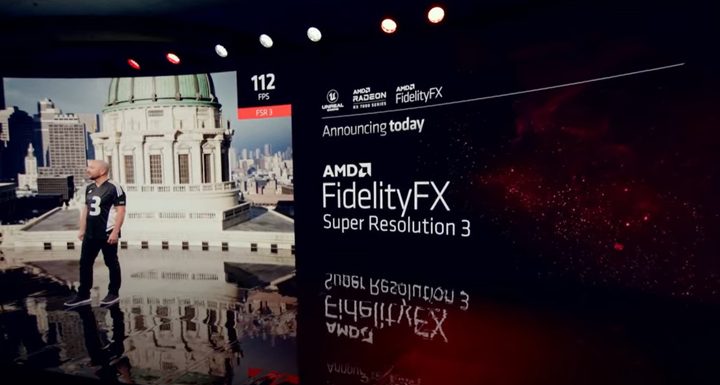
I can already hear it — so what? The list of games with DLSS 3 is still very small, and it’s a feature that only a select few early adopters even have access to. There’s clearly a rising tide here, though. DLSS 3 posed such a milestone that AMD rapidly announced it was working on a similar feature last November. Nearly six months later and after the release of the RX 7900 XTX and RX 7900 XT, we still don’t know anything about how AMD’s take works, much less when it’s coming.
The adoption of DLSS on Nvidia’s end has been stark, too. The company claims that 68% of RTX 20-series, 71% of RTX 30-series, and 79% of RTX 40-series gamers turn DLSS on. It’s interesting to compare these numbers to ray tracing adoption, which has scaled with the power of ray tracing hardware on tap; Nvidia says 42% of RTX 20-series, 56% of RTX 30-series, and 83% of RTX 40-series gamers turn on ray tracing in supported games.
But what about support?

The roadblock for DLSS has been, and will always be, that it isn’t supported in every game. It doesn’t need to be in every game, though. As long as Nvidia (and AMD with FSR, for that matter) can capture enough high-profile, recent releases, most ground is covered.
Looking at the most popular games on Steam, many of them don’t need the tremendous GPU power available to gamers today. The most demanding game in the top 15, Call of Duty Modern Warfare 2, only calls for a GTX 1060 or RX 580 in its recommended specs, and it supports DLSS and FSR. There are a few exceptions like Lost Ark — which calls for a RTX 2080 or RX 6800 if you want to play the game maxed out at 4K — but the vast majority of popular games don’t require a GPU from the most recent generation. Most don’t even require a GPU from the last three generations.
You don’t buy a new GPU to play Counter-Strike: Global Offensive or Destiny 2, though. You buy one so you have the extra power on hand for a big release like Resident Evil 4 or Hogwarts Legacy. And these big AAA releases generally support either DLSS or FSR, and usually both. There are always exceptions, but we’re living in a much different era of PC gaming in 2023.
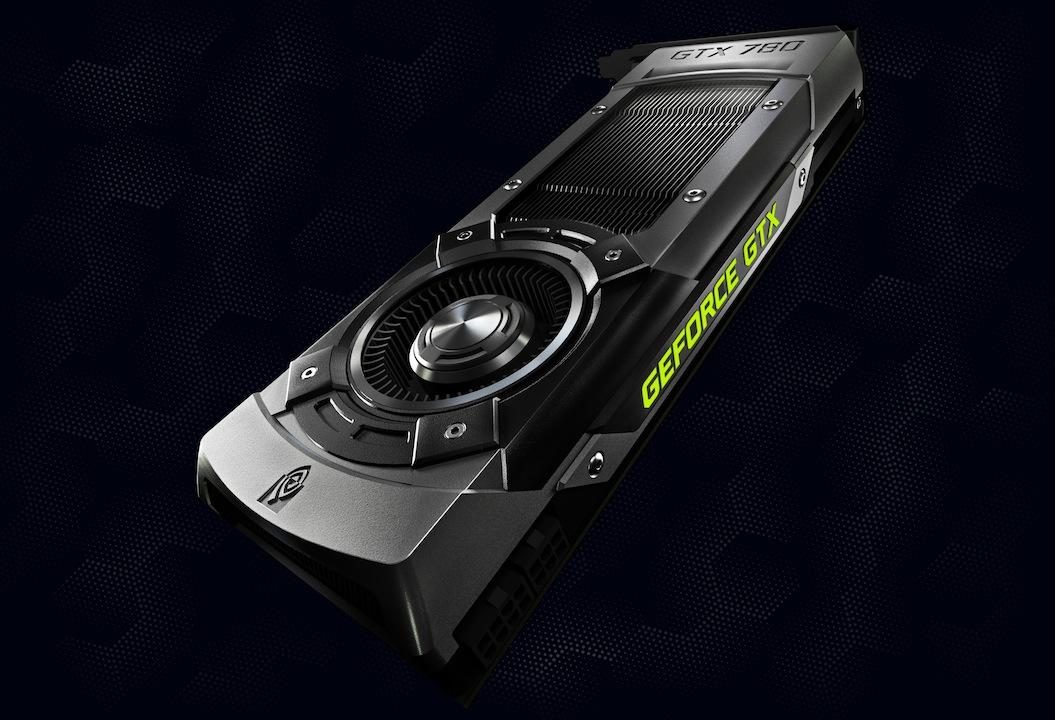
Contrast that with a year like 2013. The GTX 780 Ti, Nvidia’s flagship non-Titan card of that year, could barely maintain 30 frames per second (fps) in Metro Last Light (a game that released just months earlier) at 4K. Similarly, the card was only able to scratch 60 fps in Bioshock Infinite if you were running a dual GPU configuration at 4K. Make no mistake; if those games were released in 2023, they would support DLSS.
Years ago, there was a need for these flagship cards because games were too demanding to run at higher resolutions and settings. DLSS changes that dynamic entirely, so much so that Nvidia has had to justify the immense power of the RTX 4090 with tech demos like Portal RTX and Cyberpunk 2077‘s path tracing mode. Instead of spending more to play a more demanding game, in 2023, it’s just a matter of how intense you’re willing to let DLSS or FSR be.
Breaking product lineups
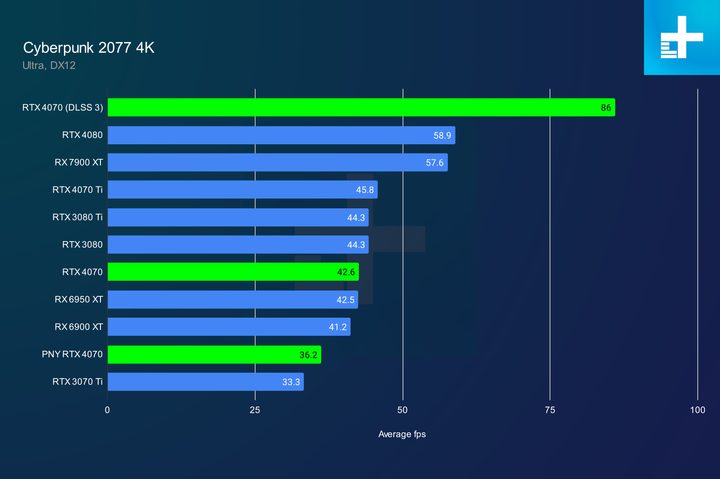
Look at the graph above. That’s the $600 RTX 4070 outpacing the $1,200 RTX 4080 in Cyberpunk 2077, and if I extended the graph out, it also beats the RX 7900 XTX and RTX 4090. Sure, it’s with DLSS 3 turned on (set to Auto, not the ugly Ultra Performance mode, mind you), and the more expensive models push to even higher frame rates with the features on. But when a $600 GPU is capable of outperforming a $1,600 one with a minor loss in image quality, it’s important to pay attention.
There has always been a desire for higher performance and better graphics settings, but unlike previous times in PC gaming where your graphics card was the difference between playable and unplayable, DLSS is often that difference today.
It’s important to compare “raw” performance numbers to get an idea about where a GPU falls relative to the competition, but DLSS 3 throws that balance off when it comes time for you to actually play a game. Sure, the RTX 4070 only gets 18 fps in Cyberpunk 2077‘s Ultra RT mode at 4K. But you will never play the game that way. You’ll turn on DLSS 3 and get well over 60 fps.

I’m not vouching for Nvidia’s misleading marketing where it compares DLSS frame rates to native frame rates, but we can’t ignore the point that the company is trying to make. It’s important to start bringing DLSS into the conversation because that’s how most people will play the most demanding games, especially when it’s turned on by default.
DLSS 3 isn’t going anywhere, and it’s now responsible for seven-eighths of of the image you see in games like Cyberpunk 2077. Eventually, it could be responsible for all the images you see.
DLSS 3 isn’t perfect — I’ve covered its issues with image quality a handful of times. But it’s still very good. As graphics cards like the RTX 4070 continue to challenge the status quo, the raw power on tap is becoming less important than what a card is capable of with DLSS. Whether that’s good or bad is up to you.
For me, I can’t argue with higher frame rates — regardless of how they’re being generated.


