  1. Home
  2. Computing
  3. News

Ray-Ban Meta glasses get camera, audio fixes in v2 update

Add as a preferred source on Google
The Ray-Ban Meta Wayfarer smart sunglasses.
Phil Nickinson / Digital Trends

The Ray-Ban Meta smart glasses are just a few months into their life at this point but have just graduated to Version 2.0 software. The update brings improvements to the camera imagery, as well as the volume controls.

Still missing, however, is any sign of the AI-powered image recognition, which will let the glasses tell you what you’re looking at, or potentially translate signs and whatnot. And a good many of us still don’t even see the option to get in on the beta testing. So stay tuned for that.
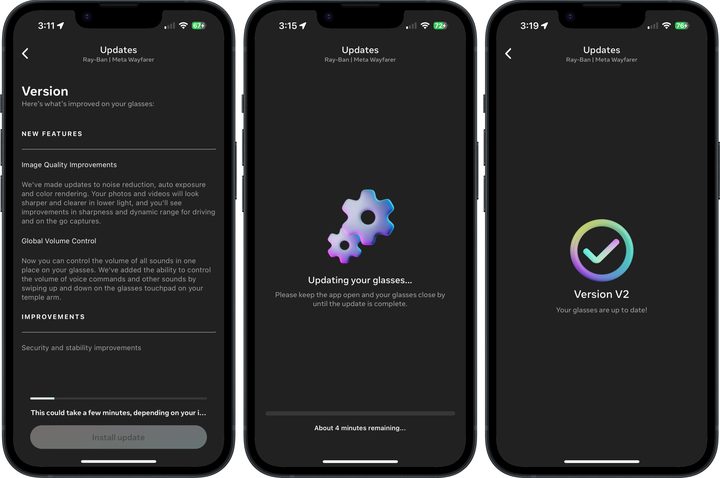
The Ray-Ban Meta glasses V2 changelog as seen in screenshots.
Screenshots

The official changelog reads thusly:

  • Image quality improvements: We’ve made updates to noise reduction, auto exposure, and color rendering. Your photos and videos will look sharper and clearer in lower light, and you’ll see improvements in sharpness and dynamic range for driving and on-the-g0 captures.
  • Global volume control: Now you can control the volume of all sounds in one place on your glasses. We’ve added the ability to control the volume of voice commands and other sounds by swiping up and down on the glasses’ touchpad on your temple arm.
  • Improvements: Security and stability improvements.
Recommended Videos

The update takes a few minutes to install, so make sure things are charged up and you’re not in a hurry. And we’d recommend power-cycling the glasses via the power switch on the left stem once the bits and bytes have done their thing. We were having issues actually taking video and stills until we did that, but your mileage may vary.

As for whether the camera is greatly improved? That’ll take a little more testing.

The Ray-Ban Meta sunglasses start at about $300 and go up from there, depending on the style and lenses.

Phil Nickinson
Former Section Editor, Audio/Video
Phil spent the 2000s making newspapers with the Pensacola (Fla.) News Journal, the 2010s with Android Central and then the…
Claude’s Sonnet 5 is built to do more on its own and cost you less
Better than its predecessor, nearly as good as the flagship, and meaningfully cheaper than both.
Art, Floral Design, Graphics

Every major AI lab is racing to prove its models can work autonomously with minimal hand-holding; we’re now seeing pricing emerge as the next battleground. 

Anthropic just fired its latest shot, Claude Sonnet 5, a model the company says performs nearly as well as its flagship Opus 4.8 at a fraction of the cost.

Read more
Apple Creator Studio adds AI tools across Final Cut Pro, Logic Pro and Pixelmator Pro
Final Cut Pro gets AI captions, Auto Mask and better Pixelmator Pro workflows in Creator Studio update
Computer Hardware, Electronics, Hardware

Apple has introduced a major update to Apple Creator Studio, adding new AI features, deeper Pixelmator Pro integration, and workflow upgrades across Final Cut Pro, Logic Pro, Keynote, Pages, Numbers, Motion, Compressor, Freeform, and Final Cut Camera.

The update makes Creator Studio more useful across Mac, iPad, and iPhone, especially for people who move between video editing, image editing, presentations, documents, spreadsheets, and music production.

Read more
AI browsers like Perplexity Comet can be tricked into spilling your password through BioShocking exploit
Six AI browsers were found leaking saved passwords and many of them haven't fixed it yet.
MacBook Air in hand, Comet browser loaded—let’s see what Perplexity’s AI can really do

Security researchers just found a strange way to trick AI browsers into handing over your passwords. They managed to trick AI browser agents into exposing sensitive data like saved passwords, session cookies, and private tokens by disguising the theft as part of a harmless "game."

The technique is called BioShocking, named after the popular video game BioShock, where a brainwashed character is manipulated into believing a false reality. Once an AI browser falls for the same trick, it stops following its own safety rules entirely.

Read more