
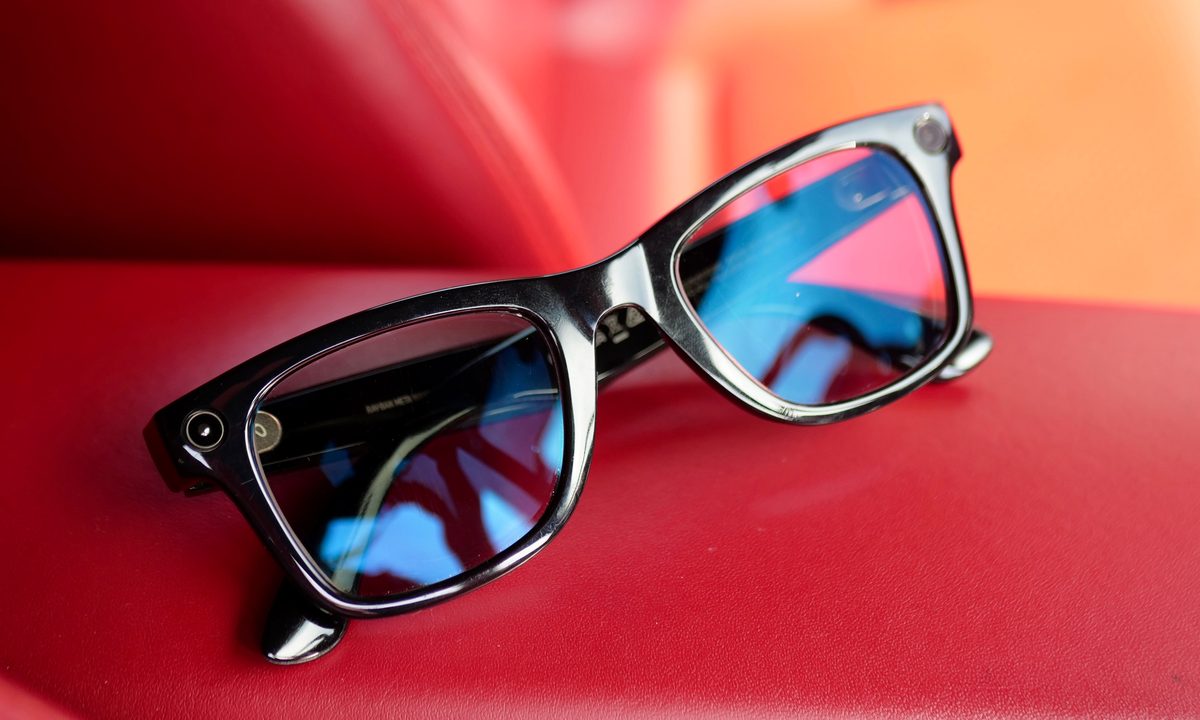

“The Ray-Ban Meta smartglasses are lightweight, good-looking, and highly customizable. The camera is fun, audio sounds great, and the AI features have steadily improved over time.”
- Lightweight and stylish glasses
- Hands-free photo and video capture
- Good 12MP photos
- HD+ videos
- Live-streaming capability
- Good speaker quality
- Impressive five-mic array
- Lots of AI features
- Basic notification support
- Transition lenses have limitations
“Why you can trust Digital Trends – We have a 20-year history of testing, reviewing, and rating products, services and apps to help you make a sound buying decision. Find out more about how we test and score products.“
The Ray-Ban Meta smartglasses have the visual appeal of a pair of classic Wayfarer sunglasses with a lot of tech we usually expect to find in a smartphone, including the latest AI features, hidden inside. But is this wearable tech for everyone, or do you need to be really committed to wear them day in, day out? We’ve found out by using the Ray-Ban Meta smartglasses since they launched in October 2023.
About our Ray-Ban Meta review
Our Ray-Ban Meta review was originally published in October 2023 and written by Alan Truly. Andy Boxall updated the review in May 2025, after using the Ray-Ban Meta smartglasses with prescription lenses since March 2024. You can read his overview of life with the smartglasses below. The remainder of the review has been updated and revised throughout.
Wearing Ray-Ban Meta in 2025

I’ve worn and used Ray-Ban Meta smartglasses for more than a year, and while my initial experiment where I wanted them to replace my usual glasses didn’t quite work out, I still think they’re a fantastic product. When they arrived at the beginning of 2024 I wanted to wear them all day, every day, and therefore purchased the Transition lenses with my prescription for them, so what stopped me wearing them all the time? I’ll come back to that, as I want to talk about the many positives first.
The Ray-Ban Meta smartglasses have received plenty of feature updates since launch, keeping them fresh and interesting, ranging from image recognition for visual search to live translation. The camera is so much fun, and has the quality to match, making it a great alternative to a fairly simple camera on a smartphone. The first-person view for video is unique and creatively exciting. The battery lasts for a day, and there’s plenty of power reserve in the glasses case too.

I love the audio feature. I often use it to listen to podcasts when doing some mundane task that doesn’t warrant getting my headphones for, and also for tasks where I’d like to hear what’s going on around me. The touch panel in the Ray-Ban Meta’s arm is responsive and accurate, so adjusting the volume or controlling playback is fast and never frustrating. Voice control is similarly accurate, but I still feel self-conscious using it in public. I’d love more notification support though.
Why haven’t I worn them all the time? They’re light and comfortable enough for all-day wear when you’re out doing things, but I don’t find them enjoyable to wear when I’m just relaxing. The classic Wayfarer frames suit most faces, but it’s a really bold look when the lenses are clear, and I find seeing the frame around my eyes a little distracting. The Transition lenses work well apart from in a car, where windshield treatments prevent ultraviolet light (UV) from causing the lens to darken as much as I’d like.

The Ray-Ban Meta haven’t become my everyday pair of glasses, but they are my second pair and until recently, my only pair of sunglasses. They still feel futuristic, and people I demonstrate them to are still surprised by the functionality, and quickly see how they’d use them personally. They’re versatile, fun, highly wearable, consistently improving, and if you don’t need prescription lenses, surprisingly affordable too. They’re the best everyday smartglasses I’ve tried, and have yet to be beaten even after being available for more than a year. Digital Trends’ writer Prakar Khanna is just as much of a fan, and gets plenty from the AI features too.
Ray-Ban Meta: design and wearability

You no doubt recognize the design of the Ray-Ban Meta smartglasses, as they’re based on the classic Wayfarer shape. It’s a great choice as it suits most faces. Meta also makes two other designs — Skyler and Headliner — but they don’t stray far from the standard Wayfarer look. Different finishes for the frames are also available, along with lens colors too, plus the option to add your own prescription and select the Transitions lens type, which adapts to lighting conditions. The Ray-Ban Meta do not have a screen of any type.
I’ve tested several types of smart glasses, but these are the first that are comfortable enough to wear all day. They feature an integrated camera and mics to capture first-person perspective photos and videos. For smart glasses, the Ray-Ban Meta are lightweight at just 48 grams (1.7 oz), even with Transitions lenses with a prescription. For reference, non-smart prescription glasses can weigh around 30 grams. The smartglasses have an IPX4 water -resistance rating so you can wear them comfortably all day without worrying about light rain or splashes. I popped out into a mild autumn rain with no worries.

The Ray-Ban Meta do take a little getting used to, even if you normally wear glasses, but they’re almost never uncomfortable. You may find they slip down your nose in hot weather though. The Transitions lenses are excellent, quickly changing from clear to dark in sunlight, and back again when you are inside. However, they don’t work that well inside a car, which is to do with the treatments used on car windshields, which block much of the UV required by the Transitions lenses to operate. While they do take on a slight tint in a car, they never fully darken.
You get a stylish, solid case with the Ray-Ban Meta, which incorporates a battery just like with a pair of true wireless earbuds, and it’s made from fake leather with a soft interior. The smartglasses magnetically clip inside the case are never in danger of falling out or disconnecting from the charging pins.
Ray-Ban Meta: using the camera

Obviously, a significant appeal of these frames is in the design, but the big upgrade over the original Ray-Ban Stories smart glasses is what you experience with them on your face: the cameras. I assumed the novelty would wear off in a hurry, and I doubted the quality would be sufficient to satisfy my preference for high-resolution photos and video with good dynamic range. However, I was pleasantly surprised to find that Meta’s computational photography is good enough to deliver nice pictures despite the small size of the camera in the upper-left corner of the glasses frame.
The first-generation Ray-Ban Stories had two 5MP cameras in each corner of the glasses, allowing stereo 3D capture, but with a lower resolution than modern phones. That meant a trade-off in quality when using the smart glasses’ cameras. The latest Ray-Ban Meta Smart Glasses have a 12MP camera and even add some AI magic to improve contrast and color. Most outdoor photos look great with no adjustments.


Meta’s algorithm is very good, but it made a few exposure mistakes in challenging lighting conditions. I wore a dark jacket against a bright waterfront. My face showed too much contrast in one photo and not enough in the next. But overall, the picture quality is very good. If you happen upon a glitch, you can report it to Meta from the companion app to help identify problems to fix in software updates. There are a few things you need to know about wearing a camera on your face, from how your hair or headwear can make a sudden appearance in photos to rethinking composition without using a viewfinder, but it’s a lot of fun experimenting.
The 12MP images are presented in portrait orientation, making them ideal for Instagram Stories and other platforms where vertical images are standard. However, they do have enough resolution to allow cropping without losing detail. Below is a 3:2 crop of a Meta Smart Glasses photo that normally has a 3:4 aspect ratio.

Hands-free photos are possible with Meta’s voice assistant. If it isn’t convenient to say, “Hey Meta, take a photo,” you can press the button at the top of the right earpiece. To capture a video, you hold the button until you hear a chime or say, “Hey Meta, record a video.” An LED lights up in the top-right corner of the frames to alert subjects you’re recording. The hands-free option is convenient, but the button activates the camera faster.
Video quality is good, though not as sharp as the 4K resolution that most modern phones boast. Stabilization smooths out walking and even running vibration nicely. Video resolution is 1552 x 2064 pixels, which is about 1.5 times 1080p, and are shot in the same 3:4 aspect ratio as the photos, and is taller than it is wide. Ray-Ban Meta Smart Glasses also support live streaming to Meta’s social media networks.
The live-streaming feature is a unique and valuable addition for Instagram and Facebook influencers. You’ll see a glasses icon in the live stream preview on your phone and hear a reminder that you can switch to the glasses. Double-press the shutter button on the Ray-Ban frames to record with the Ray-Ban Meta Smart Glasses or select the X below the glasses icon on your phone to switch back to your handheld.
The first-person view when shooting video is unique and creatively exciting. It gives the viewer a true sense of “being there” and allows you to capture events and situations in a new, and more intimate and natural way, than with the camera on your phone. It’s a bit like a GoPro without the extra gear needed to mount an action camera on your head or chest. There’s no barrel distortion in the photos and videos from the Meta Smart Glasses.
It’s also possible to start on the phone and switch to smart glasses with a double tap of the photo button. If you hand your phone or smart glasses to someone else, you’ve got a two-camera shoot with live switching capability. With the phone’s rear camera, you have three cameras to choose from. The camera is one of the top reasons to buy Ray-Ban Meta, and also one of the main reasons you’ll keep coming back to them.
Ray-Ban Meta: audio

Listening to audio on Ray-Ban Meta is perhaps just as transformative as taking photos with the cameras. Meta has refined the small speakers in the earpieces and claims they are 50% louder than the previous generation and supply twice as much bass. They provide good volume with surprisingly little sound leakage. When standing right beside me, my wife said she could barely hear any sound while I was playing music at a normal level. If I raise the volume to maximum, music is quiet, but audible to anyone nearby. Overall, the speaker design keeps audio as private as some earbuds.
As nice as the speakers are, the microphones impressed me even more. Meta’s improved five-mic array captures spatial audio and the quality is exceptionally good. I placed calls with the Ray-Ban Meta Smart Glasses, and my voice came through clearly. My wife called me from the smart glasses, and I could easily hear her voice also, so it’s not a coincidence related to my voice.
Audio is streamed from your phone and controlled either on the device, or using the touch panels in the right-side arm on the smartglasses. You tap to play and pause, and swipe to change the volume, making the controls easy to learn and use on the move. Like other open-ear earbuds, you’re in touch with the world around you listening on the Ray-Ban Meta, and the option to just listen to music or a podcast without having to grab and wear earbuds is freeing and convenient. Unfortunately, the Ray-Ban Meta’s notification support isn’t very good, with only phone calls and Meta-owned apps like Instagram and WhatsApp getting a verbal announcement. It’s a shame notifications aren’t mirrored from your phone like they are with most smartwatches, and it stops the smartglasses becoming a true alternative to one.
Ray-Ban Meta: using AI and the Meta AI app

Meta AI is built into the Ray-Ban Smart Glasses, so you have access to a personal chatbot on your face. The functionality has increased greatly since the Ray-Ban Meta first arrived, with visual search, live translation, and even a way to help visually impaired people “see” when wearing the smartglasses. You interact with the glasses using your voice, and a small LED set in the corner of the inner frame lets you know when it’s listening and thinking. You can ask it general questions, ask about current events, and activate functions.
Visual search is often faster and less intrusive than getting your phone out, and answers come through almost immediately after asking your question, provided your phone has a strong data connection. Photos are stored in the Meta AI app on your phone, and are tagged with both the question and the answer to aid memory in the future. It’s worth taking time to go through the Meta AI app’s privacy settings, as they’re quite varied and relate to voice, photos, audio, and AI.
The Meta AI app connects to your smartglasses immediately after you turn them on using a hidden switch on the left-hand arm, and remain connected until you turn them off or place them back in the case. The smartglasses also accurately recognize when you take them off, pausing operation until you put them back on. Photos and videos are imported from the smartglasses to the app when you put them back in the case, and requires a direct connection to your phone using Wi-Fi. The import process is fast, and media is stored in both the app and your phone’s gallery.
Using Meta’s AI is more natural through the Ray-Ban Meta than on your phone, enhanced by the hands-free nature and fast voice recognition. The app is reliable, but the design is messy and the settings menu packed and confusing. However, it’s fantastic to see how Meta has continued to support the smartglasses, making them a great value purchase.
Battery life and charging
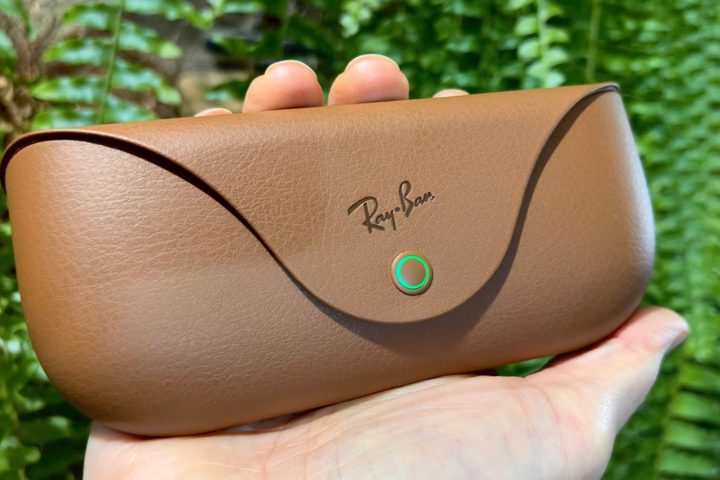
The charging case looks like an ordinary Ray-Ban case with textured synthetic leather on the outside and a brushed suede feel inside. A magnetic closure keeps it secure and an LED glows orange when charging the Meta Smart Glasses and green when the battery is full. It extends the smart glasses battery life up to 36 hours. You plug a USB-C charger into the port on the bottom to charge the case and glasses at the same time.
In reality the poor-sounding four-hour battery life is plenty, as few will constantly use the power-intensive features. I never ran out of charge, since I stored the smart glasses in their case when they were not in use. The case charges the smart glasses quickly. Starting with a 50% charge, the Ray-Ban Meta Smart Glasses reached 75% in 11 minutes and a full charge in 34 minutes.
If you drain the smart glasses completely, they need 75 minutes in the case to recharge the battery completely. Unless you wear them for hours with no break while listening to audio, use the camera for hours in a single day without taken the glasses off, or forget to charge the case every few days, battery life won’t be a problem.
Ray-Ban Meta: price and availability

The Ray-Ban Meta smartglasses start at $299 and increase up to $379 depending on the style of frame and choice of lens. Prescription lenses cost extra again. There aren’t many true alternatives to the Ray-Ban Meta, with only Solos AirGo and forthcoming models like Halliday’s smartglasses challenging Ray-Ban Meta. However, neither benefit from Ray-Ban’s knowledge of both design and fit, which are so important to any piece of tech you wear on your body. If the poor notification support puts you off, you’ll be better off with one of the best smartwatches.
Should you buy Ray-Ban Meta Smart Glasses?

The Ray-Ban Meta are the best everyday-wear smartglasses we’ve tried. The camera, AI, and audio ability makes up for the lack of a screen, and means they’re less geeky and more accessible than a pair with too much tech inside. The familiar, good-looking Wayfarer design means most people will be able to wear them without them looking odd, and the lightweight nature allows you to enjoy them for hours without fatigue. They are smartglasses for everyone, usable all day everyday, and available at a reasonable price with plenty of customization.


