

“Why you can trust Digital Trends – We have a 20-year history of testing, reviewing, and rating products, services and apps to help you make a sound buying decision. Find out more about how we test and score products.“
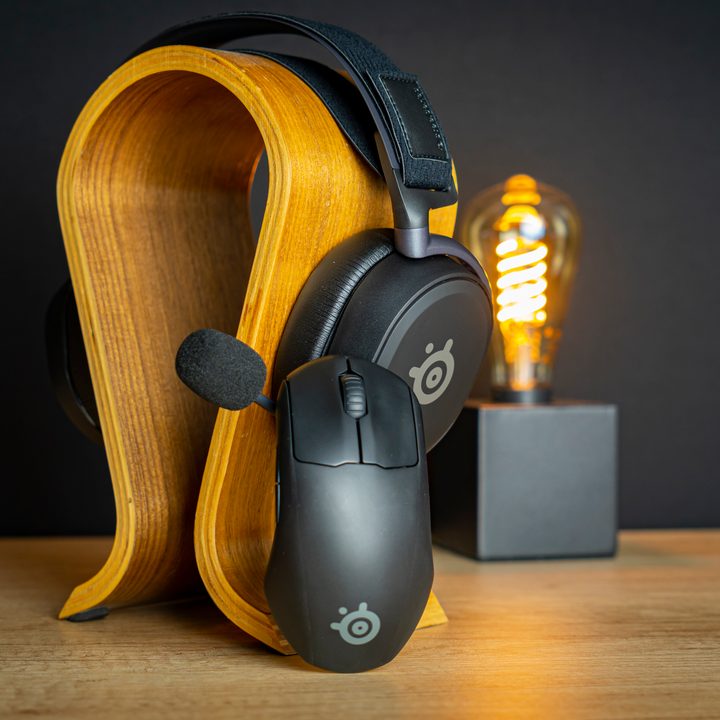
When it comes to the best gaming mice, the latest craze is all about lighter weight – preferably paired with wireless performance. With Logitech dominating the market for some time with the G Pro X Superlight Wireless mouse, it was time for a smaller company like SteelSeries to join the fray. Available today are its new Prime series peripherals, consisting of three mice and the Arctis Prime headset.
The Prime mice are about performance, not luxury

Let’s start with the Prime gaming mice, because that’s where I believe the party is at. The Prime gaming mouse is coming out in three variants — the Prime, Prime+, and Prime Wireless — and we’ve got the last one on-site for testing. Other than being wireless and having a slightly better sensor, it’s not much different than the other two.
All three mice have the same shape, and at first sight, it’s not a mouse that’s going to leave you impressed. There’s a distinct lack of premium materials on the surface, with only the scroll wheel featuring a hint of RGB illumination. The SteelSeries logo is painted on, so it’s guaranteed to wear out.
The SteelSeries Prime gaming mice don’t get distracted by luxury features. They’re all about performance. It’s easy to forget that if you want an ultralight mouse, you have to make some concessions – this isn’t a mouse that’s going up against Logitech’s G502 Lightspeed, even if it costs about the same.
These mice weigh around 70 grams (or 80 grams for the wireless variant, but it has 100 hours of battery life), which isn’t much. It’s not superlight like the 63-gram G Pro X, but it’s still well under the magical 100 grams figure while still feeling much sturdier than Logitech’s G502 Lightspeed Superlight. I’m not afraid of dropping this one off my desk.

Weight isn’t everything. Under the buttons, you’ll find magnetic optical switches as opposed to the usual Omron switches found on most gaming mice. It also features an excellent sensor that’s capable of up to 18k DPI and 450 inches per second in flick tracking. That’s tremendous, and I can attest to its performance in my own Insurgency Sandstorm sessions.
Charging happens with a very nice sleeved USB-C cable, which enables the mouse to be used during charging. Fifteen minutes plugged in is good for a total of 15 hours of playtime.
The clicking action is where it’s at

Now, let me get back to those switches for a second. Many mice aim for very light, crisp clicks that you can almost barely feel but still guarantee click action. But the click of these optical switches is totally different. It’s deeper. Literally with more travel, but also in how the clicks sound. They feel more distinct. I won’t go as far as saying it’s better, but it’s certainly different, and the action is more reassuring.
Meanwhile, the scroll wheel is also excellent, offering some of the most distinct notching I’ve ever felt on a mouse — and I love that. There’s nothing quite as annoying as scrolling through weapons in-game and going right past the weapon you were aiming for because you couldn’t feel what the scroll wheel was landing on.
The Arctis Prime Headset

Whereas the Prime mice seem to fill a niche that I can see a lot of folks being interested in, I’m not as impressed with the Arctis Prime headset. Starting with the good stuff, though, it’s extremely comfortable (like, I’ve rarely worn gaming headsets this comfortable) thanks to the stretchy headband. I also do like the simplistic appearance, the microphone quality is excellent, and it’s relatively affordable at $99.
But I have two major hang-ups: The sound and the cable. And if I may be so blunt, they’re deal breakers for me.
The cable uses a proprietary connector on the headset end, and it’s not very strong. It’s not sleeved either, which would be just fine if it was a thick matte cable, but it isn’t. It’s thin, sticky, and annoying when it dangles over my arm. And because it’s proprietary, you can’t easily replace it, meaning you’ll have to write off the whole headset when it breaks.
For in-game sound, the Arctis Prime headset has some shortcomings.
When it comes to the sound, it’s fairly enjoyable for music. But for games, which is its primary purpose, it has some shortcomings. I noticed a dip in midrange frequencies, right where many guns land in the mix. They sound dampened and hollow, and there’s a general emptiness to the sound profile.
Maybe that’s the point, so that the headset can emphasize the sound of footsteps to let you better track enemies sneaking up on you, but to me, it takes the satisfaction out of gameplay — and that’s a real shame on a headset that’s meant for FPS games. As always, sound is highly personal, so keep that in mind.
I have my issues with this headset, but in general, it does offer great value and comfort at its price.
So, should you buy these?
If you’re in the market for a new gaming mouse, play mostly FPS games, and want to see what superlight, high-performance gaming mice are all about, I can absolutely recommend you take a look at SteelSeries’ new Prime gaming mice, perhaps the wired variants more than the wireless variant that we tested.
Pricing starts at $60 for the base version, $80 if you add some sensor modification, and $130 for the wireless variant. That’s a steep premium at the top end, making the wired variants much more interesting, but I reckon street pricing will be quite a bit friendlier in due time, so it may be worth keeping an eye on.


