
Good news for those who want to buy a new monitor sometime soon — a new specification has just come out that should make the whole process just a little bit easier.
The Video Electronics Standards Association (VESA) has just introduced a new motion blur spec, dubbed ClearMR. The standard will show at a glance whether or not a monitor excels in eliminating motion blur.
Shopping for a monitor, especially a gaming monitor, can be rather tricky. There are a lot of factors to consider, and unfortunately, gaming monitors often make some sacrifices in order to focus on things like refresh rates and response times. This is why VESA standards are so important — they make it clear whether the device will tick some of the boxes you’re looking for or not, all without any chance of artificially boosting a certain parameter.
Motion blur refers to the amount of time it takes for a pixel to change from one color to the next. That’s why benchmarks that test a monitor’s capabilities in that regard involve switching between various shades, such as the Black to White test. If the response time is kept low, this spells good news for a monitor, implying an increased sharpness of moving objects and less overall blur. However, VESA now claims that these types of benchmarks are no longer good enough to accurately measure motion blur.
According to VESA, modern displays are now decked out with a range of technologies that artificially boost pixel response time. This is especially common in gaming monitors, but these solutions don’t tell the whole story; while the performance may get an artificial upgrade in one area, a different area will often lag behind. ClearMR is said to limit the use of artificial enhancements that only improve certain things in certain scenarios.
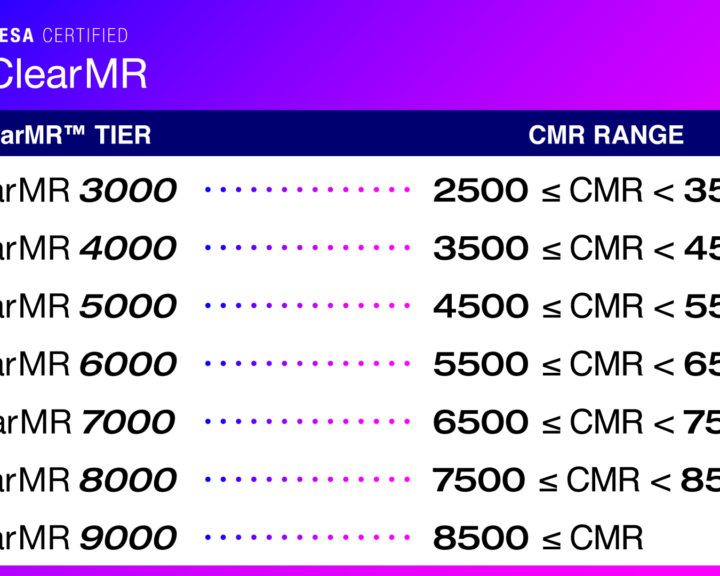
VESA is introducing a special new ranking system with ClearMR, referred to as the CMR range. As seen above, this includes a total of seven categories, ranging from CMR 3000 to CMR 9000. Each of these categories refers to a performance tier, with 9000 being the best there is. In order to test the scale of motion blur, a high-speed camera and a luminance device are used, and the collected data is then compiled and converted into a CMR value. A ClearMR 7000 rating ensures that the monitor will have 65 to 75 times more clear pixels than blurry pixels.

The monitors that manage to score the top rating (ClearMR 9000) will be awarded a badge that manufacturers will be able to stick on the display. This should make it simpler to shop for monitors with that particular concern in mind — the badge will be visible front and center, and only the best monitors will be able to sport it.
VESA’s ClearMR is slowly working its way into the market right now. Samsung and LG have already received the new certifications on several of their displays. As time goes on, more monitors, TVs, and tablets will be VESA-certified for motion blur.


