
Thunderbolt 4 is one of the fastest and most capable connection standards you can utilize today, but Intel has announced its successor: Thunderbolt 5, and it’s very impressive. With promises of up to triple the bandwidth in some scenarios, support for ultra high resolutions and refresh rates, and even the potential for a resurgence in external graphics cards, there’s a lot to be excited about with Thunderbolt 5.
Intrigued? Here’s everything we know about Thunderbolt 5.
Availability
Thunderbolt 5 was long-rumored but officially announced in September 2023, with plans for the first Thunderbolt 5 devices to launch in 2024. That will likely come in the form of external drives, and crucially, Intel-based laptops. However, Intel hasn’t made it clear on what platform such laptops would be based, whether it’s the upcoming refresh of its 13th generation Raptor Lake CPUs, the potentially delayed Meteor Lake, or something else entirely.
Performance
Intel’s announcement claimed that Thunderbolt 5 would double and triple the bandwidth of Thunderbolt 4, depending on the scenario. It will offer 80Gbps of bi-directional bandwidth — For tasks like transferring files from your laptop to an external drive, and vice versa. But it will also offer up to 120Gbps of uni-directional bandwidth when connected to an external display.
This would make Thunderbolt 5 by far the most capable connection for video transmission. HDMI 2.1 is the hot new thing in living room and TV display technology, but its maximum bandwidth is a mere 48 Gbps, and DisplayPort 2.0/2.1 only offers 80Gbps. USB4 has the potential to offer up to 80Gbps of bandwidth, and Intel previously demoed a Thunderbolt 4 connection offering the same, though most Thunderbolt and USB4 connections are more commonly limited to 40Gbps of bandwidth or less.
Thunderbolt 5 should have no trouble handling 8K monitors at high refresh rates, or multiple 8K and 4K monitors in various configurations. It also supports refresh rates up to 540Hz at lower resolutions and even has the potential to support 10K and 16K displays, especially with Display Stream Compression or Chroma Subsampling. That massive bandwidth would also be very useful for external graphics cards, which have hit a limit in recent years with the performance of Thunderbolt 3/4 and USB4. That will benefit external storage, too, with the potential for far faster external SSDs to be used to their full potential.
Technology
Thunderbolt 5 is based on PAM-3 modulation technology. That’s a novel method of transmitting bits along the cable.
Traditionally, NRZ (non-return-to-zero) encoding is used, which allows for a 0 or a 1, or a single bit, to be transmitted. Some connection options also make use of PAM -4 or Pulse Amplitude Modulation 4, which allows two bits to be transferred. The 4 is a demarcation of how many different variants of two bits could be seen (00, 01, 10, or 11). Thunderbolt 5 will make use of a 3-bit data signal, allowing it to reach a higher bandwidth than that achieved by the standard NRZ and PAM-4 implementations seen in current connectivity technologies.
The intriguing real-world effect of this is that it does mean using shorter cables. Passive Thunderbolt 5 cables will be limited to just one meter in length.
Like previous generations of Thunderbolt technology, Thunderbolt 5 will leverage other protocols to achieve its excellent performance. That includes USB4 V2, DisplayPort 2.1, and PCI-Express 4, with backward compatibility with previous versions, too. That allows Thunderbolt 5 to work with a range of external displays and devices with native cabling, or with adapters.
Port
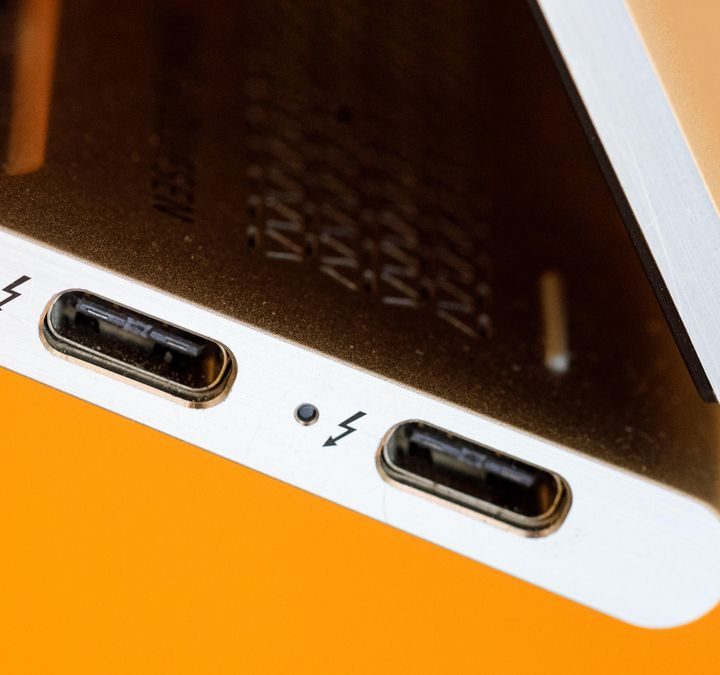
Intel will continue to use the popular and increasingly universal USB-C connector for Thunderbolt 5. This gives it backward compatibility with all existing Thunderbolt 4 and 3 cables and devices, as well as all USB-C and USB4 connections and cables. However, to get the full performance and features of Thunderbolt 5, you will need to have all devices and cables in a chain be Thunderbolt 5 certified.


