
During Microsoft’s press conference on Wednesday, the company officially announced the Redstone 2 update, also known as the Windows 10 Creators Update, which is slated for the spring of 2017. This free platform upgrade will focus on 3D creativity, such as generating 3D images in an updated Paint as well as uploading and downloading 3D objects from a newly launched community website. However, one of the biggest aspects of Creators Update is how users will use and view 3D content in headsets.
Part of the presentation included HoloLens, Microsoft’s headset for viewing and manipulating holograms. The headset projects virtual objects, scenery, and more in your field of view, blending virtual objects with the physical world. Creators Update will enhance the HoloLens experience by allowing owners to pull 3D creations into the real world.
For instance, a Windows 10 customer could create a 3D object using a phone to scan in a sandcastle. That virtual sandcastle could then be inserted into a scene in Paint 3D along with other objects. In turn, that whole art project can be uploaded to the community website to be downloaded and used in other projects. However, with HoloLens, headset owners can grab that 3D scene from Microsoft Edge, and place it on a table to view from any angle as if it were a physical object.
This, of course, can be expanded. Thanks to this Windows 10 feature, HoloLens can seemingly be used to pull any 3D object from Microsoft Edge. In a demonstration, the headset was used to pull a chair from the community website and place it in front of a real-world table. Another chair was added after that so the user could see how these chairs look together with the table. This will enable shoppers in the future to view furniture and other objects in their home before they make an actual purchase.
Creators Update will also introduce HoloTours. This feature will enable headset owners to explore and interact with virtual experiences. It’s more than just 360 video feeds, as the wearer will feel like they’re visiting a city across the sea. It mixes together spacial sound, panoramic video, and holographic scenery to build a virtual world around you. Take a tour of Rome or check out scenery that is impossible to see from the ground.
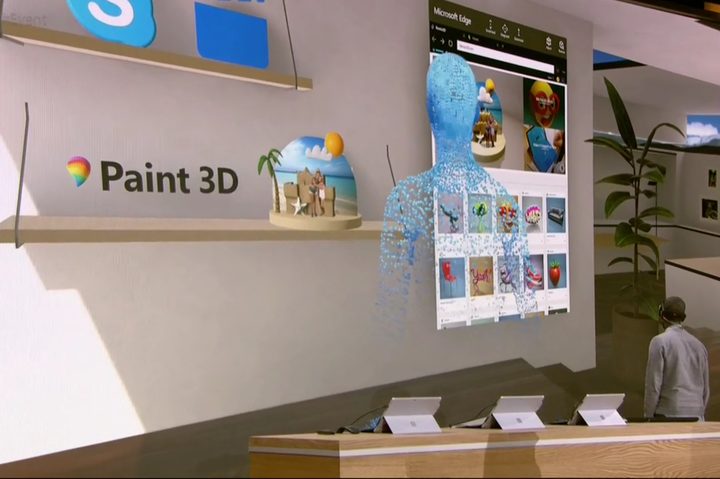
Another feature introduced with Creators Update will be the ability to create a custom space in VR (and possibly AR). As shown above, a demonstration showcased a virtual room that the user decorated, including a “wall-mounted” display piping in a local football game. The spaces will provide access to all your favorite Windows 10 apps, so you feel like you’re accessing Windows 10 in a whole new, non-2D approach. These apps can be placed on virtual shelves like decorations next to a virtual potted plant.
Microsoft has teamed up with HP, Dell, Lenovo, Asus, and Acer to provide VR headsets for Windows 10. They will have sensors providing six degrees of freedom, but that’s all we know about the headsets at this point. Based on images provided in the background, there may be at least two VR solutions with the main body covering the eyes, and a single band wrapping around the user’s head.
According to Microsoft, the listed companies will ship the first VR headsets “capable of mixed reality with the Windows 10 Creators Update.” That means the headsets will have a camera on the front to possibly provide a live video feed of the real world, with holograms embedded on an overlay, similar to how Pokémon Go works on phones (only bigger and in your face). There’s a good chance AR may only be served up on certain headsets as well.
Pricing will start at $300. We imagine there could be tiered levels of headsets to match the different applications, such as one for general use that plugs into a laptop and just works, one for virtual gaming to match the HTC Vive and Oculus Rift, and models with added AR capabilities. That is just speculation, but we’ll see what partners roll out when Windows 10 Creators Update lands next spring.


