  1. Home
  2. Computing
  3. News

Windows 10 officially powers over 900 million devices

Add as a preferred source on Google

Microsoft has announced a new milestone for Windows, the company’s operating system: It has officially reached 900 million active devices.

The news officially broke on Twitter when Yusuf Mehdi, corporate vice president of Microsoft’s Modern Life, Search & Devices Group, tweeted out the company’s latest accomplishment.

Recommended Videos

Specifically, Mehdi pointed out that the company has “added more Windows 10 devices in the last 12 months than ever before.” In addition to PCs, Microsoft is also counting other devices that are actively using Windows 10. This includes the HoloLens smartglasses, the Surface Pro Hub, and Xbox One gaming consoles to name a few. Of course, it’s highly probable that a vast majority of the devices using Windows 10 are PCs.
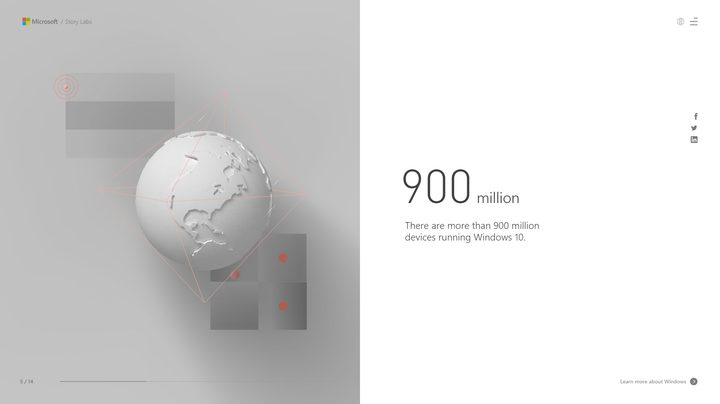
Image used with permission by copyright holder

This is not the only significant achievement Windows 10 has reached this year. Earlier this year, Microsoft confirmed that Windows 10 had seen a 100 million increase from just last March, when the operating system was officially powering more than 800 million “active” devices worldwide.

Additionally, an increase in the numbers might also have something to do with Microsoft announcing that it will be discontinuing free support for Windows 7 starting on January 14, 2020. With support for Windows 7 ending very soon, it’s no surprise that a majority of its users are switching over to Windows 10, with a high probability that more individuals will be switching over to Windows 7’s successor by the end of the year. Either way, Windows 10 is bound to hit the 1 billion device mark very soon.

Microsoft is continuously looking for ways to innovate and improve Windows 10 and the Windows platform as a whole. Reports are circulating that Microsoft may introduce Windows Sets in the near future. There have also been rumors that Microsoft could release a lighter operating system later this year dubbed “Windows Lite.”

We are also less than two weeks away from Microsoft’s annual Surface Hardware event. This year’s event is projected to be a big one, with the company expected to flaunt new updates and models for all of its product lines, and perhaps even a revised model of the Surface Pro’s stylus.

Taylor Lyles
Former Digital Trends Contributor
Based out of Baltimore, Maryland, Taylor is a contributing writer for Digital Trends covering the latest news in the computer…
Windows 11 is testing a low-latency mode and it visibly speeds up app launch
Windows 11’s new performance trick lets your CPU go all out for a moment
Windows 11 Laptop

Even on powerful hardware, you have probably noticed that Windows 11 can feel less responsive than it should. Tiny delays in basic actions like opening the Start menu or navigating File Explorer can make the system feel heavier and less polished than rivals like macOS.

Microsoft appears to know this is an issue and may finally be working on a fix. After speeding up right-click menus and Quick Settings, improving File Explorer, and making broader under-the-hood changes, the company is now reportedly testing a new feature called Low Latency Profile to make Windows 11 feel more responsive overall.

Read more
Chuwi’s CoreBook Air wants to be the rare ultra-light Copilot+ laptop without an outrageous price
The CoreBook Air 226V's specs would be impressive from Lenovo or Dell; coming from Chuwi at $800, they're either a genuine breakthrough or a reminder that price isn't the only thing that matters when buying a laptop.
Chuwi new lightweight option.

Chuwi has never been the brand you associate with top-tier hardware: it built its name on budget laptops that punched above their weight at entry-level prices. 

The new CoreBook Air 226V is a deliberate step away from the brand’s comfort zone. It’s a sub-1kg Copilot+ PC built around Intel’s Lunar Lake processors, and at $800, it’s asking buyers to trust it with something that it has never before: a premium Windows laptop. 

Read more
Bots now account for over half of the internet traffic and they’re raising all kinds of hell
Humans are now the minority on the web, thanks to bots
Isometric Ai assistant and bubble speech, 3D illustration

While humans built the internet, actual people aren't the ones roaming the online space the most. A new report from Thales says bots accounted for more than 53% of all web traffic in 2025, up from 51% the previous year. Meanwhile, human activity has fallen by 47%, which means automated traffic has now become the dominant force online. And that's not even the bad news.

How AI is making the bot problem worse

Read more