  1. Home
  2. Computing
  3. News

Digital Trends may earn a commission when you buy through links on our site. Why trust us?

The first Windows 11 update makes a major performance issue even worse

Add as a preferred source on Google

Windows 11 just experienced its first “patch Tuesday,” where Microsoft issues a patch fixing issues on the second Tuesday of every month. This time around, many hoped the patch would include fixes for an issue with Windows 11 that can tank the gaming performance of AMD processors by as much as 15%. It didn’t fix the problem, though, and it may have made the situation worse.

TechPowerUp reports that the October 12 Windows 11 patch nearly doubled the level 3 (L3) cache latency of a Ryzen 7 2700X. This is the lowest-level cache on your processor, storing data streamed in from your RAM before passing it up to higher levels. According to AMD, the increased latency can result in up to a 15% drop in frame rates, especially in esports titles.
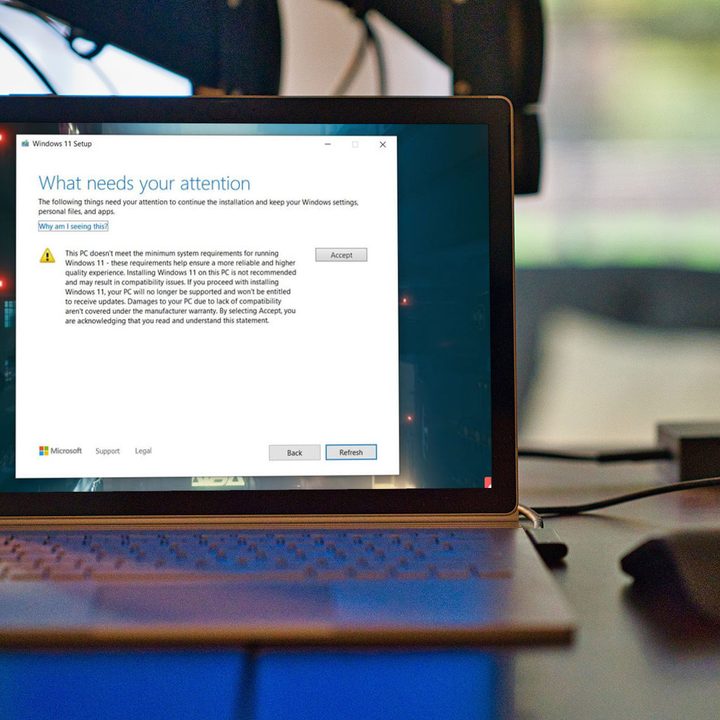
Unsupported Windows 11 waiver.
Image used with permission by copyright holder

For specifics, TechPowerUp says it went from an L3 cache latency of 17 nanoseconds on Windows 11 to 31.9ns after the patch. The first result is already way above the 10ns cache latency the chip should have, making the jump with the recent Windows update all the worse.

Recommended Videos

The good news is that a fix is on the horizon. On Reddit, u/destiny2sk shared an image showing the release date for patches fixing problems with Windows 11 and AMD processors. According to the post, Microsoft will release a patch resolving the cache latency issue on October 19, while AMD will release a patch for a separate Windows 11 issue on October 21.

We weren’t able to track down the original post, so these dates may not be accurate. However, AMD has confirmed that both issues are expected to be resolved in October.

Windows 11 is off to a rocky start. The operating system stirred up a lot of controversy when it was announced due to its strict CPU and TPM requirements. Now that it’s here, we’re hearing about all sorts of Windows 11 problems, from slowed gaming performance on AMD chips to a nasty memory leak bug.

As TechPowerUp notes, these issues are critical not only for AMD users, but also for the upcoming launch of Intel Alder Lake processors. We’ve heard a lot about Thread Director in this new generation, which reportedly improves performance when paired with Windows 11. If these problems aren’t addressed soon, AMD could enter the battle at an immediate disadvantage.

Jacob Roach
Former Lead Reporter, PC Hardware
Jacob Roach is the lead reporter for PC hardware at Digital Trends. In addition to covering the latest PC components, from…
Google wants Gemini to help build the next big scientific breakthrough
Gemini for Science pushes agentic AI deeper into real research workflows
gemini for science

Google is building Gemini deeper into the research workflow, starting with ideas, tests, and scientific literature.

At Google I/O 2026, the company announced Gemini for Science, an experimental suite built around agentic AI science. It targets the manual work behind discovery, including hypothesis building, computational testing, and literature review.

Read more
Discord calls finally get end-to-end encryption, but your DMs didn’t make the cut 
Discord spent three years building one of the most cross-platform encryption systems ever shipped, and it doesn’t cover the part of the app that forms the basis of day-to-day communication.
Computer, Electronics, Laptop

Discord just completed something it started back in 2023, and while the result is genuinely impressive, there’s a big asterisk in place. 

As of early March 2026, every standard voice and video call on Discord is end-to-end encrypted (E2EE), and you don’t have to toggle any switches, as the feature is enabled by default. The encryption is based on DAVE, which, for the uninitiated, is Discord’s own open-source protocol. 

Read more
OpenAI has a new website where you can check if an image is real or AI slop
OpenAI and Google are teaming up to put a stamp on every AI image.
OpenAI verification tool in action on iPad

Spotting an AI-generated image is getting harder by the day. OpenAI wants to change that, and it is using Google as a partner to accomplish this behemoth task.

OpenAI has announced a significant update to how it handles content provenance, which is just a fancy way of saying how you can tell where an image came from and whether it was AI-generated.

Read more