  1. Home
  2. Emerging Tech
  3. News

The Aalto Explorer drone lets people explore under the sea using VR

Add as a preferred source on Google
IFA 2025
This story is part of our coverage of IFA Berlin 2025

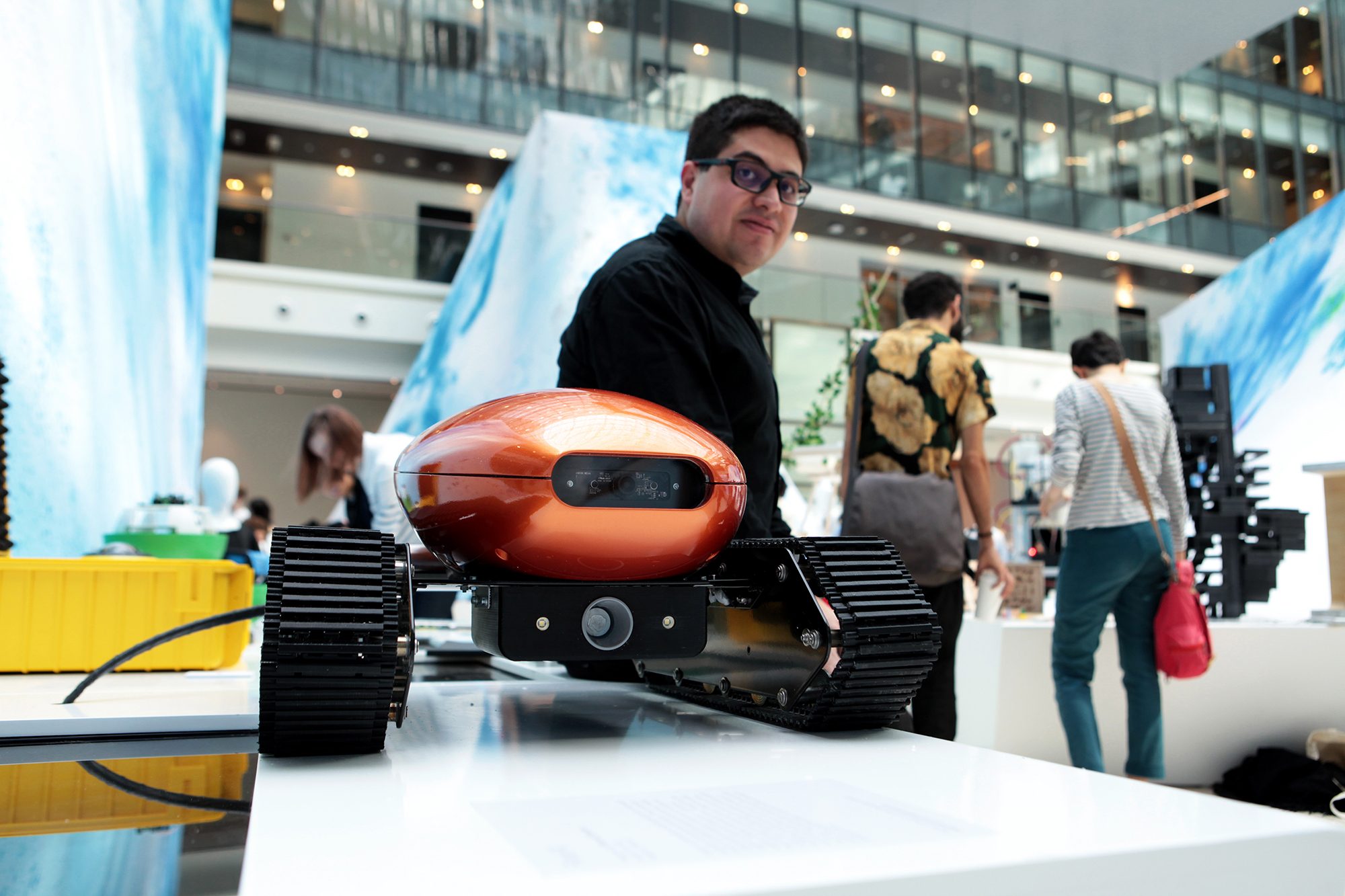
The second generation Find-X underwater drone, overseen by project manager Manuel Rosales. Image used with permission by copyright holder

If you’ve ever wanted to experience life beneath the waves without getting your feet wet, now’s your chance. A project called the Aalto Explorer will let members of the public get a first-person view from an underwater drone using virtual reality. At IFA 2019, Digital Trends spoke with Aalto Explorer team member Annie Tran about the project and the team’s plans to get more people interested in the oceans.

Recommended Videos

The Aalto Explorer consists of an underwater drone, or remotely operated vehicle (ROV), called the Find-X. The team recently built a third-generation prototype ROV that can go deeper than previous versions. The previous ROV could travel only to a depth of 50 meters, but the new version can go all the way down to 100 meters. The current ROV is preparing to launch in a few days with a dive into the Baltic Sea near Finland, where the company is based.

On each “expedition,” there are three roles for participants: Captain, passenger, and researcher. The captain steers the ROV and chooses which direction to move in, while passengers observe and researchers collect data. The participants form a “crew” that can communicate with each other as if they were traveling together, even if they’re located on opposite sides of the world.

Crew members can use the ROV’s 360-degree camera to see under the water and a keyboard and mouse to control the view. But for a truly immersive experience, the visuals from the ROV can be sent to a VR headset, giving crewmembers a first-person perspective of exploring the ocean’s depths.

A youngster tries out the Aalto Explorer VR. Image used with permission by copyright holder

There’s a clever system for recharging the ROV: An inflatable module that floats on top of the water and acts as a platform. The module has a solar panel that passes on energy from the sun to the ROV. The platform also has a 5G connection to beam data from the ROV to the computers of crew members around the world.

Tran told us that the primary aim of the project is education, as the concept began as a university project. The team wants to get children interested in the ocean, as well as offer a unique opportunity for adults to play at being a ship’s captain. But there’s a role for serious researchers as well, as oceanographers who don’t have the budget for their own undersea mission can come along on trips to collect information about the water around the ROV, including pH, pressure, temperature, and salinity. As the ROV explores, researchers can see data in real time in the software interface.

The team wants to expand the project to build five of the new ROVs, each to explore a different ocean, so they are currently crowdfunding on Indiegogo.

Georgina Torbet
Georgina has been the space writer at Digital Trends space writer for six years, covering human space exploration, planetary…
Robots just ran the Beijing half-marathon faster than the world record holder
humanoid robot running a marathon

A humanoid robot just ran a half-marathon faster than the world record holder. It might not seem impressive at first, but considering last year, the fastest robot at Beijing's humanoid robot half-marathon finished in two hours and 40 minutes, this is a huge achievement. 

As reported by the Associated Press, the winning robot at this year's Beijing half-marathon crossed the finish line in 50 minutes and 26 seconds, comfortably beating the human world record of 57 minutes recently set by Jacob Kiplimo. 

Read more
As if the plate wasn’t already full, AI is about to worsen the global e-waste crisis
New report highlights a rising environmental concern
Stack of graphics cards and motherboards in a landfill site e-waste

AI is already changing how the world works, but it’s also quietly making one of our biggest environmental problems even worse. And no, this isn’t about energy consumption this time. It’s about the hardware. Because every smarter AI model comes with a physical cost.

AI is about to supercharge the e-waste problem

Read more
Smart glasses are finding a surprise niche — Korean drama and theater shows
Urban, Night Life, Person

Every year, millions of people follow Korean content without speaking a word of the language. They stream shows with subtitles, read translated lyrics, and find workarounds. But live theater has always been a different problem — you can't pause or rewind it. That's the problem: a Korean startup thinks it's cracked, and Yuroy Wang was one of the first to try it. The 22-year-old Taipei retail worker is a K-pop fan who loves Korean culture but doesn't speak the language. When he went to see "The Second Chance Convenience Store," a touring play based on a Korean novel that was a bestseller in Taiwan, he expected supertitles. What he got instead was a pair of chunky black-framed AI-powered glasses sitting on his nose, translating the dialogue in real time directly on the lenses. "As soon as I found out they were available, I couldn't wait to try them," he said. Wang is part of a growing audience discovering that smart glasses, a category of tech that has struggled to find mainstream purpose for years, might have just found their calling in the most unexpected of places: live Korean theater.

How do the glasses work?

Read more