

There are no shortage of new milestones being reached by artificial intelligence these days. But unless you work in computer science, chances are that most of them won’t really resonate with you. The A.I. landmarks that do capture the public’s imagination are the ones that are only partially to do with machines at all.
They’re the ones that are about humans every bit as much as they are about robots: Chess champion Garry Kasparov’s loss to Deep Blue. IBM Watson’s 2011 Jeopardy win over former human trivia kings Ken Jennings and Brad Rutter. The success of Google DeepMind’s Go-playing bot against Korean grandmaster Lee Sedol in 2016. As stunning as these feats are from a technical perspective, they’re just as profound on a human level because they make us question the increasingly thin line that exists between machines as labor-saving tools and machines as our superiors. They make use of A.I.’s purposely provocative challenge of a name and force us to question what it is that makes us human — and why that really matters.
It’s in this vein that a newly announced A.I. milestone arrives. Later this year, Christie’s — the auction house that initially banged its auctioneer’s gavel in 1766 — will sell its first work of art created by an algorithm. And, yes, it’s actually rather good. The portrait in question is of a somewhat rotund man, apparently named Edmond Belamy, in a dark frock coat and white collar. His face looks unfinished, as if machines figure that we all look pretty much alike anyway.
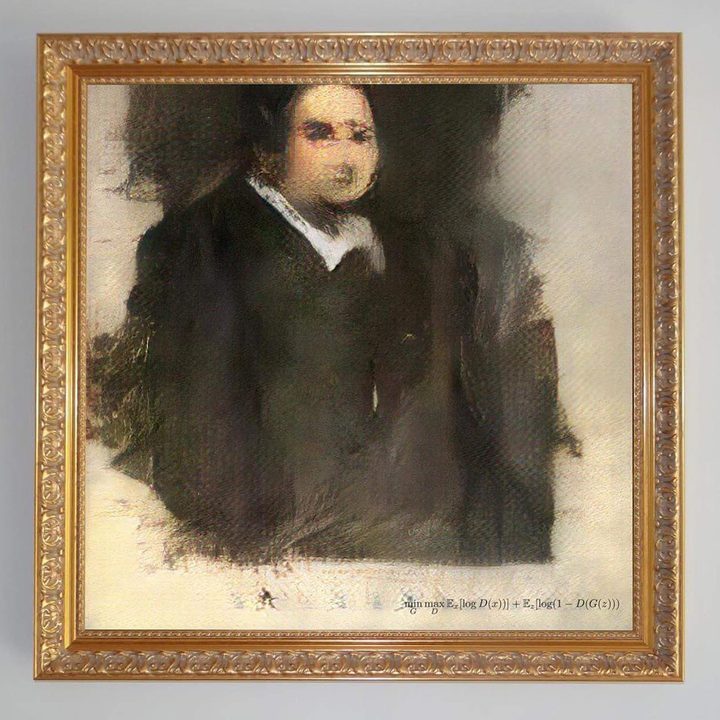
The 70cm x 70cm print on canvas was generated by a type of A.I. called a GAN, or “generative adversarial network.” The GAN was created by a Paris-based art collective called Obvious, and was fed 15,000 portraits painted between the 14th and 20th century. This is the kind of collection that art collectors would do unspeakable things to assemble in one place. For an A.I., of course, it’s just another data set — like Scrubs scripts or signs of tumors on a brain scan or any of the other things machines can make sense of, but don’t care about the actual contents.
As a technical achievement, it’s pretty darn impressive. The GAN has swallowed centuries of art history and used it to generate something that references the past, but does so in a way that appears new. It’s not like one of those A.I. filters you find in a smartphone app that makes your summer selfies look like they were painted by Picasso or Monet. It crunches data about how art has changed over the centuries, and then spits out a piece that looks both modern and like an old 18th-century portrait.
Generating art that we’ll accept as art is one of the biggest challenges for an A.I.
Obvious’ A.I. combines both artist and critic in one. The GAN consists of “generator” (the artist) and “discriminator” (the critic) components. The generator creates new portraits in the style of the pictures it’s been shown. The discriminator then tries to spot the difference between the generator’s work and that of the human artists. When it can’t, the work is finished.
Like generating realistic human faces (the challenge of the so-called “uncanny valley” effect), generating art that we’ll accept as art is one of the biggest challenges for an A.I. That’s because we hold machines to a different standard than we do humans. We’ve been purposely vague about what actually constitutes art precisely because we like to flatter ourselves that it is non-automatable. Sure, A.I. can generate stock music for YouTube videos or background characters for Hollywood movies, but we put artists on a platform that we don’t extend to too many others. We talk about artists as geniuses, and praise them for stirring emotions within us. We don’t do this for Siri or Amazon’s Alexa.
Is the October Christie’s auction in New York about novelty? Sure. Are machines painting 18th century-inspired portraits going to disrupt the workforce in the same way that, for instance, factory robots or self-driving cars will? Absolutely not. Is there still a human hand in this, insofar as someone programmed the Obvious A.I. to begin with? Obviously.
Something tells me this isn’t going to settle the debate about whether machines can create art. Not by a long shot. The double standard will persist, and we’ll endlessly nitpick about whether Obvious is showing actual creativity since it honed its expertise on centuries of human creativity. We’ll ignore that human creators do exactly the same thing.
But does this represent another crucial step in showing us that A.I. is capable of pretty much anything we can throw it? It does indeed. And once it sells at auction, it will have the monetary value to prove it.


