
Nothing says celebration quite like a glass of bubbly. Unfortunately, preserving a bottle of sparkling wine can be challenging, especially beyond a few days. That issue has always made enjoying sparkling wines by the glass something of a crapshoot. The best champagnes and other sparkling wines tend to be prohibitively expensive to open and let go flat for a daily glass of wine. While champagne stoppers reduce the amount of carbon dioxide escaping an opened bottle, the flavors and effervescence degrade within a short amount of time (usually no more than three days). Suffice to say that up until recently, the best advice for preserving an open bottle of sparkling wine was to just finish it.
Now however, the Perlage system has been created to keep sparkling wines at their best for weeks and even months. Does it work? It works exceptionally well and, if price is no object, the Perlage system is the best choice for preserving your sparkling wines. While restaurants have a commercial version of the Perlage available, the consumer version of the Perlage system works well for home use. Priced at $199, this isn’t a gadget to pick up on a whim. If you buy a few mid-priced bottles of sparkling wine a year, you are better off spending a few dollars for a champagne stopper and drinking the wine within a couple of days. However, if you are someone who enjoys sparkling wines on a frequent basis, investing in the Perlage consumer system will ensure that your wine stays as fresh and flavorful as the day it was opened.
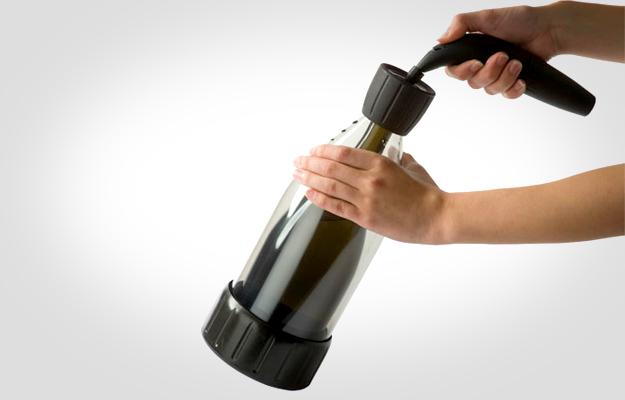 The Perlage consumer system itself consists of a hand-held pressurizer and a sleek plastic shell designed to hold a bottle of sparkling wine. Note that the Perlage consumer system only works with standard-sized sparkling wine bottles. Magnums, splits or other formats aren’t able to be preserved at this time. A CO2 cartridge is placed inside of the pressurizer, and then the bottle of sparkling wine is placed inside the shell. A regulator sits on top of the shell, which allows oxygen to be purged from the wine and the bottle to be repressurized with CO2. Repressurizing the bottle takes no more than 15 seconds, and then the wine is preserved almost indefinitely. Serving is easy, as the cap can be removed slowly from the shell and the wine can be poured directly out of the Perlage system without having to remove the bottle, or the bottle can be removed for table service.
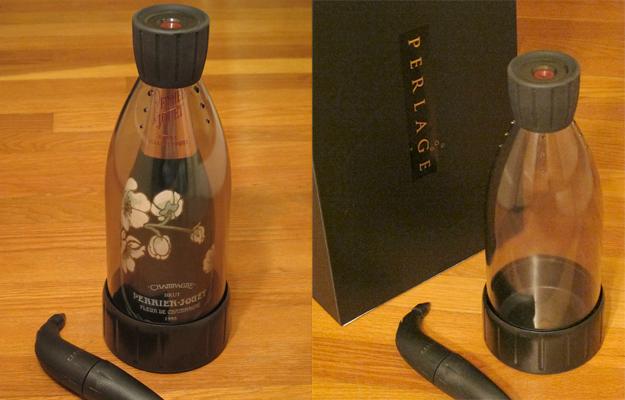 One drawback is that once reopened, the Perlage consumer system needs to be repressurized again to maintain the wine. The Perlage system uses 16-gram CO2 cartridges which run north of $1 apiece, even in bulk. So pouring a glass and repressurizing a bottle nightly can quickly add additional expense to using the Perlage consumer system. Of course, if you enjoy the occasional glass of Dom Perignon or Louis Roederer Cristal champagne and want to enjoy them at their best, the Perlage is an worthwhile investment in preserving your sparkling wines.


