  1. Home
  2. Emerging Tech
  3. News

Loose pin responsible for Boeing Starliner’s failure to deploy parachute in test

Add as a preferred source on Google
 

Boeing has identified the part which lead to a parachute failing to deploy during the testing of its Starliner capsule earlier this week. The company has announced that a misplaced pin was the cause of the issue.

Recommended Videos

On Tuesday, Boeing performed a launch abort test of its capsule, which is intended to eventually ferry astronauts to the International Space Station (ISS). For a manned craft, the launch abort test is vitally important. It is where the engineers test what would happen if something goes wrong during the launch and the passengers are forced to evacuate.
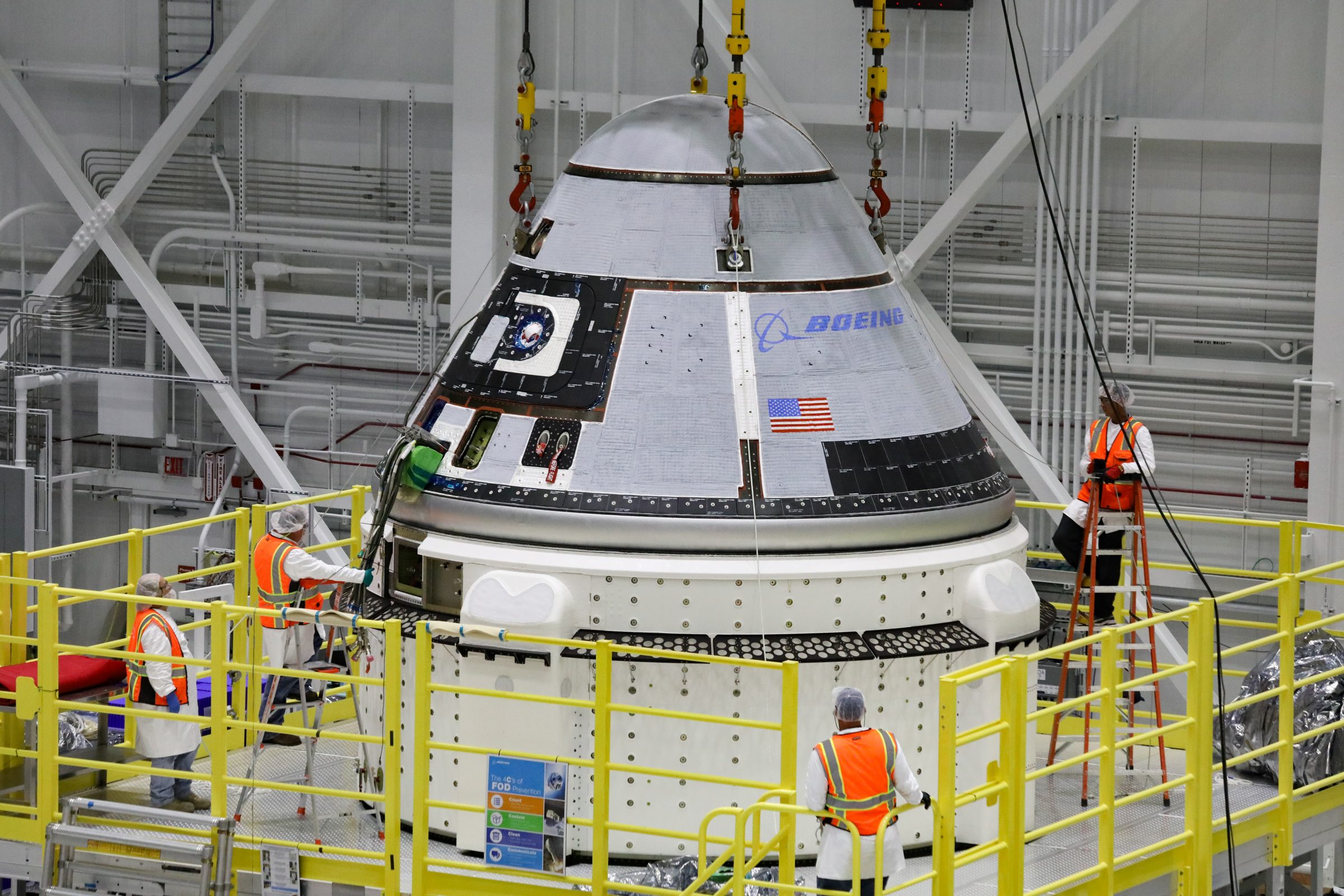
The crew module of Boeing’s CST-100 Starliner spacecraft is lifted onto its service module on Oct. 16 inside the Commercial Crew and Cargo Processing Facility (C3PF) at Kennedy Space Center in Florida. Boeing

Although the test was mainly a success, with the capsule being pushed away from the rocket as it should be and landing a mile away from the launch site, there was a snag. Only two of the three parachutes which slow the descent of the capsule opened, with the third failing to deploy.


Following an investigation, Boeing announced it had discovered the cause of the parachute failing to open. As reported by Space Flight Now, John Mulholland, vice president and program manager for commercial crew at Boeing, announced the findings in a call with reporters.

“The root cause was a lack of secure connection between the pilot chute and the main chute lanyard,” Mulholland said. There is a pilot parachute which fires first and inflates to pull the main parachute out behind it. But in this case, the pilot parachute wasn’t connected securely enough to the main parachute to successfully deploy it. The connection between the two parachutes is a loop with a pin inserted inside, both of which are enclosed in a sheath. But the sheath makes it difficult to see if the pin is secured correctly.

“In this particular case, that pin wasn’t through the loop, but it wasn’t discovered in initial visual inspection because of that protective sheath,” Mulholland said. “It was subsequently … determined by both detailed close-out photos and then, obviously, when we recovered the hardware in the field, [when we] were able to conclusively tie those two pieces together.”

Now that Boeing has discovered the issue, it is confident it can be fixed. In addition, the test showed that even with only two of the three parachutes deployed, the capsule could still land safely. So despite the hiccups, it’s overall good news for the Starliner and there shouldn’t be any delays to the planned Orbital Flight Test of the capsule in December.

Georgina Torbet
Georgina has been the space writer at Digital Trends space writer for six years, covering human space exploration, planetary…
Google wants Gemini to help build the next big scientific breakthrough
Gemini for Science pushes agentic AI deeper into real research workflows
gemini for science

Google is building Gemini deeper into the research workflow, starting with ideas, tests, and scientific literature.

At Google I/O 2026, the company announced Gemini for Science, an experimental suite built around agentic AI science. It targets the manual work behind discovery, including hypothesis building, computational testing, and literature review.

Read more
You can now walk through AI versions of real places with Google’s Project Genie
Text, Logo

Google is pushing its experimental AI world-building project into surprisingly realistic territory. The company announced that Project Genie can now use real-world imagery from Google Street View to generate interactive virtual environments, blending real locations with imaginative AI-generated styles.

At its core, Genie is what Google calls a “world model” — an AI system capable of creating explorable digital environments where AI agents, robots, or even users can interact naturally. Until now, those worlds were mostly synthetic. But with this new update, Genie can anchor itself to real places pulled directly from Street View imagery. This is actually where things start feeling like a glimpse into the future of simulation.

Read more
Google wants to reinvent your TV remote with Gemini and pointer controls
Computer Hardware, Electronics, Hardware

Google is making a bigger play for the living room, and this time, it is not just about what you watch — it is also about how you interact with your TV. At Google I/O 2026, the company revealed a fresh batch of updates for Google TV and Android TV developers, all centered around one idea: TVs are no longer passive screens sitting in the corner of your house. With more than 300 million monthly active devices across Google TV and Android TV, Google clearly sees the television as its next major AI battleground. And Gemini is now at the center of that strategy.

The company says Gemini is already helping users discover content through natural voice interactions. But Google now wants the experience to feel more dynamic and conversational, almost like searching the web — except on your couch. Instead of only surfacing static results, Gemini on Google TV can now respond with a combination of visuals, videos, and text snippets to answer queries. So if someone asks for a thriller with a strong female lead or a documentary about space exploration, Gemini pulls contextual recommendations directly from streaming apps and their metadata.

Read more