  1. Home
  2. Emerging Tech
  3. News

Chandra X-ray telescope uncovers evidence of the universe’s missing matter

Add as a preferred source on Google

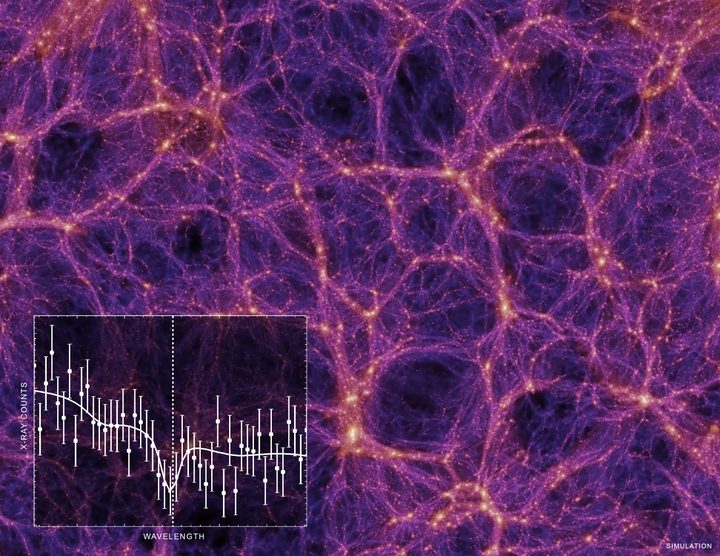
An illustration of the Millennium simulation, which uses supercomputers to formulate how the key components of the Universe would have evolved over cosmic time. Illustration: Springel et al. (2005); Spectrum: NASA/CXC/CfA/Kovács et al.

There’s a puzzle that has been taxing astronomers for many years: Where is all of the matter in the universe? You might think that it would be hard to miss, but observations of the universe have turned up only around two thirds of the regular matter that is known to exist due to mathematical models. So where is the other third?

Recommended Videos

The matter in question is normal matter, referring to elements like hydrogen and helium which were created in the first few minutes following the Big Bang. Over the first one billion years of the history of the universe, this matter was spread out and gradually became cosmic dust, gas, stars, and planets. Scientists have calculated how much of this matter must have existed immediately after the Big Bang and found that about a third of it cannot be accounted for in current models of the universe. This is a separate issue from the question of dark matter, which is a different type of matter that effects the movements of galaxies.

Astronomers believe the missing normal matter could have formed into huge strands of hot gas out in the reaches of space, which would be invisible to most telescopes but could be detected using ultraviolet light. These gas strands are known as the “warm-hot intergalactic medium” or WHIM. Now researchers using data from NASA’s Chandra telescope believe that they have found evidence of the WHIM.

Chandra was used to search for filaments of warm gas near to a quasar, which produces X-rays from its supermassive black hole. The scientists were able to see that some of the X-rays were absorbed by the hot gas, which allowed them to find a “signature” of hot gas as the X-rays traveled 3.5 billion light-years to us. Because the universe is expanding, X-rays are stretched as they travel, meaning that the rays absorbed by matter are shifted towards the red end of the spectrum. The researchers calculated how much shift should have occurred in the distance between them and the quasar, and this information told them where in the spectrum to look for absorption by the WHIM.

“We were thrilled that we were able to track down some of this missing matter,” co-author of the paper Randall Smith of the Center for Astrophysics, Harvard & Smithsonian, said in a statement. “In the future we can apply this same method to other quasar data to confirm that this long-standing mystery has at last been cracked.”

The findings are published in The Astrophysical Journal.

Georgina Torbet
Georgina has been the space writer at Digital Trends space writer for six years, covering human space exploration, planetary…
Edge browser on mobile gets a huge upgrade that makes it a worthy pick over Chrome
Edge mobile gets smarter just before Chrome’s big Gemini moment
Microsoft Edge on a phone

Chrome is still the default browser for many smartphone users, but Microsoft’s latest Edge update gives them a practical reason to try something else.

Microsoft has announced a major Copilot update for Edge across desktop and mobile. The rollout comes ahead of Google’s Gemini-powered Chrome upgrade for Android, which is expected in June, giving Edge a chance to stand out on phones before Chrome’s next big AI push.

Read more
After flubbing with Siri, Apple plans to host AI agents on the App Store
One problem is about money Apple won't commit to not charging. The other is about AI agents Apple can't figure out how to control. WWDC needs to solve both.
Electronics, Mobile Phone, Phone

Apple is currently facing a Siri problem that has nothing to do with Siri at all. With WWDC 2026 just weeks away, The Information reports the company is actively courting developers to integrate their apps with the new Siri coming in iOS 27. 

The mechanism powering the overhauled Siri, App Intents, is an API that lets Siri execute actions inside third-party apps without you actively opening them, which sounds quite useful, I’d say. However, some of the world’s largest developers are dragging their feet on it, not because it’s tough, but because Apple left the door open on charging for it later.

Read more
EV batteries just need some AI top-up nudge, and they get a big 23% life boost, finds research
Charging fast and lasting long seemed impossible. A new AI trick says otherwise.
EV Charging

EV battery charging technology has always had to find the right balance between charging speed and battery longevity. If the charging speed is too fast, it wears down the battery. If the charging is too slow, nobody is happy. 

Researchers Meng Yuan from Victoria University of Wellington and Changfu Zou from Chalmers University of Technology in Sweden may have cracked this long-standing problem using an AI technique called deep reinforcement learning, and the results are pretty encouraging.

Read more