
“Why you can trust Digital Trends – We have a 20-year history of testing, reviewing, and rating products, services and apps to help you make a sound buying decision. Find out more about how we test and score products.“
Tactile learning is one of the most powerful ways to teach a kid. Kids who touch and feel their way through a difficult subject tend to internalize — and articulate — the concepts better. And for a subject as abstract as circuitry, there’s perhaps no better way to convey the basics than with Circuit Cubes, snap-on modules that kids can use to build the machines of their dreams.
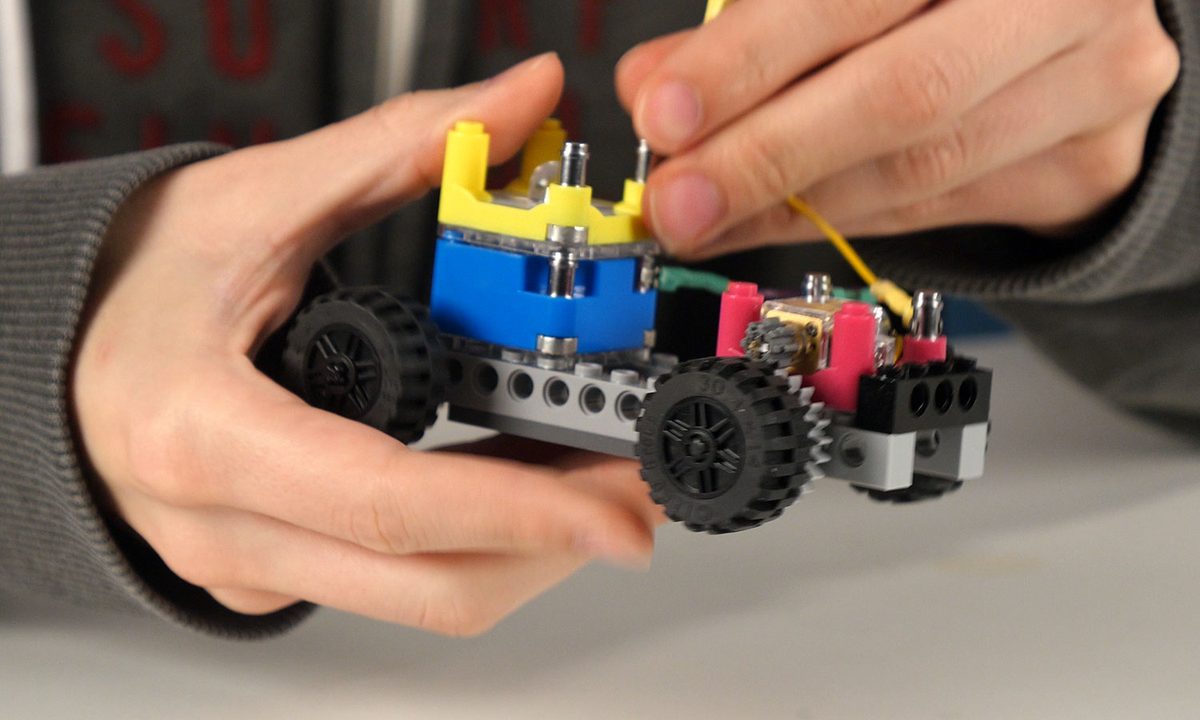
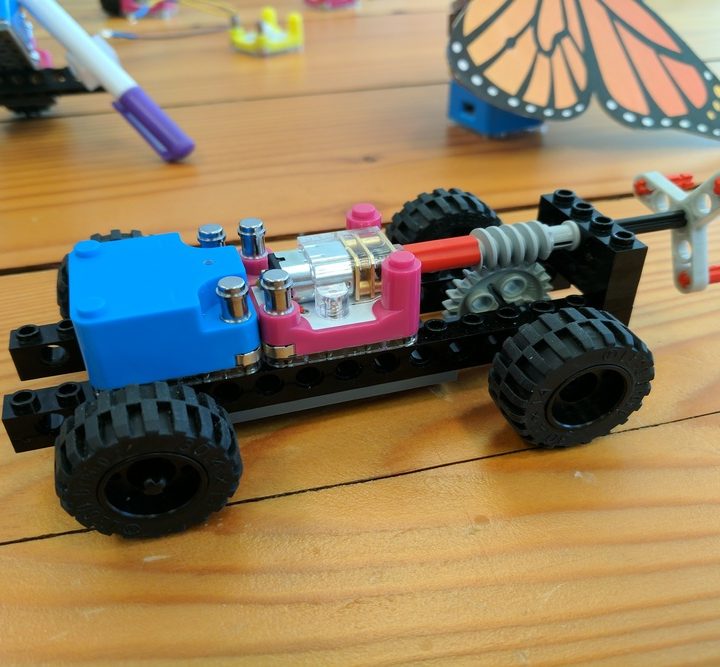
There’s a motor cube that drives a gear shaft at 1,000 RMPs, an LED module that lights up brightly when attached to a completed circuit, and a rechargeable battery module that last up to one hour of active play (and three days on standby).
It’s the debut effort of longtime educators Nate MacDonald and John Schuster, who spent years developing lessons with an interdisciplinary basis in STEM — science, technology, engineering, and mathematics. MacDonald co-founded Sonoma State University’s Maker Certificate program and advised the White Hill Robotics Club, an elective at White Hill Middle School in Fairfax, California.
Schuster, the former IT director at White Hill Middle School, teamed up with MacDonald to found Tenka Labs, a startup with a mission to design toys that are “as fun to play with and build with, but that along the way, enable kids to learn about basic circuitry.”
Legos + circuits = fun
Intuitiveness was a core consideration in the Circuit Cubes’ design. Each module measures two standard Lego bricks high and four Lego bricks wide and pairs via two silver terminals on the modules’ front.
“We wanted the form factor to be approachable, but small enough to build structures with,” Schuster said, “and we wanted the components to be visible so that kids could experiment.”


To that point, the base of the motor and LED module are made of a translucent material, and motor lines on the bottom show the flow of electricity. That’s to demonstrate the concept of polarity and resistance, Schuster said. Attaching a motor module directly to a battery module will cause it to spin quickly, but adding an LED module to the circuit will slow it down. Swapping the negative and positive contacts, on the other hand, will cause it to reverse its direction.
“It teaches kids basic technology literacy,” he said. “It’s not about the blocks themselves but what you can make with them.” It’s not so complicated that kids couldn’t figure out how to build things on their own, Schuster was quick to point out. “The minute kids have to go ask their parents for help, they’ve lost ownership of it,” he said. As a result, the system is simple enough that kids can construct a simple gadget without much thought. “They can build a car in tens seconds or less.”
Different designs for all interests
Circuit Cubes ship in one of three $60 kits differentiated by pack-ins. The Whacky Wheels kit ships with building instructions for cars, trucks, bikes, bridges, and Ferris wheels. Bright Lights boasts templates for telescoping tools, light sabers, and superhero GOBO. The Smart Art kit comes with felt tip pens for drawing robots that produce swirling designs on canvases.
The kits don’t prescribe designs, though. “The core ones allow you to do so many things,” John said. “It’s a design driven by kids. Their inspiration is what it’s all about.”
“It’s a design driven by kids. Their inspiration is what it’s all about.”
Schuster showed off a few models early Circuit Cube testers put together. There was a cut-out butterfly that flapped its wings with the help of a motor module, a battery module, and a few moving Lego “limbs.” An AT-AT_inspired walker moved lumbered forward, and another simulated rotating lights that’d be right at home on top of a police siren.
One of the most inventive creations was a toy rabbit that’d been stuffed with a Lego “skeleton” comprising a “spine,” a battery module, and a motor module that caused it to nod its head as though it was acknowledging Schuster’s words. “It’s a bit creepy,” he said. “But that’s the beauty. The Circuit Cubes allow almost endless creativity. ”
Getting kids into tech
The launch of Circuit Cubes comes as the U.S. faces record growth in demand — 17 percent by 2024 — for STEM jobs. But there’s a shortage of qualified candidates. The country ranks 27th in math compared to the rest of the world, and only 36 percent of the country’s high school graduates are ready to take college-level science courses.
“Kids need to be completely engaged first if they’re going to really absorb complex concepts on how things work,” Schuster said. He and MacDonald are developing a classroom curriculum for the Circuit Cube kits that are launching today, and are building an online community that’ll host “hundreds” of projects that kids will be able to “get ideas from.”
“When kids are having fun, they’re at their maximum learning curve to develop the skills needed to start building and designing things, and to go on their own adventure,” he said.
Schuster and MacDonald are focusing on the launch of the first-generation Circuit Cubes, but they’re already hard at work on a future iteration that will allow kids to control modules with a smartphone or tablet via Bluetooth.
“It’s like the cheese on the broccoli,” said Schuster. “It’s forgetting about what the Circuit Cubes can do and creating some cool adventure.”


