1. Home
  2. Emerging Tech
  3. Virtual Reality
  4. News

Drones and virtual reality the latest tools in Dallas Cowboys’ arsenal

Add as a preferred source on Google

While companies like Oculus Rift, Google, and HTC showcase virtual reality for personal entertainment, the Dallas Cowboys are hoping that it will help them win a Super Bowl.

The Cowboys are using drones that can capture 360-degree video of their practices, providing a better perspective of each player. Players later wear virtual reality headsets that show the game video in a special room created at their Valley Ranch facility. The video will also appear on a main screen and will adjust based on where the player is looking.

Recommended Videos

Coaches will be able to tell if players made the proper reads because they will be able to see things they normally could not see from typical practice cameras such as each player’s eyes, hand placements, and feet. Practices are generally filmed with end-zone and overhead cameras, but a drone overhead filming 360 degrees will give coaches every perspective possible. It will be especially helpful to backup players, who rarely get that kind of hands-on experience.

The technology is from StriVR labs, which makes the software that was developed by former Stanford kicker Derek Belch. It has already been adopted by college teams such as Arkansas, Auburn, Clemson, and Vanderbilt. The Cowboys are the first NFL team to adopt such a program, but other teams will likely follow suit. The Atlanta Falcons have already showed interest.

While filming practices will be an important role for virtual reality, it’s only the tip of the iceberg. Fans will benefit once the technology makes it possible to stream live games in full 360-degree video. Imagine watching a game from the point of view of being on the field with the players and seeing exactly what the quaterback sees. That will bring a whole new meaning to “armchair quarterback.”

Robert Nazarian
Robert Nazarian became a technology enthusiast when his parents bought him a Radio Shack TRS-80 Color. Now his biggest…
OpenAI reveals its most advanced GPT-5.6 model, but you can’t access it yet
GPT-5.6 brings new reasoning, autonomy, and cybersecurity capabilities, but its rollout is currently limited to government-approved customers.
OpenAI ChatGPT 5.6 Sol Terra Luna Announced

OpenAI has officially taken the wraps off GPT-5.6, its most advanced family of AI models to date. There's just one catch: unless you're one of a handful of approved customers, you won't be able to try it anytime soon. Instead of a broad launch, the company is beginning with a tightly controlled preview while it works through a new U.S. government review process.

GPT-5.6 is here, but only a few people can use it

Read more
Bacteria could be the secret sauce to keeping your computers cool
Scientists find bacteria can grow thermal materials that outperform current cooling tech.
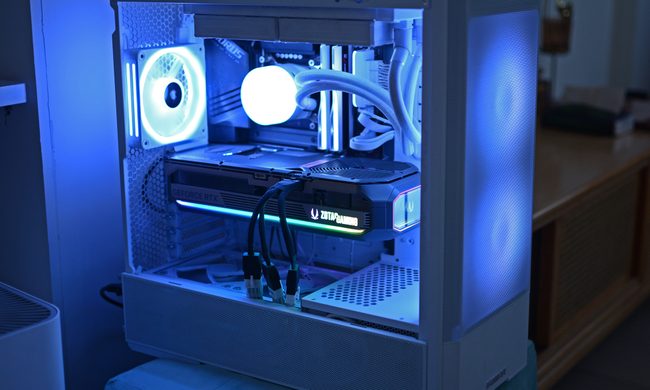
The Zotac RTX 5070 Ti Amp Extreme Infinity plugged into a white gaming PC

Your PC and laptop runs hotter every year, especially now that AI tools and heavy software push it harder than ever. Heat is a real bottleneck for performance, which is why people have gone to wild lengths to solve it, like strapping an actual ice machine to an RTX GPU. A new study points to a far less extreme fix for this problem, and it involves bacteria (via TechXplore).

Researchers have developed a new way to grow thermal interface materials, the substances that sit between a chip and its cooling system to help heat escape faster. The process involves feeding bacteria sugar and metal ions, letting the microbes build the material naturally instead of relying on traditional chemical manufacturing.

Read more
Bored of reading papers? This AI tool turns them into TikTok-like videos
PaperTok brings academic papers to people with short attention spans
Head, Person, Face

Academic papers aren't what you'd consider a fun read. For the average person, the dense, long, and field-specific language-filled papers can be quite intimidating to get into. These are usually packaged as PDFs that look like they were designed to test your willpower. A group of University of Washington researchers thinks there may be a better way to get that work in front of regular people. They are turning the papers into short-form videos.

The tool is called PaperTok, and it uses AI to help researchers convert academic papers into short, social-friendly videos. Think TikTok, except the idea is to explain research instead of sharing brain-rotting content. The best part? PaperTok is building a platform around scientists and researchers who are involved in the process, rather than simply using AI to summarize these papers.

Read more