
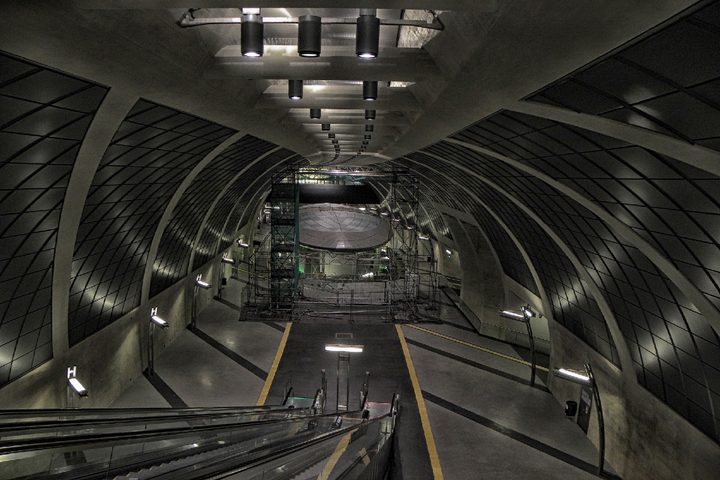
DARPA, the United States’ Defense Advanced Research Projects Agency, is looking to occupy some kind of underground lair where it can carry out all manner of crazy experiments.
How do we know? Well, mainly because DARPA just put out a public request for anyone who happens to know of any potential underground lairs that may happen to be on the market. It’s kind of like the military-industrial complex version of asking if you’ve got any friends renting out a room right now.
“Attention, city dwellers,” reads a tweet from DARPA’s official Twitter account. “We’re interested in identifying university-owned or commercially managed underground urban tunnels & facilities able to host research & experimentation.”
Attention, city dwellers! We're interested in identifying university-owned or commercially managed underground urban tunnels & facilities able to host research & experimentation. https://t.co/tHZ1Tqy5nV
It's short notice… We're asking for responses by Aug. 30 at 5:00 PM ET. pic.twitter.com/TSWO07bJam
— DARPA (@DARPA) August 28, 2019
It’s short notice, they admit, but they’re hoping to get responses by August 30. Accompanying documentation notes that the request comes from DARPA’s Tactical Technology Office.
The tweet describes the ideal space as “a human-made underground environment spanning several city blocks” that includes a “complex layout and multiple stories, including atriums, tunnels, and stairwells. Spaces that are currently closed off from pedestrians or can be temporarily be used for testing are of interest.
While my own personal working theory is that it’s looking to move the aliens out of Area 51 before the impending September raid, DARPA maintains the (somewhat vague) cover story that it wants to use the James Bond villain-style underground space to “support research and experimentation associated with ongoing and future research initiatives.” See, doesn’t that totally clear things up?
A DARPA spokesperson told Digital Trends that underground urban infrastructure can “present significant challenges for situational awareness in time-sensitive
scenarios, such as active combat operations or disaster response.”
“DARPA is interested in exploring this domain for researchers to analyze and enhance
approaches to improve situational awareness and response times in emergency
scenarios,” the spokesperson added. “Locations submitted could help the research community identify relevant sites for further field experimentation to accelerate their
development of such technologies.”
That said, even DARPA’s Twitter account admits that the request is ominous.
Even to us.
— DARPA (@DARPA) August 28, 2019
DARPA has shown a surprising amount of interest in the underground world as of late. Earlier this month, it wrapped up the first phase of its so-called “Subterranean Challenge,” a competition which aims to put various robots and other high-tech creations through their paces in a simulated underground disaster scenario. This contest involved 11 international robotics teams, and took place in a defunct mine system in Pittsburgh, Pennsylvania. Future phases of the contest (which this latest request may be related to) will involve an underground cave system and one other setting. The winner will take home $2 million of prize money for their hard work.
If you do happen to have any underground space you’re interested in renting out, contact DARPA via either the tweet or on the U.S. government’s Federal Business Opportunities page. With DARPA’s considerable budget at its disposal, it should hopefully be able to cover the first couple of months’ rent in advance. And the cleaning bill at the end.
Updated 8/28: Added comment from DARPA spokesperson.


