  1. Home
  2. Emerging Tech
  3. News

5,000 ‘eyes’ will scan the night sky for clues to the puzzle of dark energy

Add as a preferred source on Google

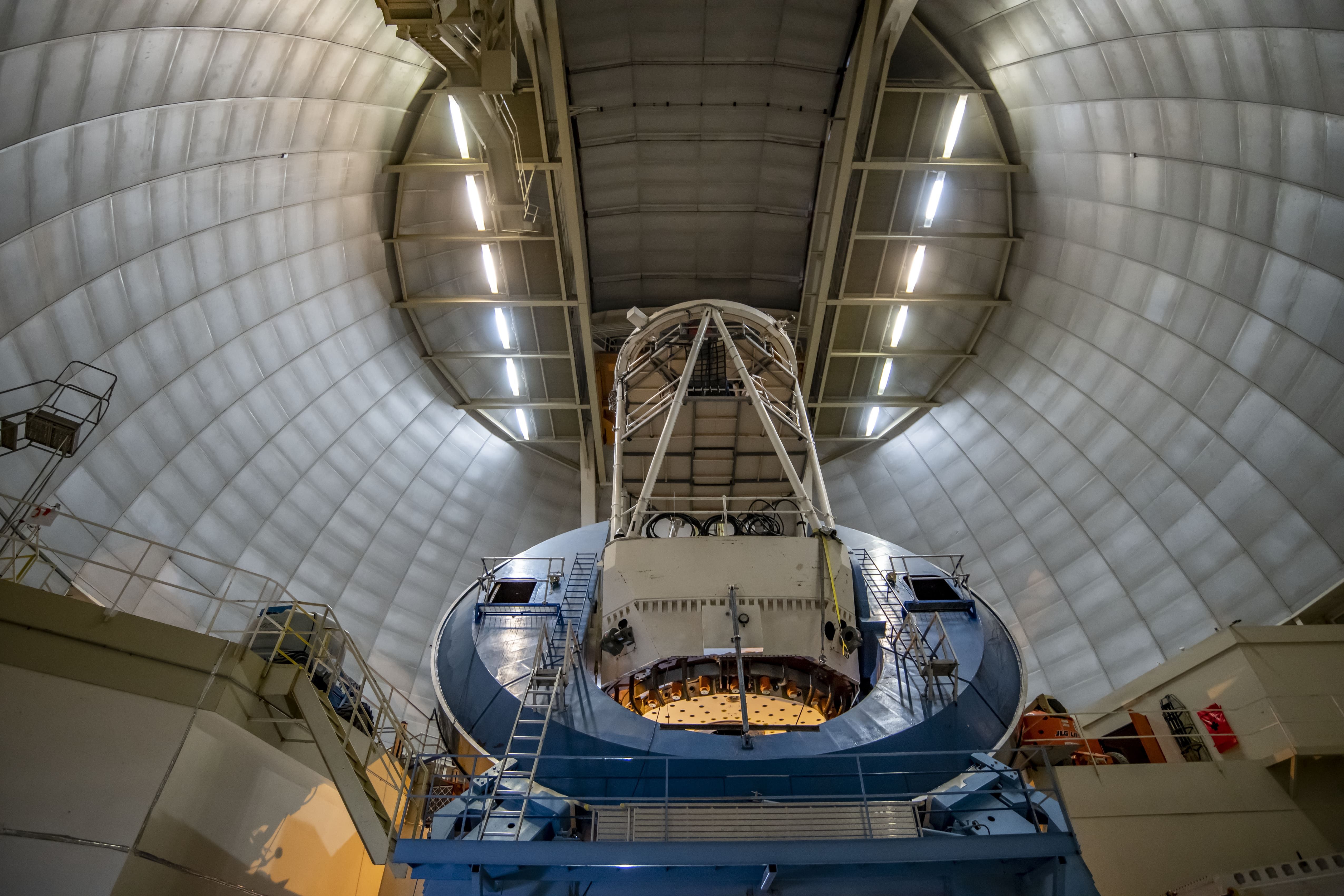
A view of the interior of the Mayall Telescope at Kitt Peak National Observatory. Marilyn Chung/Berkeley Lab

The hunt for dark energy has gained a new weapon, with the first test of the Dark Energy Spectroscopic Instrument (DESI) being completed recently. DESI is installed atop the Nicholas U. Mayall Telescope at Kitt Peak National Observatory outside Tucson, Arizona and will search for evidence of the mysterious energy which makes up 68% of the universe and speeds up its expansion.

Recommended Videos

“After a decade in planning and R&D, installation and assembly, we are delighted that DESI can soon begin its quest to unravel the mystery of dark energy,” DESI Director Michael Levi of the Department of Energy’s Lawrence Berkeley National Laboratory said in a statement. “Most of the universe’s matter and energy are dark and unknown, and next-generation experiments like DESI are our best bet for unraveling these mysteries. I am thrilled to see this new experiment come to life.”
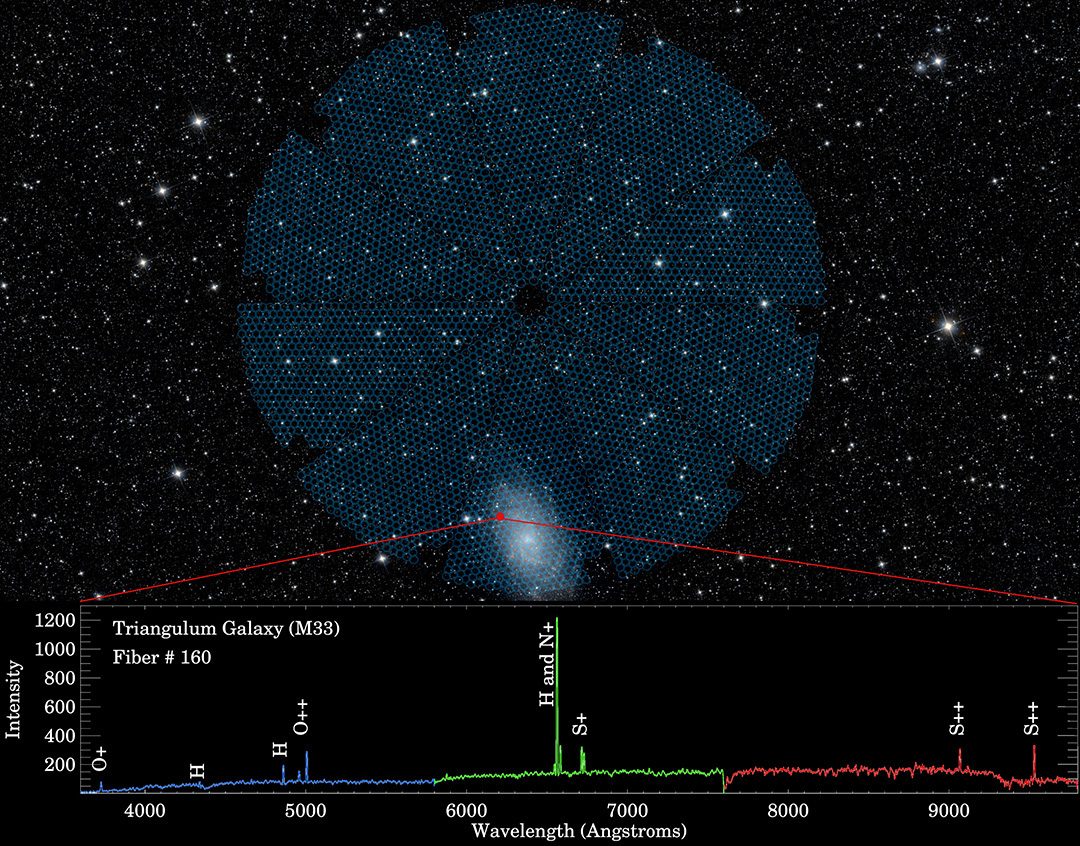
The gathered light collected from a small region in the Triangulum galaxy (bottom) by a single fiber-optic cable is split into a spectrum (bottom) that reveals the fingerprints of the elements present in the galaxy and aid in gauging the distance to the galaxy. The test spectrum shown here was collected by DESI on October 22. Credit: Dustin Lang, Aaron Meisner, DESI Collaboration/Imagine Sky Viewer; NASA/JPL-Caltech/UCLA; and Legacy Surveys project

To compile the first image shown above, DESI used its 5,000 spectroscopic “eyes” which peer out into the night sky. Each eye can focus on a single object to take in the light it produces. In this case, the instrument collected data from a small region in the Triangulum galaxy.

In order to hunt out dark energy, DESI will begin by mapping the distance to 35 million galaxies across one-third of the sky. It will also map the distance to 2.4 million quasars, supermassive black holes which give off powerful bursts of electromagnetic radiation. This mapping will help astronomers see the literal big picture of the expansion of the universe.

“Galaxies aren’t scattered randomly in space, but instead form a complex pattern from which we can learn about the composition and history of the universe,” Professor Daniel Eisenstein of the Center for Astrophysics at Harvard & Smithsonian explained in the same statement. “The unprecedented maps from DESI will allow us to measure how the universe has expanded over time, to see how gravity and dark energy compete to pull and push material apart.”

Having captured its first image, DESI will officially begin its scientific observations in early 2020.

Georgina Torbet
Georgina has been the space writer at Digital Trends space writer for six years, covering human space exploration, planetary…
This jacket pulls drinking water straight from the air
Engineers at UT Austin have developed a wearable textile that harvests ambient moisture into drinkable water.
Image showing person wearing a jacket with special fiber that pulls water from air

Engineers at the University of Texas at Austin have built a jacket that pulls drinkable water directly from the air, offering a potential solution for hikers, soldiers, agricultural workers, and emergency responders who operate far from reliable water sources.

How the jacket collects water

Read more
Google built an AI that can see football plays before they happen
DeepMind’s latest research predicts player movement up to eight seconds into the future
Google Deepmind TacticAI Featured

Football managers spend countless hours analyzing corners, free kicks, and player positioning in search of tiny competitive advantages. Google DeepMind believes artificial intelligence can make that process significantly faster, and its latest project, TacticAI, is designed to do exactly that. TacticAI is a football-specific AI assistant capable of modeling player movement, forecasting future play dynamics, and even recommending tactical adjustments for corner kicks. One of its standout abilities is predicting player trajectories up to eight seconds into the future using only broadcast-style visual data.

TacticAI was built with Liverpool FC and validated by football experts

Read more
Radical new coffee-making method uses sound, skips hot water and reduces energy bills
UNSW reserachers brewed espresso with room-temperature water and ultrasonic sound waves, cutting energy use by 75% in blind tests that fooled 100 regular drinkers.
Person brewing espresso in a lab with a modified ultrasonic espresso machine

Researchers at UNSW Sydney have figured out how to brew espresso-strength coffee without heating any water. The method replaces hot water and high pressure with ultrasonic sound waves, and in blind taste tests involving 100 regular coffee drinkers, participants could not tell the two apart.

How it works

Read more