  1. Home
  2. Emerging Tech
  3. News

A defense company is building a drone that can fly continuously for one year

Add as a preferred source on Google
BAE Systems

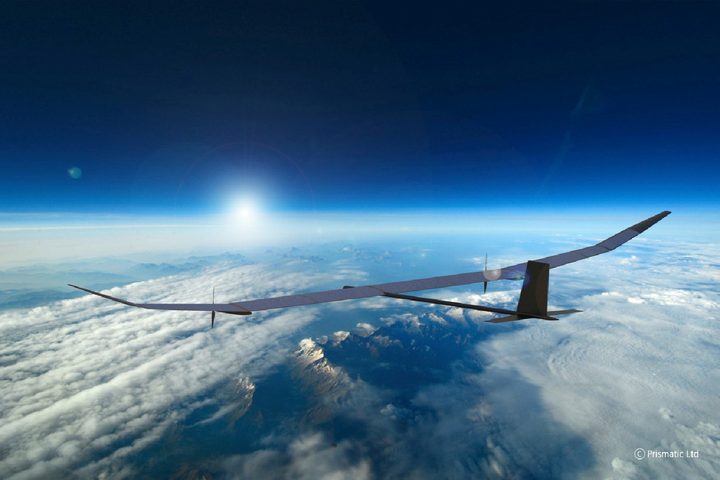
An average drone has a flight time of around 10 to 20 minutes. Record-breaking drones, meanwhile, can eke out anything from a few hours to, in the case of one diesel-powered drone, a few days. None of these can hope to hold a candle to a new solar electric unmanned aerial vehicle (UAV) being developed by cutting-edge British companies, BAE Systems and Prismatic.

They are collaborating on the development of a new high-altitude, long-endurance drone called PHASA-35, which aims to achieve flight times of anywhere up to an astonishing 12 months. To do this, it will use a combination of long-life battery technology and ultra-lightweight solar cells that will allow it to power itself using the sun’s rays.

Recommended Videos

This isn’t your ordinary drone, of course. It has a wingspan of 35 meters, which is around half that of a Boeing 747. However, it is also extraordinarily light, weighing just 150 kilos — or 0.05 percent of the 747’s maximum takeoff weight. The craft has been in development for the past two years, and a quarter-scale model took to the skies in 2017 for a test flight. The team developing it is hoping that the real thing will be ready for test flights of two production prototypes sometime in the second half of 2019.

“PHASA-35 is an air vehicle that is being developed to be capable of flying in the stratosphere at 70,000 feet above the earth, and is anticipated to fly for up to a whole year at a time,” a spokesperson from BAE Systems told Digital Trends. “The platform can achieve these previously unseen performance characteristics due to its extremely lightweight and innovative carbon fiber construction, coupled with its highly efficient solar panels which are able to power the vehicle and also charge the batteries for nighttime operation.”

BAE’s spokesperson said that they perceive multiple uses for the craft, including communications, providing GPS coverage to remote areas, and optical imaging.

If the name BAE Systems sounds familiar, that is because it has previously been behind such science fiction-sounding projects as military drones which can be “grown” using chemistry in large-scale labs and energy-scattering deflector shields. The fact that this latest project arguably isn’t its most ambitious sounding concept yet speaks volumes about how much exciting work the company is engaged in!

Luke Dormehl
I'm a UK-based tech writer covering Cool Tech at Digital Trends. I've also written for Fast Company, Wired, the Guardian…
Robots just ran the Beijing half-marathon faster than the world record holder
humanoid robot running a marathon

A humanoid robot just ran a half-marathon faster than the world record holder. It might not seem impressive at first, but considering last year, the fastest robot at Beijing's humanoid robot half-marathon finished in two hours and 40 minutes, this is a huge achievement. 

As reported by the Associated Press, the winning robot at this year's Beijing half-marathon crossed the finish line in 50 minutes and 26 seconds, comfortably beating the human world record of 57 minutes recently set by Jacob Kiplimo. 

Read more
As if the plate wasn’t already full, AI is about to worsen the global e-waste crisis
New report highlights a rising environmental concern
Stack of graphics cards and motherboards in a landfill site e-waste

AI is already changing how the world works, but it’s also quietly making one of our biggest environmental problems even worse. And no, this isn’t about energy consumption this time. It’s about the hardware. Because every smarter AI model comes with a physical cost.

AI is about to supercharge the e-waste problem

Read more
Smart glasses are finding a surprise niche — Korean drama and theater shows
Urban, Night Life, Person

Every year, millions of people follow Korean content without speaking a word of the language. They stream shows with subtitles, read translated lyrics, and find workarounds. But live theater has always been a different problem — you can't pause or rewind it. That's the problem: a Korean startup thinks it's cracked, and Yuroy Wang was one of the first to try it. The 22-year-old Taipei retail worker is a K-pop fan who loves Korean culture but doesn't speak the language. When he went to see "The Second Chance Convenience Store," a touring play based on a Korean novel that was a bestseller in Taiwan, he expected supertitles. What he got instead was a pair of chunky black-framed AI-powered glasses sitting on his nose, translating the dialogue in real time directly on the lenses. "As soon as I found out they were available, I couldn't wait to try them," he said. Wang is part of a growing audience discovering that smart glasses, a category of tech that has struggled to find mainstream purpose for years, might have just found their calling in the most unexpected of places: live Korean theater.

How do the glasses work?

Read more