
If you’re trying to carry something that is heavy or unwieldy, the easiest thing to do is to grab a buddy and take one end each. But while this may seem straightforward to us, no one has previously managed to get drones to carry items in this way — until now, at least. With the goal of helping create the drone-led warehouses of the future, researchers at the University of Pennsylvania have developed a smart system that allows autonomous drones to work together to transport payloads in this collaborative manner.
“We address the problem of cooperative transportation of structures, which are either too heavy or too big to be carried by small vehicles,” Giuseppe Loianno, a doctor of computer and automatic engineering and lead author of the research, told Digital Trends. “A more advanced form of collective behavior is required for tasks that simply cannot be accomplished by individuals, but can be solved by cooperation and coordination. Each robot needs to interact with the payload and also accommodate the rigid constraints introduced between the different robots. The transportation task does not depend on cable connections, but rather on a rigid connection between the vehicles and the load. The rigid connection is preferable in constrained environments where physical constraints do not allow the use of suspended cables. Our solution is simple and inexpensive. The proposed approach also scales very well with a large number of robots.”
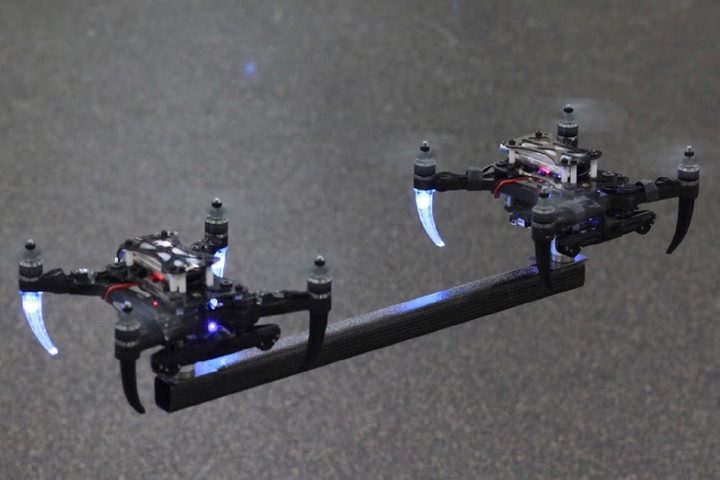
The drones are equipped with just a single camera and inertial measurement unit (IMU), an electronic device which measures the physical forces acting upon them, using a combination of accelerometers and gyroscopes. With just these simple measurement devices they then communicate with one another using a cooperative localization scheme that allows each vehicle to benefit from measurements acquired by the other vehicles. This ensures that the object being carried is done evenly and in a way that will not cause it damage. Using this system, the drones can reach speeds of 4.2 meters per second while carrying objects.
“In the future, we aim to have a complete system that will be able to automatically infer to an operator the number and types of vehicles needed to pick each object in a coordinated fashion, and transport them to the final destination,” Loianno said. “The system has to guarantee a close and safe collaboration and coordination between robots and humans, allowing an operator to benefit from the collaborative interaction with the robot during the task. This system must be intelligent and adapt itself to the type of environment and objects [that need] to be manipulated and transported.”
A paper describing the work was recently published in the journal IEEE Robotics and Automation Letters.


