
As our urban centers become more densely populated, engineers are continuously looking to maximize this space by building upward rather than outward. As a result, we’ve seen massive skyscrapers sprout up in metropolitans around the world. But some of the most populated areas on the globe are also prone to earthquakes. As history has shown time and time again, a massive tremor in an ill-designed city center can have costly and, most importantly, deadly ramifications. This is why earthquake proof buildings, also known as earthquake resistant buildings, are becoming more common.
In an attempt to prevent damage during a quake, many earthquake-prone cities have mandated sweeping engineering standards for new high-rises as well as retrofitting standards for older units. But just because a building is sturdy doesn’t mean it can’t have style. We’ve collected the most amazing and gorgeous earthquake proof buildings from around the world.
(When you’re done with these buildings, check out the craziest, most tricked-out shipping container homes, or everything we know about how China builds artificial islands.)
Taipei 101 (Taipei, Taiwan)


At 1,667 feet tall, Taipei 101 was the tallest building in the world when it was completed in 2004. While it may no longer hold claim to this engineering title, Taipei 101 still houses some of the most impressive seismic- and weather-resistant technologies ever designed. Taipei 101 uses a a massive internal damper to control swaying and minimize the possibility of structural damage or failure, making it a very earthquake resistant building. The goal of such a damper isn’t to prevent swaying in general, but to instead attempt to control this movement.
This tuned mass damper weighs 728 tons and is suspended between the 87th and 92nd floors. During an earthquake or high winds, the pendulum counteracts the building’s movements. In 2005, during Typhoon Soudelor, Taipei 101 was blitzed with winds of 100 miles per hour and even a gust of 145 mph. However, the damper — which was engineered for a maximum wind speed of 135 mph — quite literally weathered the storm. You can watch the pendulum in motion during Typhoon Soudelor.
Shanghai Tower (Shanghai, China)

Standing more than 2,000 feet high, the Shanghai Tower is the second tallest building on the planet. Unfortunately, Shanghai is located in a seismically active area and the site of the tower is composed primarily of soft, clay-heavy soil. To boost the foundation and make it more of an earthquake proof building, engineers incorporated 980 piles — some nearly 300 feet deep — secured within 2.15 million cubic feet of reinforced concrete.
Like Taipei 101, the Shanghai Tower also utilizes a tuned mass damper to control sway during an earthquake or high winds. Weighing in at 1,000 tons, the damper in the Shanghai Tower dwarfs the device used in Taipei 101 by more than 200 tons. As the building sways, the inertia of the weight counters this movement. For optimal counterbalancing, a series of shock absorbers keep the pendulum from swinging too far or too quickly.
The Transamerica Pyramid (San Francisco, California)

A study published in 2016, stated that current predictive earthquake models could be significantly underestimating the potential of the next massive tremor to strike the Bay Area. This future shock is currently forecasted to be at least as strong as the notorious 1994 6.7-magnitude Northridge quake and the Transamerica Pyramid — currently the tallest building in San Francisco — was deigned to withstand the inevitable Big One.
The building itself sits on a 52-feet deep foundation of concrete and steel that was designed to move with the earth during a quake. The exterior is made of precast quartz aggregate, buttressed with reinforcing rods at four points on each level. During the 1989, the 6.9-magnitude Loma Prieta quake, the building shook for more than a minute and the top floor swayed from side-to-side nearly a foot, but the building sustained no structural damage. A series of sensors installed in the frame of the building measure horizontal displacement and according to the U.S. Geological Survey, the Transamerica Pyramid could withstand an even larger seismic event. It may be a truly earthquake proof building.
Mori Tower (Tokyo, Japan)

Japan sits in one of the most seismically active regions on the planet. Each year, the country experiences more than 100,000 earthquakes, according to the Seismology Society of Japan. After the catastrophic 1995 Great Hanshin earthquake — or Kobe earthquake is it more commonly known — the country mandated new engineering standards and sweeping retrofitting overhauls to prevent similar devastation in the future.
Mori Tower is one of the tallest buildings in Tokyo and per its official website, the tower was designed to be a “a ‘city to escape into’ rather than a city from which people run away.” To fulfill this ambitious goal, the Mori Tower features some of the most sophisticated motion-absorbing, earthquake resistant building technology ever implemented.
Like Taipei 101, Mori Tower uses damper engineering for seismic resistance. However, rather than implementing a massive tuned damper Mori Tower uses 192 of fluid-filled shock absorbers. These semi-active dampers are filled with a thick oil, and as the tower begins to sway — as a result of tremor or high winds — this oil is sloshed in the opposite direction to counter and/or minimize this swaying.
New Wilshire Grand Center (Los Angeles, California)
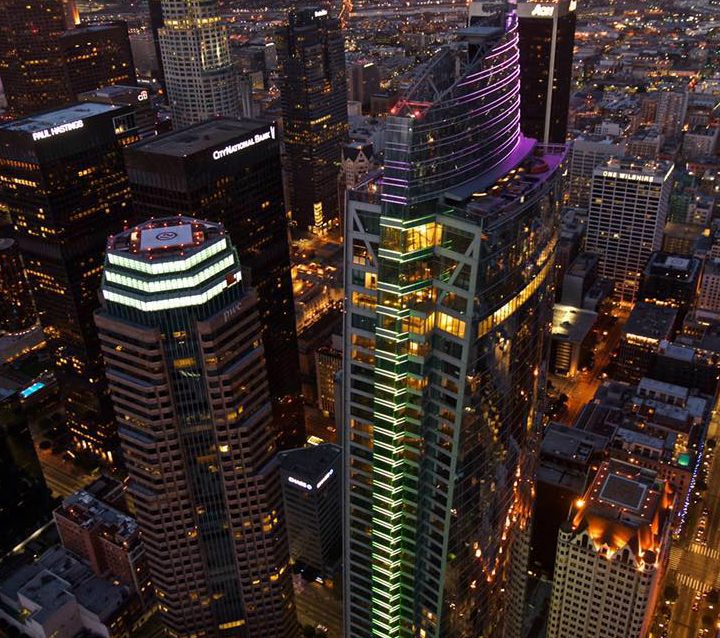
Southern California is long overdue for a massive earthquake and this was known even prior to a newly identified fault in the area capable of creating a 7.4-magnitude earthquake. With this rather foreboding knowledge in mind, Los Angeles has some of the most expansive seismic building regulations in the country. In fact, in 2015, more than 15,000 buildings were required to be retrofitted to meet these new guidelines.
As one could imagine, the tallest building in Los Angeles, the New Wilshire Grand tower, went through rather rigorous seismic modeling beforehand. During testing it was realized that an earthquake could create catastrophic whiplash on the top floors of the building. To counter this, the team implemented 30 outriggers along three sections of the building. Outriggers are braces that form triangles that extend from the center of the complex to the exterior columns of the building, allowing the facility to resist vertical and lateral forces.
To further buttress these outriggers, engineers incorporated a series of so-called buckling-restrained braces to each unit. These specialized braces can stretch and also compress without buckling. The building itself sits on a 17.5-foot concrete foundation and the seismic savvy skyscraper also utilizes a joint between the base and the tower that is capable of sustaining up to 1.5-feet of sway.
Sabiha Gökçen Airport (Istanbul, Turkey)
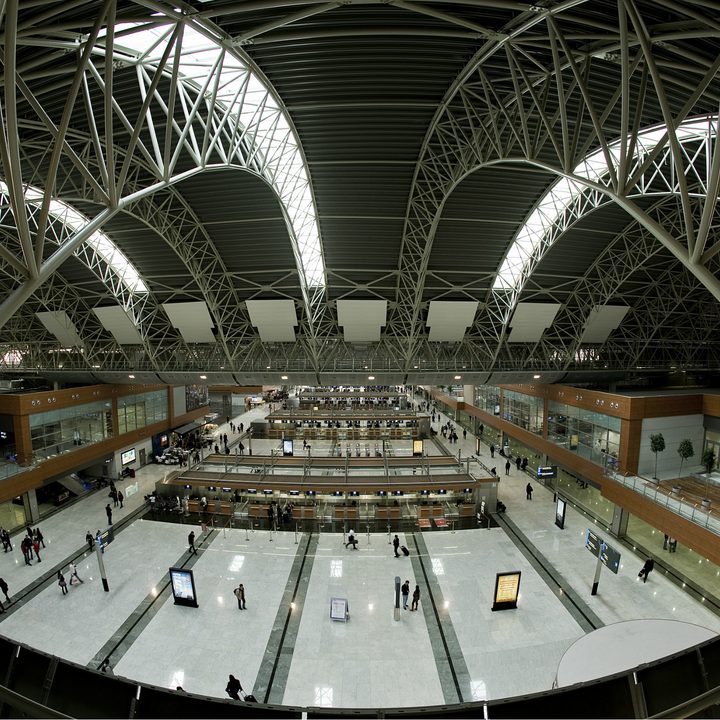
In 1999, a 7.4-magnitude earthquake hit Istanbul killing 17,000 people. Seeing as the city is situated near the Arabian, African, and Eurasian tectonic plates, another large quake is projected to happen within the next 30 years. With that in mind, engineers designed Istanbul’s Sabiha Gökçen Airport to be able to withstand the next inevitable seismic shock. The airport now claims the lofty and very specific title of the world’s largest seismically isolated building.
The two-million square foot complex sits above the ground on more than 300 seismic isolators. These individual bearings shift with the undulations of the earthquake, allowing the entire building to move as a single unit. This design diminishes the acceleration the building would experience during an earthquake by 80 percent.
Komatsu Seiren (Nomi, Japan)

Not all earthquake proof building designs utilize the most sophisticated dampers or seismic isolators to protect buildings during major seismic shifts. A Japanese textile firm, Komatsu Seiren, recently used high-tensile twine developed from carbon fiber to reinforce its facility in Nomi, Japan. Architects Kengo Kuma and Associates then attached more than 1,000 of these high-tensile rods to the roof of the facility. Inside the showroom, another “curtain” of nearly 3,000 additional rods add further structural reinforcement. Together these systems help minimize the horizontal forces exerted during an earthquake.


