  1. Home
  2. Emerging Tech
  3. News

Elon Musk shares a new look at the SpaceX rocket he wants to send to Mars

Add as a preferred source on Google
SpaceX Starship Prototype
SpaceX

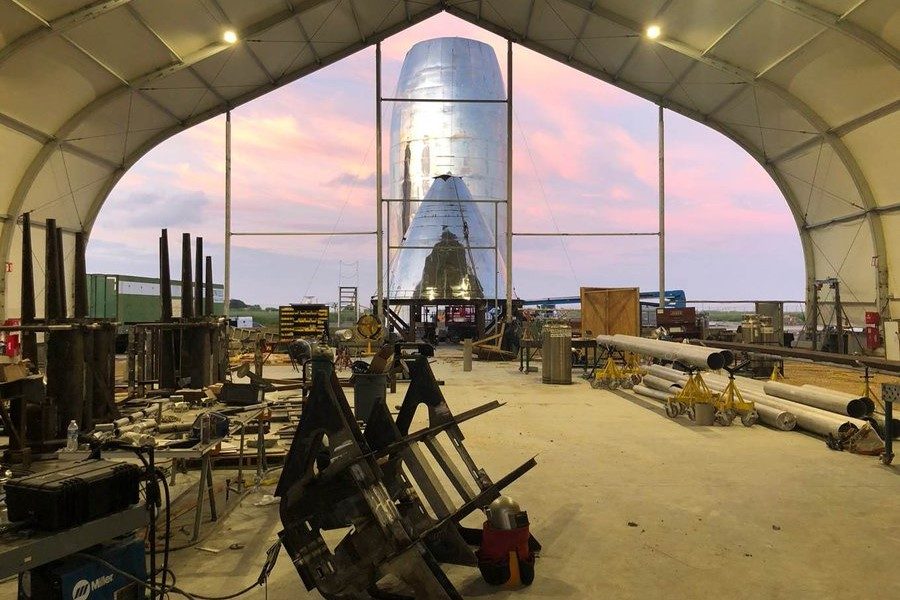
Elon Musk tweeted out two new photos showing how work on SpaceX’s Starship rocket prototype is coming along. The commercial space company expects to fly the ship to the moon and hopes to use it to help establish a colony on Mars 

In a tweet posted on Tuesday and captioned with “Droid Junkyard, Tatooine” — a Star Wars reference, of course — Musk shared an image of the SpaceX facility where work is underway on the Starship.

Recommended Videos

The stainless steel rocket that peaks through the photo is currently under construction in Boca Chica, Texas — though there’s another version, Starship Mk2, that’s being built at the company’s workspace in Florida.

Droid Junkyard, Tatooine pic.twitter.com/yACFR9y04P

— Elon Musk (@elonmusk) September 17, 2019

And, in true Musk fashion, he included a timely Area 51 joke in a second picture showing a section being lowered onto the main rocket.

Area 51 of Area 51 pic.twitter.com/Du7i92sFaO

— Elon Musk (@elonmusk) September 17, 2019

SpaceX hopes for Starship to be used as a commercial spacecraft that will be able to take off and land again, like an airplane. The hope is to have Starship ready for commercial flights by 2021. Musk has previously said that SpaceX hopes to land the Starship on the moon by that year, followed by a crewed mission a year or two later.

An application to the Federal Communications Commission (FCC) submitted by SpaceX on September 9 revealed that SpaceX is preparing to launch its Starship spacecraft into orbit. The test will include an “Experimental launch, landing, and recovery of the Starship suborbital test vehicle.” The vehicle will land about hundred or so feet from its launch site. 

The application dates point to the possibility that the company could launch the Starship prototype as soon as October 13. With Musk’s timely tweets, it looks like that date might not be too far of a stretch. 

These tests are essential to perfecting the Starship rocket. Musk’s ultimate goal for the rocket is to help set up a colony on Mars, bringing people on a trip to the moon, and even bring used for transcontinental travel. 

Digital Trends reached out to SpaceX for any official updates on the launch of the Starship rocket, and we’ll update this story if we hear back from the company.

Allison Matyus
Former Digital Trends Contributor
Allison Matyus is a general news reporter at Digital Trends. She covers any and all tech news, including issues around social…
Google wants Gemini to help build the next big scientific breakthrough
Gemini for Science pushes agentic AI deeper into real research workflows
gemini for science

Google is building Gemini deeper into the research workflow, starting with ideas, tests, and scientific literature.

At Google I/O 2026, the company announced Gemini for Science, an experimental suite built around agentic AI science. It targets the manual work behind discovery, including hypothesis building, computational testing, and literature review.

Read more
You can now walk through AI versions of real places with Google’s Project Genie
Text, Logo

Google is pushing its experimental AI world-building project into surprisingly realistic territory. The company announced that Project Genie can now use real-world imagery from Google Street View to generate interactive virtual environments, blending real locations with imaginative AI-generated styles.

At its core, Genie is what Google calls a “world model” — an AI system capable of creating explorable digital environments where AI agents, robots, or even users can interact naturally. Until now, those worlds were mostly synthetic. But with this new update, Genie can anchor itself to real places pulled directly from Street View imagery. This is actually where things start feeling like a glimpse into the future of simulation.

Read more
Google wants to reinvent your TV remote with Gemini and pointer controls
Computer Hardware, Electronics, Hardware

Google is making a bigger play for the living room, and this time, it is not just about what you watch — it is also about how you interact with your TV. At Google I/O 2026, the company revealed a fresh batch of updates for Google TV and Android TV developers, all centered around one idea: TVs are no longer passive screens sitting in the corner of your house. With more than 300 million monthly active devices across Google TV and Android TV, Google clearly sees the television as its next major AI battleground. And Gemini is now at the center of that strategy.

The company says Gemini is already helping users discover content through natural voice interactions. But Google now wants the experience to feel more dynamic and conversational, almost like searching the web — except on your couch. Instead of only surfacing static results, Gemini on Google TV can now respond with a combination of visuals, videos, and text snippets to answer queries. So if someone asks for a thriller with a strong female lead or a documentary about space exploration, Gemini pulls contextual recommendations directly from streaming apps and their metadata.

Read more