  1. Home
  2. Emerging Tech
  3. News

There may be frozen water on the moon, new study suggests

Add as a preferred source on Google

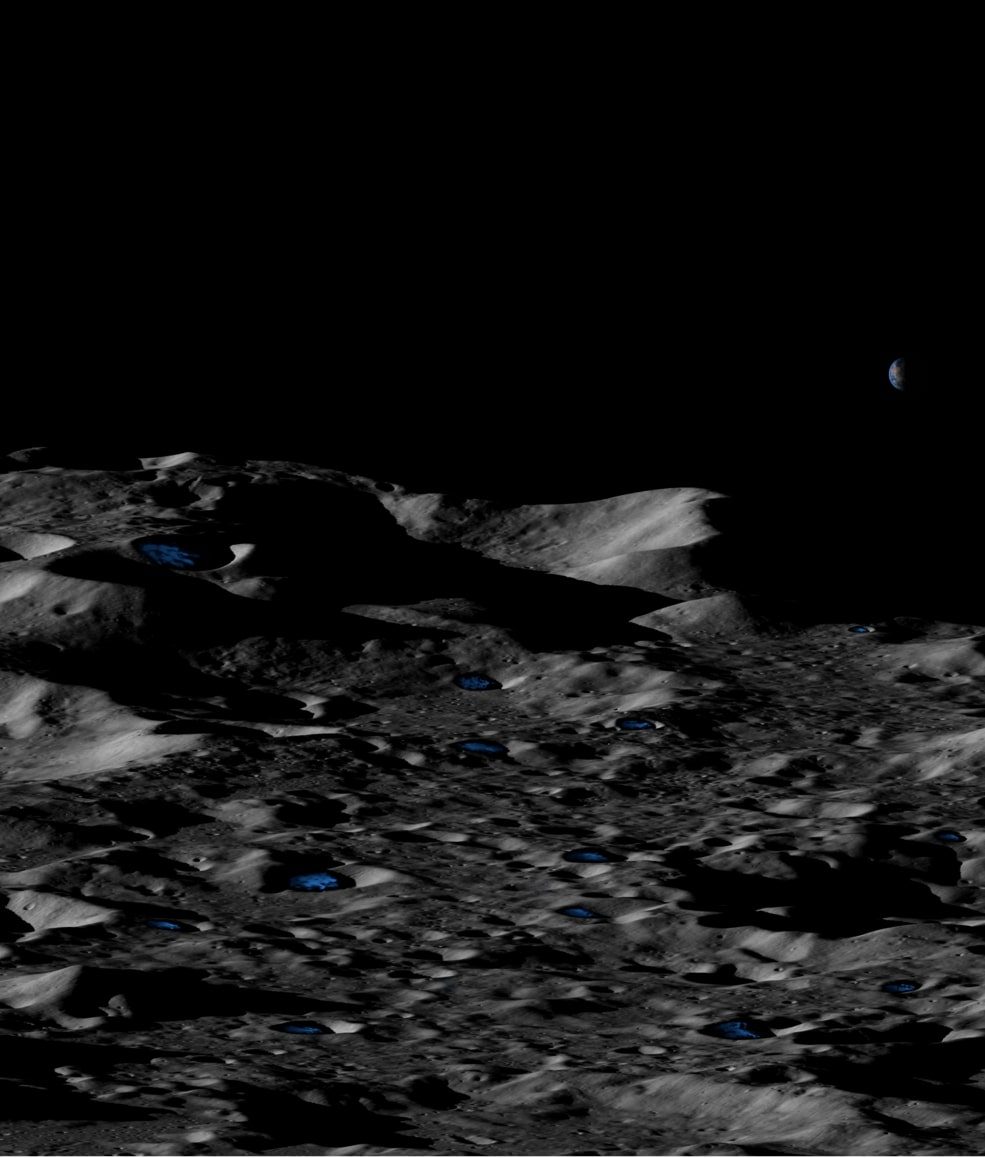
Conceptual illustration of permanently shadowed, shallow icy craters near the lunar south pole. UCLA/NASA

A new study suggests that there could be thick deposits of frozen water on the moon, located in craters near the lunar pole.

Recommended Videos

Discovering potential frozen water on the moon is not only of scientific interest. It could also be important for future lunar exploration, providing a water source for astronauts who stay on the moon for an extended period. As transporting supplies from Earth on a rocket requires a huge amount of fuel, finding an off-planet water source could enable longer missions and more efficient launches.

The findings on the moon are based on findings on Mercury. The planet and the moon share a similarly scarred surface caused by impacts from asteroids, creating many craters. And both the moon and Mercury spin in such a way that the Sun never rises high over the horizon over the poles, making these regions exceptionally cold. Some areas of the poles, like impact craters, are permanently in shadow and thus stay cold enough for ice to be preserved there indefinitely.

The observations of Mercury were made using MESSENGER, the MErcury Surface, Space ENvironment, GEochemistry and Ranging spacecraft, and the moon observations were made using LRO, the Lunar Reconnaissance Orbiter. Scientists used elevation data to determine the location and depth of craters, showing that the craters were up to 10% shallower near the poles, suggesting they could contain ice. This was supported by findings that the craters were shallower on their sides which faced the pole rather than the sides which faced the equator, which is what would happen if ice were exposed to less sunlight on the pole-facing side.

Using radar, scientists have searched for ice on the moon before but have only discovered small, shallow deposits. By contrast, on Mercury, they have discovered thick ice deposits. “We showed Mercury’s polar deposits to be dominantly composed of water ice and extensively distributed in both Mercury’s north and south polar regions,” Nancy Chabot, instrument scientist for MESSENGER’s Mercury Dual Imaging System at the Johns Hopkins Applied Physics Laboratory, said in a statement. “Mercury’s ice deposits appear to be much less patchy than those on the Moon, and relatively fresh, perhaps emplaced or refreshed within the last tens of millions of years.”

The findings are published in the journal Nature Geoscience.

Georgina Torbet
Georgina has been the space writer at Digital Trends space writer for six years, covering human space exploration, planetary…
Google wants Gemini to help build the next big scientific breakthrough
Gemini for Science pushes agentic AI deeper into real research workflows
gemini for science

Google is building Gemini deeper into the research workflow, starting with ideas, tests, and scientific literature.

At Google I/O 2026, the company announced Gemini for Science, an experimental suite built around agentic AI science. It targets the manual work behind discovery, including hypothesis building, computational testing, and literature review.

Read more
You can now walk through AI versions of real places with Google’s Project Genie
Text, Logo

Google is pushing its experimental AI world-building project into surprisingly realistic territory. The company announced that Project Genie can now use real-world imagery from Google Street View to generate interactive virtual environments, blending real locations with imaginative AI-generated styles.

At its core, Genie is what Google calls a “world model” — an AI system capable of creating explorable digital environments where AI agents, robots, or even users can interact naturally. Until now, those worlds were mostly synthetic. But with this new update, Genie can anchor itself to real places pulled directly from Street View imagery. This is actually where things start feeling like a glimpse into the future of simulation.

Read more
Google wants to reinvent your TV remote with Gemini and pointer controls
Computer Hardware, Electronics, Hardware

Google is making a bigger play for the living room, and this time, it is not just about what you watch — it is also about how you interact with your TV. At Google I/O 2026, the company revealed a fresh batch of updates for Google TV and Android TV developers, all centered around one idea: TVs are no longer passive screens sitting in the corner of your house. With more than 300 million monthly active devices across Google TV and Android TV, Google clearly sees the television as its next major AI battleground. And Gemini is now at the center of that strategy.

The company says Gemini is already helping users discover content through natural voice interactions. But Google now wants the experience to feel more dynamic and conversational, almost like searching the web — except on your couch. Instead of only surfacing static results, Gemini on Google TV can now respond with a combination of visuals, videos, and text snippets to answer queries. So if someone asks for a thriller with a strong female lead or a documentary about space exploration, Gemini pulls contextual recommendations directly from streaming apps and their metadata.

Read more