

There are critics out there complaining about NASA’s inability to innovate simply due to the grounding of explorations to the moon. But a crop of 28 funded projects by NASA’s Innovative Advanced Concepts Program will make anyone think twice about the organization’s aptitude for forward-thinking ideas.
Now that the most difficult part of Curiosity’s successful trip to Mars has come to pass, and placed NASA back on the radar of countless space enthusiasts throughout the world, NASA has an untold number of projects, not related to Curiosity, up its sleeve. And if its latest funded projects are any indication, some of these concepts appear to have been taken right out of a science fiction movie.
The award recipients were separated by two categories, Phase 1 and Phase 2.
PHASE 1
Phase 1 fellows are those whose concept proposals won NASA’s $100,000 grant for one year of further the research to discover the proposals’ feasibility. Among the Phase 1 proposals, the following caught our eye.
Venus Landsailing Rover
Proposed by NASA’s Glenn Research Center (GRC), is a practical ways to landsail above or through the dense atmosphere of Venus, the second rock from the sun.
HOMES – Holographic Optical Method Exoplanet Spectroscopy
This proposal suggests a technology that will enable scientists to study planets outside of our solar system using holographic projections or representations of said planets.
Exploration of Under-Ice Regions with Ocean Profiling Agents (EUROPA)
Researchers at Virgina Polytechnic Institute and Virginia State University are researching feasible ways to explore what’s beneath the icy surface of Jupiter’s sixth closest moon. What the researchers suggest building is a submarine destined for Europa.
Water Walls: Highly Reliable and Massively Redundant Life Support Architecture

Intended for long-duration space missions, waste, fecal matter and urine need an efficient way of being recycled as the consequences of simply disposing of the grey matter onto an extraterrestrial planet is unknown. NASA’s Ames Research Center (ARC) has proposed the construction of a habitat where waste water is treated within its walls. Osmosis would filter out usable water, while the waste would be re-purposed as a radiation shield.
PHASE 2
Phase 2 proposals are ideas from Phase 1 of last year that have shown promise and will be rewarded $500,000 for further development and analysis – a potential precursor to the development of a prototype. Here are some Phase 2 ideas that we were intrigued by.
The Fusion Driven Rocket: Nuclear Propulsion through Direct Conversion of Fusion Energy

MSNW scientists have been researching and prototyping is a rocket propulsion system that would be propelled by fusion energy. What are the benefits of this technology? According to the research, existing technology can send a mission to Mars in approximately 210 days. A fusion driven rocket, however, would theoretically enable NASA to reach Mars in a blazing-fast 30 days.
Printable Spacecraft: Flexible Electronic Platforms for NASA Missions
The future of manufacturing could be in 3D printing. Today, our technological capabilities today enable us to print flexible substrates from silicon and glass to metal and biological inks. Eventually 3D printing technology could be scaled up to print an entire spacecraft.
Variable Vector Countermeasure Suit (V2Suit) for Space Habitation and Exploration
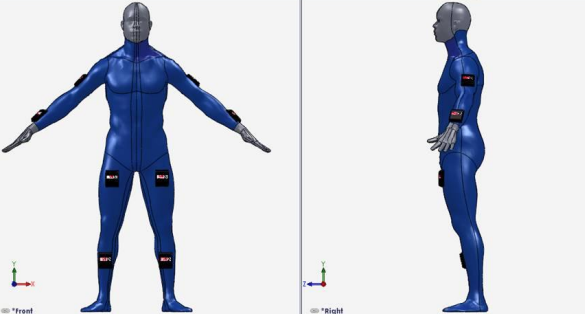
As you surely already know, objects in space are subject to weightlessness. In this odd environment, astronauts can often become disoriented when attempting to position themselves within the confines of a spacecraft. Using gyroscopes and accelerometers to provide resistance in space, the V2Suit will mimic the sensation of gravity for its wearers.
The development of the V2Suit is evidence that NASA has human-manned, deep-space exploration missions in mind. (Currently, they only use robots.)
“These selections represent the best and most creative new ideas for future technologies that have the potential to radically improve how NASA missions explore new frontiers,” said Michael Gazarik, director of NASA’s Space Technology Program in a statement.
The listed projects are still in early development. And if any reach the prototyping stage, it won’t be for another 10 or more years that we would see their use in an actual mission. But with Obama’s plans to send a human mission to Mars by 2030, we wouldn’t be surprised if the V2Suit, Printable Spacecraft, and other sci-fi-like technologies are among those that end up aiding the human exploration of the Great Unknown.


