  1. Home
  2. Emerging Tech
  3. News

The birth of stars creates epic stellar winds which seed new galaxies

Add as a preferred source on Google

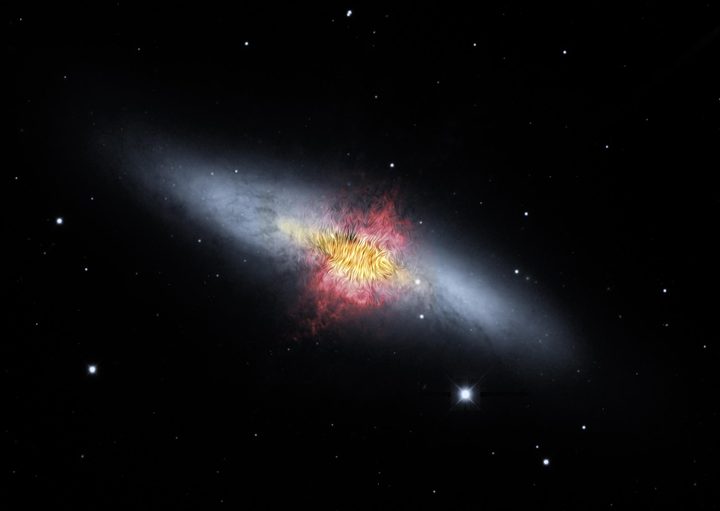
The magnetic field lines of the the Cigar Galaxy (also called M82) appear in this composite image. The lines follow the bipolar outflows (red) generated by exceptionally high rates of star formation. NASA/SOFIA/E. Lopez-Rodiguez; NASA/Spitzer/J. Moustakas et al.

In the vast distances between galaxies, space is not completely empty — gas and dust is blown into the void and this matter eventually becomes the seed for new stars and galaxies. But where does this matter come from? A new study reveals how galactic winds carry this material away from sites of new star creation and out into intergalactic space.

Recommended Videos

Researchers at the Stratospheric Observatory for Infrared Astronomy (SOFIA) looked at the Cigar Galaxy, also known as M82, which is famous for producing new stars at a tremendous speed. In this galaxy, stars are born 10 times faster than they are here in our Milky Way. As well as this unusual feature, the Cigar Galaxy has particularly strong galactic winds — streams of highly charged particles which shoot off into space when new stars are formed. This makes it the ideal location to observe how gas and dust are carried out into intergalactic space.

Using the SOFIA flying observatory, the astronomers were able to observe the magnetic field of the Cigar Galaxy and see how it related to the movement of galactic winds. They found that the powerful winds moved not only matter but also the magnetic field itself, dragging it more than 2,000 light-years across.

“One of the main objectives of this research was to evaluate how efficiently the galactic wind can drag along the magnetic field,” Enrique Lopez-Rodriguez, a Universities Space Research Association (USRA) scientist working on the SOFIA team, said in a statement. “We did not expect to find the magnetic field to be aligned with the wind over such a large area.”

This finding suggests that the galactic winds could be responsible for seeding new galaxies as they carry not only gas and dust but also a magnetic field into the intergalactic medium, which would encourage stars and eventually galaxies to form. This is also relevant to understanding how the earliest galaxies formed at the start of the universe.

“Studying intergalactic magnetic fields — and learning how they evolve — is key to understanding how galaxies evolved over the history of the universe,” lead researcher for this study, Terry Jones, professor emeritus at the University of Minnesota, Minneapolis, said in the same statement. “We now have a new perspective on these magnetic fields.”

The findings are published in the Astrophysical Journal Letters.

Georgina Torbet
Georgina has been the space writer at Digital Trends space writer for six years, covering human space exploration, planetary…
Edge browser on mobile gets a huge upgrade that makes it a worthy pick over Chrome
Edge mobile gets smarter just before Chrome’s big Gemini moment
Microsoft Edge on a phone

Chrome is still the default browser for many smartphone users, but Microsoft’s latest Edge update gives them a practical reason to try something else.

Microsoft has announced a major Copilot update for Edge across desktop and mobile. The rollout comes ahead of Google’s Gemini-powered Chrome upgrade for Android, which is expected in June, giving Edge a chance to stand out on phones before Chrome’s next big AI push.

Read more
After flubbing with Siri, Apple plans to host AI agents on the App Store
One problem is about money Apple won't commit to not charging. The other is about AI agents Apple can't figure out how to control. WWDC needs to solve both.
Electronics, Mobile Phone, Phone

Apple is currently facing a Siri problem that has nothing to do with Siri at all. With WWDC 2026 just weeks away, The Information reports the company is actively courting developers to integrate their apps with the new Siri coming in iOS 27. 

The mechanism powering the overhauled Siri, App Intents, is an API that lets Siri execute actions inside third-party apps without you actively opening them, which sounds quite useful, I’d say. However, some of the world’s largest developers are dragging their feet on it, not because it’s tough, but because Apple left the door open on charging for it later.

Read more
EV batteries just need some AI top-up nudge, and they get a big 23% life boost, finds research
Charging fast and lasting long seemed impossible. A new AI trick says otherwise.
EV Charging

EV battery charging technology has always had to find the right balance between charging speed and battery longevity. If the charging speed is too fast, it wears down the battery. If the charging is too slow, nobody is happy. 

Researchers Meng Yuan from Victoria University of Wellington and Changfu Zou from Chalmers University of Technology in Sweden may have cracked this long-standing problem using an AI technique called deep reinforcement learning, and the results are pretty encouraging.

Read more