  1. Home
  2. Emerging Tech
  3. News

Animal gene sequencing project aims to assemble a comprehensive genomic zoo

Add as a preferred source on Google

You’ve quite possibly heard of the Human Genome Project, the massive international science research project dedicated to sequencing the human DNA. A less well-known project called Genome 10K has a not-unrelated mission — but instead of mapping just the human genome, it’s dedicated to sequencing the genome of thousands of animal species, including those most at risk of extinction.

“The purpose of the Genome 10K project is to assemble a genomic zoo of DNA sequences representing the full diversity of vertebrate animals, including at least 10,000 different vertebrate species,” David Haussler, the Genome 10K trustee and scientific director at the University of California Santa Cruz Genomics Institute, told Digital Trends. “Establishing the genetic diversity of vertebrate species would create a priceless resource for the life sciences and worldwide conservation efforts. We have only just begun to understand our natural environment. Because virtually all the biology of an animal is encoded in its genome, the Genome 10K project will provide a great leap forward.”

Recommended Videos

A genome, Haussler said, can help us calculate how endangered a particular species is by the effects of population size reductions that lead to inbreeding. This information is vital for prioritizing conservation efforts and helping plan efforts to conserve, and, via outbreeding, increase diversity within a species.
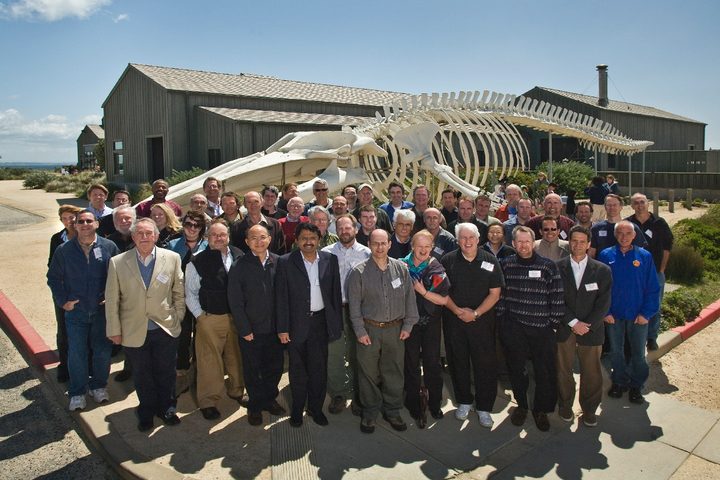
Members of the Genome 10K Community of Scientists gathered at its first meeting in April 2009 at the Seymour Center in Santa Cruz, California. Image used with permission by copyright holder

“The genomes of different vertebrates also tell us a great deal about ourselves: How we became human and what makes us uniquely human genetically,” Haussler continued. “By sequencing thousands of vertebrate genomes we will have an unprecedented evolutionary microscope for peering into our natural history, allowing us to understand our story over the last several hundred million years, and helping us better predict which genetic variations that are in our genomes today cause disease.”

Scientists involved with Genome 10K have developed new methodologies for genome sequencing and analysis. These have been proved on hundreds of cases, including many endangered species.

“Anyone can help assemble this genomic zoo by making a donation on our website,” Haussler said. “By donating now, you can help create a shared resource that will inform and guide our understanding of animal life for generations to come.”

Luke Dormehl
I'm a UK-based tech writer covering Cool Tech at Digital Trends. I've also written for Fast Company, Wired, the Guardian…
Robots just ran the Beijing half-marathon faster than the world record holder
humanoid robot running a marathon

A humanoid robot just ran a half-marathon faster than the world record holder. It might not seem impressive at first, but considering last year, the fastest robot at Beijing's humanoid robot half-marathon finished in two hours and 40 minutes, this is a huge achievement. 

As reported by the Associated Press, the winning robot at this year's Beijing half-marathon crossed the finish line in 50 minutes and 26 seconds, comfortably beating the human world record of 57 minutes recently set by Jacob Kiplimo. 

Read more
As if the plate wasn’t already full, AI is about to worsen the global e-waste crisis
New report highlights a rising environmental concern
Stack of graphics cards and motherboards in a landfill site e-waste

AI is already changing how the world works, but it’s also quietly making one of our biggest environmental problems even worse. And no, this isn’t about energy consumption this time. It’s about the hardware. Because every smarter AI model comes with a physical cost.

AI is about to supercharge the e-waste problem

Read more
Smart glasses are finding a surprise niche — Korean drama and theater shows
Urban, Night Life, Person

Every year, millions of people follow Korean content without speaking a word of the language. They stream shows with subtitles, read translated lyrics, and find workarounds. But live theater has always been a different problem — you can't pause or rewind it. That's the problem: a Korean startup thinks it's cracked, and Yuroy Wang was one of the first to try it. The 22-year-old Taipei retail worker is a K-pop fan who loves Korean culture but doesn't speak the language. When he went to see "The Second Chance Convenience Store," a touring play based on a Korean novel that was a bestseller in Taiwan, he expected supertitles. What he got instead was a pair of chunky black-framed AI-powered glasses sitting on his nose, translating the dialogue in real time directly on the lenses. "As soon as I found out they were available, I couldn't wait to try them," he said. Wang is part of a growing audience discovering that smart glasses, a category of tech that has struggled to find mainstream purpose for years, might have just found their calling in the most unexpected of places: live Korean theater.

How do the glasses work?

Read more