  1. Home
  2. Emerging Tech
  3. Health & Fitness
  4. Wearables
  5. News

Smart gloves can recognize American Sign Language and convert to text

Add as a preferred source on Google

One of the areas where it’s been truly amazing to watch technology make progress over the past few years is in accessibility. From gadgets that are designed to help blind people to see the world around them, to assistive technology that can help paralyzed people to walk, it’s a pleasure to be able to write about technology that can profoundly transform people’s lives for the better.

The latest potential example? A low-cost smart glove created by researchers at the University of California San Diego, which promises to automatically translate American Sign Language (ASL) into digital text that appears on a corresponding computer or smartphone. To use the glove, the wearer simply signs letters in the ASL alphabet, which are then recognized by way of variances in the electrical resistance. These variances allow an onboard computer to work out which letter is being signed, and then to relay this information via Bluetooth — no cameras required.

Recommended Videos

“The key innovative element of our device is the use of a conductive polymer composite at the knuckles, which are highly sensitive to bending and stretching,” Dr. Darren Lipomi, head of UC San Diego’s Lipomi Research Group, told Digital Trends. “There are other gesture-recognition gloves out there, but ours is the first to use extremely simple components that can be replicated by other researchers in the field of stretchable, wearable electronics to test their materials.”

The components in the glove add up to less than $100 in cost, making this a potentially affordable solution to a challenging problem.
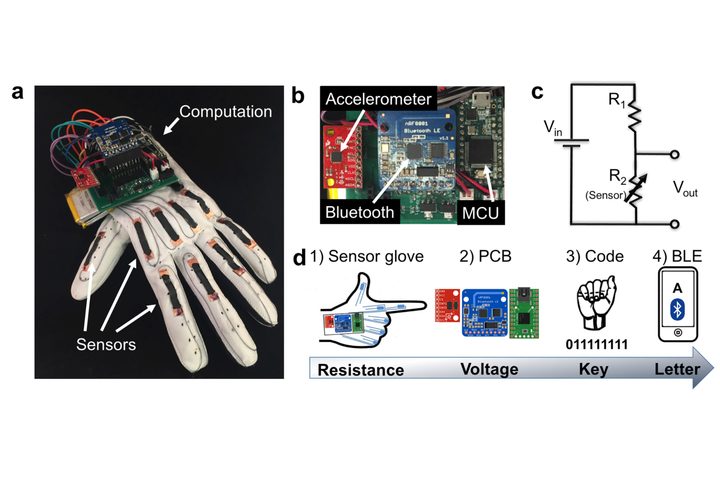
Image used with permission by copyright holder

“The [biggest] challenge of the project was one of integration,” Lipomi continued. “My research team is made up of chemists, chemical engineers, and materials scientists — me included. We are not specialists in electronics. The key was getting advanced materials to interact with electronic components one might find at a hardware store.”

Lipomi says that “essentially all the credit” goes to his graduate student, Timothy O’Connor, who worked tirelessly for two years to complete the project.

As to what’s next for the project, Lipomi said the next step is to incorporate tactile sensations on the interior of the glove. In addition to signing, he said he thinks there are also commercializable aspects in both virtual and augmented reality, as well as robotic surgery, medical training, and gaming.

A paper describing the work was published in the journal PLOS One.

Luke Dormehl
I'm a UK-based tech writer covering Cool Tech at Digital Trends. I've also written for Fast Company, Wired, the Guardian…
This see-through smart ring translates sign language and almost works like magic
asl translator smart ring on hand

For people who are hard of hearing, sign language isn't just a communication tool; it's their primary language. The problem is that sign language is not taught to people with regular hearing, thus creating a barrier that's hard to bridge. Now, a team of researchers in South Korea may have just found a surprisingly elegant solution to this age-old problem. 

According to a new study published in Science Advances, the system, called WRSLT (wirelessly connected, ring-type sign language translator), can recognize and translate both American Sign Language and International Sign Language words with around 88% accuracy. And yes, it works in real time.

Read more
The Android Show 2026: Gemini Intelligence, Googlebook, Android 17 updates, and everything else
Gemini Intelligence, Googlebooks, Android 17, and redesigned Android Auto. Google didn't hold back at its pre-I/O show, and the main event is still a week away.
The Android Show 2026

Every year, Google front-loads its Android announcements in a separate pre-show the week before its annual I/O conference. This year, the company did exactly that, and The Android Show: I/O Edition was anything but a warmup act. 

Google showed up well prepared, with plenty of software and a major hardware announcement that took everyone by surprise. One by one, let's talk about everything, including a deeply integrated AI overhaul, a long-overdue security upgrade, an Android Auto makeover that feels like it was designed for 2026, and a brand-new laptop category. 

Read more
Google is redefining the cursor for computers, and it’s AI-charged future looks ridiculous
Google’s Magic Pointer could be the next evolution of AI on laptops
AI, App

The humble mouse pointer has barely changed in decades. It moves, clicks, selects, drags, and occasionally turns into a spinning wheel of frustration. Google now wants to turn that tiny arrow into one of the most powerful AI tools on your laptop, which sounds ridiculous until you think about how often you use it.

The company has announced Magic Pointer for Googlebook, its new category of Gemini-powered laptops. The feature gives the cursor AI abilities, allowing it to understand what you are pointing at and help you act on it without needing a long prompt or a separate chatbot window.

Read more