
There is a lot of work and research being done to find ways to improve life for partially-sighted and blind people. Reading and recognition devices could make smartphones, tablets, and smart glasses into indispensable aids for the visually impaired.
The statistics on blindness vary because there is no universal definition. In the United States it is defined as “central visual acuity of 20/200 or less in the better eye with the use of a correcting lens.” Solid statistics are hard to come by, but the National Federation of the Blind estimates that there are around 7 million Americans with a visual disability. According to the World Health Organization there are 285 million visually impaired people worldwide. That’s a lot of people who could stand to benefit from some clever technology.
We have been checking out five of the most interesting technological developments that could help the visually impaired and the blind.
Assisted Vision Smart Glasses
“What we’re trying to do with the project is produce a pair of glasses that can enable someone who has got very little sight to allow them to walk around unfamiliar places, to recognize obstacles, and to get a greater independence,“ Dr Stephen Hicks from the University of Oxford, recently explained to The Royal Society as he showed off his smart glasses.
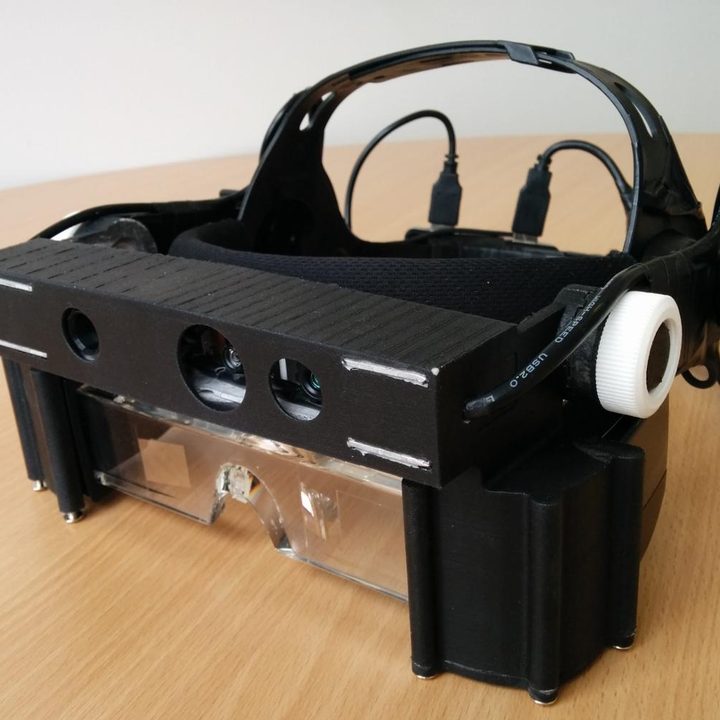
Since the vast majority of blind people have some remaining sight, these smart glasses can be tuned to make the most of it. They are constructed using transparent OLED displays, two small cameras, a gyroscope, a compass, a GPS unit, and a headphone. “Our latest prototype (pictured) has an Epson Moverio BT 100 and an Asus xtion depth camera and 3D printed frames,” explained Dr Hicks.
The incoming data can be processed and then used in various ways, for example, brightness can be used to show depth. Most visually impaired people can distinguish light and dark, these glasses can make anything that’s close to the wearer brighter, so they can discern people and obstacles.
The cameras could also work with the computing module and the right software to recognize the number on an approaching bus, or to read a sign. The GPS module can be used to give directions. The gyroscope helps the glasses to calculate changes in perspective as the wearer moves. All of the information is spoken aloud through the built-in ear piece.
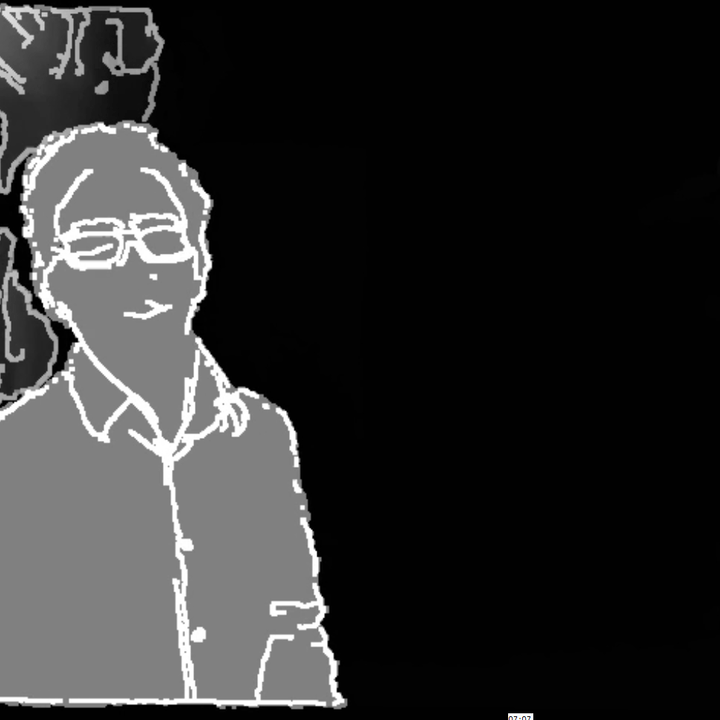
Professor Phil Torr wants to bring machine learning into the equation, which is all about “trying to understand patterns and classify them into different types.” This could enable the system to recognize objects, like your favorite coffee mug. It could also help you navigate inside a building by guiding you toward the exit and then recognizing and highlighting the door handle as you approach.
It’s easy to imagine how augmented reality could tie in here. The researchers are still working on reducing the size of the glasses and plan to distribute an initial batch of 100 to blind and partially sighted people before the year is out. If the trial goes well, and there’s interest from a manufacturer, then larger scale production could be on the cards.
AI Glasses
Halfway around the world at CINVESTAV (Center for Research and Advanced Studies of the National Polytechnic Institute) in Mexico, there is another smart glasses project in progress. It combines computational geometry, artificial intelligence, and ultrasound techniques, amongst other things, to create a useful aid for the visually impaired.
“We currently have a light weight, ergonomically acceptable prototype since it almost looks like a normal pair of glasses and can work in real time with batteries that last approximately four hours in continuous use. We hope to have a commercial prototype by next August at the latest, and being able to market it in early 2015,” project leader, Eduardo José Bayro Corrochano, told Investigacion y Desarrollo.
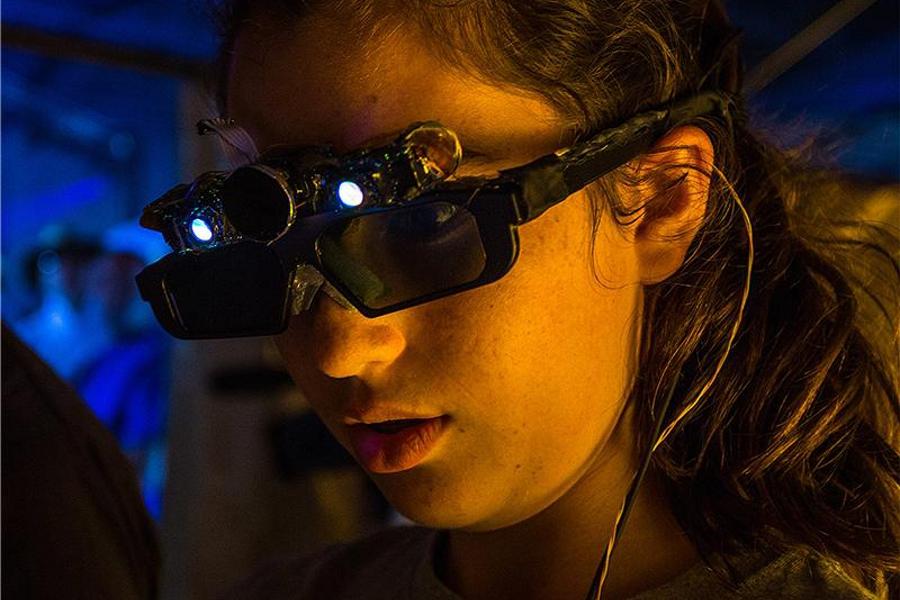
The prototype combines glasses with stereo sound sensors and GPS technology attached to a tablet, which can give spoken directions and recognize denominations of currency, read signs, identify colors, and other things. It also employs machine learning to recognize different places and objects. Because it uses ultrasound, it can also detect translucent obstacles, like glass doors.
The estimated cost of the commercial product is between $1,000 and $1,500 and the project is apparently seeking investors as it transfers to technology company, Qualtop.
Braille ebook reader
This idea first surfaced a few years back as a concept on Yanko Design. Why not create a tactile digital reader device for Braille readers, like a Kindle for the blind? Braille literacy has been in steady decline since the 1960s for various reasons. There’s still a debate raging about the importance of Braille and the potential problems with talking computers after research revealed a link between Braille literacy and employment.
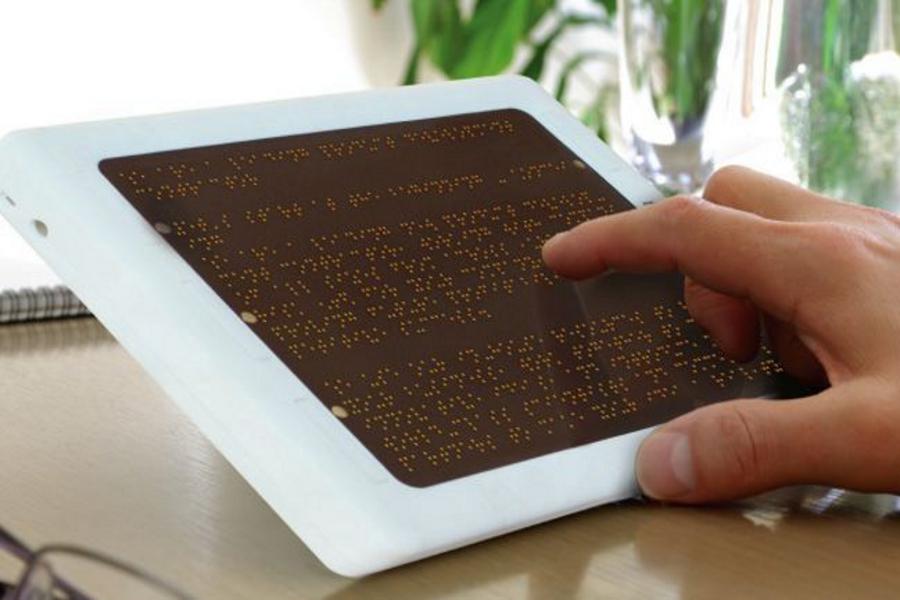
The Anagraphs project took up the idea and began to work on plans for a device that would employ thermo-hydraulic micro-actuation to activate Braille dots by infrared laser radiation via a micro-mirror scanning system. It’s easier to imagine it as a kind of wax material, which can go from solid to liquid with heat and be easily reshaped to create Braille dots. Unfortunately the EU funding has run out and the project needs more cash to be realized.
FingerReader
The technology for reading written text continues to improve and the FingerReader is a good example of a new way of interacting. This MIT Media Labs project is a wearable device, a very chunky ring that sits on the finger and is capable of detecting and interpreting 12-point printed text as the user scans his or her finger across it. It reads aloud in real-time. Small vibrations alert the wearer to any deviation off the line.
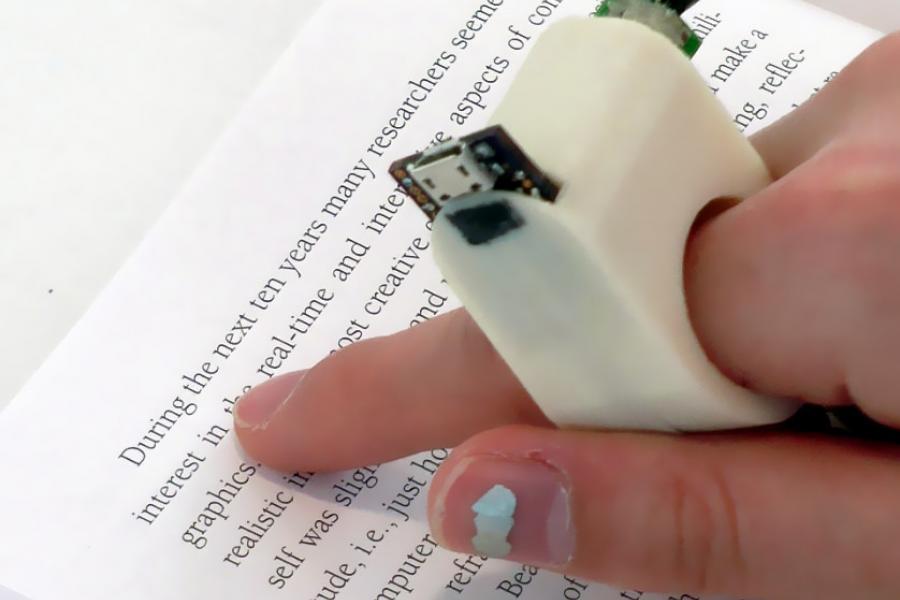
It’s currently just a concept with a prototype, but it has potential applications beyond the visually impaired for teaching children to read or translating languages. We already have apps capable of doing this on our smartphones, and OCR (optical character recognition) is getting fairly reliable, but the FingerReader provides a more natural way of interacting.
ARIANNA app
Sometimes the best solutions are the ones that take advantage of the technology you already have. There are a few great apps available for the blind and partially sighted, such as TapTapSee, which can recognize objects that you take a photo of and tell you what they are.
The ARIANNA app (pAth Recognition for Indoor Assisted NavigatioN with Augmented perception) solves another difficult problem. GPS and other navigation systems tend to struggle with indoor environments. The name of the app is a reference to Greek mythology and a clue to how it works. Before it can be used you must stick colored tape to the ground to mark out specific routes, much like you see in hospitals.
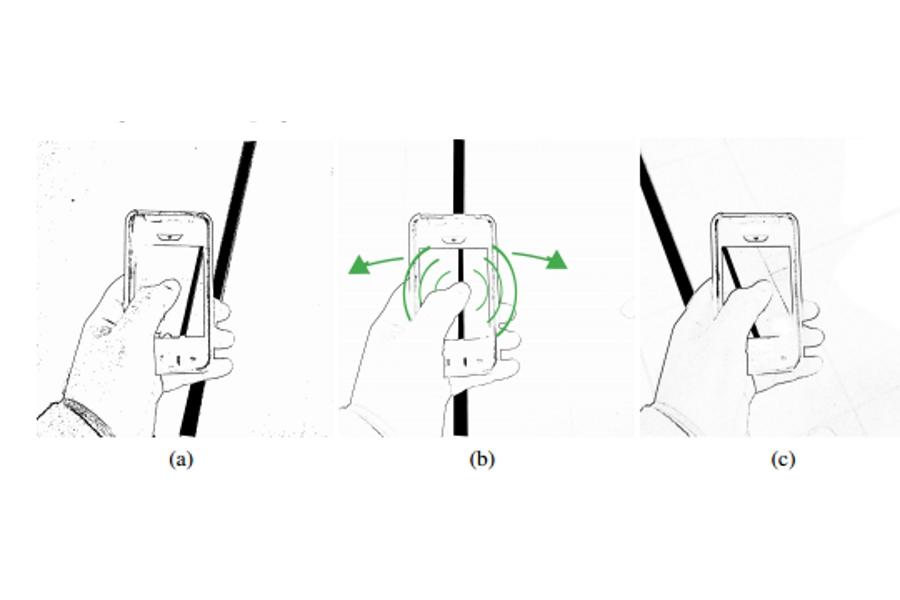
Users of the app point their smartphone camera at the ground, and as they wave it back and forth there’s a vibration when it finds the line. This means that there’s no problem with audio interference, and people can use the device without headphones. As an extra layer, it’s possible to place QR codes that give additional information, like telling the user there’s a water fountain nearby, or a toilet.
If you’re worried about the need for colored lines everywhere then you’ll be glad to know the researchers have thought of that. They suggest infrared paths, which can be picked up by smartphone cameras, but remain invisible to naked eye, as a possible way to create paths in future.
Going further
Technology is supposed to make our lives easier. Too often accessibility is seen as something to tick off the list for developers, and there’s a missed opportunity to transform lives for the better.
To an extent, the natural development of some technology brings unexpected benefits, like the recent story about Alex Blaszczuk, a paralyzed woman who credited Google Glass with boosting her confidence and aiding her independence.
Consider how much more can be achieved when bright minds target disabilities like blindness specifically.
Further reading
If you’re an Apple fan, the Apple Vis website is a great resource for finding apps, guides, and more content that’s relevant for the blind and visually impaired.
The American Foundation for the Blind has a section on assistive technology products that are on the market right now.


